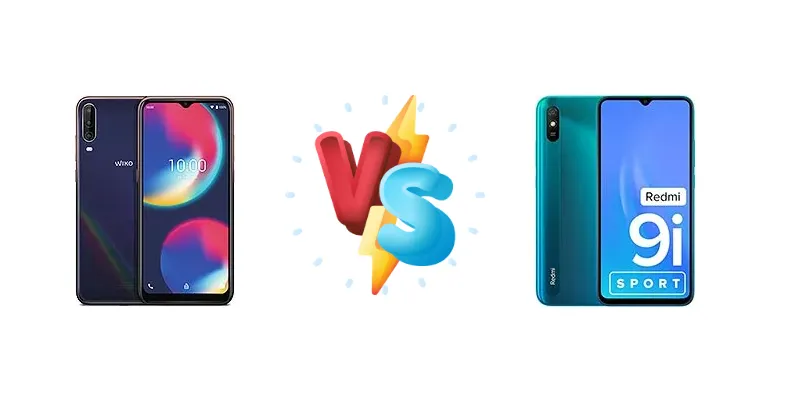
The Wiko View4 and Xiaomi Redmi 9i Sport represent the fiercely competitive sub-$150 smartphone market. Both devices aim to deliver essential functionality at an accessible price point, but they achieve this with slightly different approaches to chipset selection and feature sets. This comparison dissects their key differences to help you determine which phone best suits your needs.
🏆 Quick Verdict
For the average user prioritizing slightly better performance and faster charging, the Xiaomi Redmi 9i Sport is the stronger choice. Its Helio G25 chipset, with a 2.0 GHz clock speed, offers a noticeable edge over the Wiko View4’s Helio A25, despite both being built on a 12nm process. However, the Wiko View4 remains a viable option for those seeking a basic, functional device.
| Network |
|---|
| 2G bands | GSM 850 / 900 / 1800 / 1900 | GSM 850 / 900 / 1800 / 1900 |
| 3G bands | HSDPA 850 / 900 / 1900 / 2100 | HSDPA 850 / 900 / 2100 |
| 4G bands | 1, 3, 5, 7, 8, 20, 28, 40 | 1, 3, 5, 8, 40, 41 |
| Speed | HSPA 42.2/5.76 Mbps, LTE Cat4 150/50 Mbps | HSPA, LTE |
| Technology | GSM / HSPA / LTE | GSM / HSPA / LTE |
| Launch |
|---|
| Announced | 2020, February. Released 2020, February | 2021, September 28 |
| Status | Discontinued | Available. Released 2021, September 28 |
| Body |
|---|
| Dimensions | 165.7 x 75.8 x 8.9 mm (6.52 x 2.98 x 0.35 in) | 164.9 x 77.1 x 9 mm (6.49 x 3.04 x 0.35 in) |
| SIM | Nano-SIM + Nano-SIM | Nano-SIM + Nano-SIM |
| Weight | 180 g (6.35 oz) | 194 g (6.84 oz) |
| | - | Water-repellent coating |
| Display |
|---|
| Resolution | 720 x 1600 pixels, 20:9 ratio (~269 ppi density) | 720 x 1600 pixels, 20:9 ratio (~269 ppi density) |
| Size | 6.52 inches, 102.6 cm2 (~81.7% screen-to-body ratio) | 6.53 inches, 102.9 cm2 (~81.0% screen-to-body ratio) |
| Type | IPS LCD, 450 nits (peak) | IPS LCD, 400 nits (typ) |
| Platform |
|---|
| CPU | Octa-core (4x1.8 GHz Cortex-A53 & 4x1.5 GHz Cortex-A53) | Octa-core (4x2.0 GHz Cortex-A53 & 4x1.5 GHz Cortex-A53) |
| Chipset | Mediatek MT6762D Helio A25 (12 nm) | Mediatek MT6762G Helio G25 (12 nm) |
| GPU | PowerVR GE8320 | PowerVR GE8320 |
| OS | Android 10 | Android 10, MIUI 12 |
| Memory |
|---|
| Card slot | microSDXC | microSDXC (dedicated slot) |
| Internal | 64GB 3GB RAM | 64GB 4GB RAM, 128GB 4GB RAM |
| | eMMC 5.1 | eMMC 5.1 |
| Main Camera |
|---|
| Features | LED flash, HDR | LED flash, HDR |
| Single | - | 13 MP, f/2.2, 28mm (wide), 1.0µm, PDAF |
| Triple | 13 MP, (wide)
5 MP, 114˚, (ultrawide)
Auxiliary lens | - |
| Video | 1080p@30fps | 1080p@30fps |
| Selfie camera |
|---|
| Features | - | HDR |
| Single | 8 MP | 5 MP, f/2.2, (wide), 1.12µm |
| Video | - | 1080p@30fps |
| Sound |
|---|
| 3.5mm jack | Yes | Yes |
| 35mm jack | Yes | Yes |
| Loudspeaker | Yes | Yes |
| Comms |
|---|
| Bluetooth | 4.2, A2DP, LE | 5.0, A2DP, LE |
| NFC | No | No |
| Positioning | GPS | GPS, GLONASS, BDS |
| Radio | FM radio | FM radio |
| USB | microUSB 2.0, OTG | microUSB 2.0, OTG |
| WLAN | Wi-Fi 802.11 b/g/n | Wi-Fi 802.11 а/b/g/n, Wi-Fi Direct |
| Features |
|---|
| Sensors | Accelerometer, proximity, compass | Accelerometer, proximity, compass |
| Battery |
|---|
| Charging | - | 10W wired |
| Type | Li-Po 5000 mAh | Li-Po 5000 mAh |
| Misc |
|---|
| Colors | Cosmic Blue, Cosmic Gold, Cosmic Green | Carbon Black, Coral Green, Metallic Blue |
| Price | About 160 EUR | About 100 EUR |
| SAR | 0.38 W/kg (head) 1.69 W/kg (body) | - |
Wiko View4
- Potentially longer software support from Wiko.
- Simple and straightforward user experience.
- European brand reputation for reliability.
- Slower processor (Helio A25).
- Likely slower charging speeds.
- Less optimized for gaming.
Xiaomi Redmi 9i Sport
- Faster processor (Helio G25).
- 10W wired charging for quicker top-ups.
- Potentially better image processing.
- MIUI software can be resource-intensive.
- Xiaomi’s software update policy can be inconsistent.
- Build quality may be less premium.
Display Comparison
Neither device boasts a standout display. Both likely utilize LCD panels, typical for this price bracket. Specifics like resolution and brightness are not provided, but we can assume they are similar – likely 720p+ resolution. The focus here isn’t on visual fidelity, but rather on basic usability. Bezels are expected to be noticeable on both, impacting the overall screen-to-body ratio. Color accuracy will likely be standard for budget panels, prioritizing power efficiency over color gamut coverage.
Camera Comparison
Camera performance is expected to be basic on both devices. Without sensor size or aperture information, it’s difficult to make definitive claims. However, the Redmi 9i Sport’s chipset may offer slightly better image signal processing (ISP) capabilities, potentially resulting in marginally improved image quality. The inclusion of a dedicated 'Sport' mode suggests Xiaomi is targeting active users, potentially with enhanced video stabilization. It's safe to assume both phones will feature a primary camera and depth sensor, with any additional sensors (like macro lenses) offering limited practical value.
Performance
The core difference lies in the chipsets. The Xiaomi Redmi 9i Sport’s Mediatek Helio G25 (MT6762G) features a slightly higher CPU clock speed (2.0 GHz vs 1.8 GHz on the Wiko View4’s Helio A25 MT6762D). While both utilize the same Cortex-A53 architecture, the 100MHz difference, coupled with the 'G' designation indicating gaming optimizations, suggests a modest performance advantage for the Redmi 9i Sport in tasks like app loading and light gaming. Both phones will likely struggle with graphically intensive games, but the Redmi 9i Sport should offer a smoother experience. RAM configurations are not specified, but are likely similar, further minimizing the performance gap.
Battery Life
Battery capacity is not specified for either device. However, the Redmi 9i Sport’s inclusion of 10W wired charging is a significant advantage. The Wiko View4 likely relies on slower charging speeds, meaning a longer time to reach a full charge. In real-world usage, this translates to less downtime and more convenience for Redmi 9i Sport users. Without knowing the battery capacity, it’s difficult to predict battery life, but the faster charging of the Redmi 9i Sport provides a tangible benefit.
Buying Guide
Buy the Wiko View4 if you need a simple, no-frills smartphone for basic communication and light tasks, and prioritize a potentially longer software support lifecycle from a European brand. Buy the Xiaomi Redmi 9i Sport if you prefer a device capable of handling slightly more demanding applications, enjoy faster charging speeds, and are comfortable with Xiaomi’s MIUI software experience.
Frequently Asked Questions
❓ Will the Redmi 9i Sport struggle with popular apps like WhatsApp and Facebook?
While the Helio G25 isn't a powerhouse, it's sufficient for running everyday apps like WhatsApp and Facebook smoothly. The 2.0 GHz clock speed provides enough headroom for these applications, though multitasking with many apps open simultaneously may cause some slowdown.
❓ Is the 10W charging on the Redmi 9i Sport fast enough for daily use?
10W charging is relatively slow by modern standards, but it's adequate for overnight charging. Expect a full charge to take around 3-4 hours. This is a trade-off for the lower price point, and it's still a significant improvement over the likely slower charging on the Wiko View4.
❓ Can either of these phones handle basic mobile gaming like PUBG Mobile?
Both phones will struggle with PUBG Mobile at higher settings. However, the Redmi 9i Sport, with its Helio G25, will likely offer a slightly more playable experience at the lowest settings. Expect low frame rates and occasional stuttering on both devices.
❓ Which phone is likely to receive more software updates?
Wiko, as a European brand, generally offers a more predictable software support lifecycle. However, Xiaomi has been improving its update commitment. It's difficult to say definitively, but the Wiko View4 *may* receive updates for a slightly longer period.