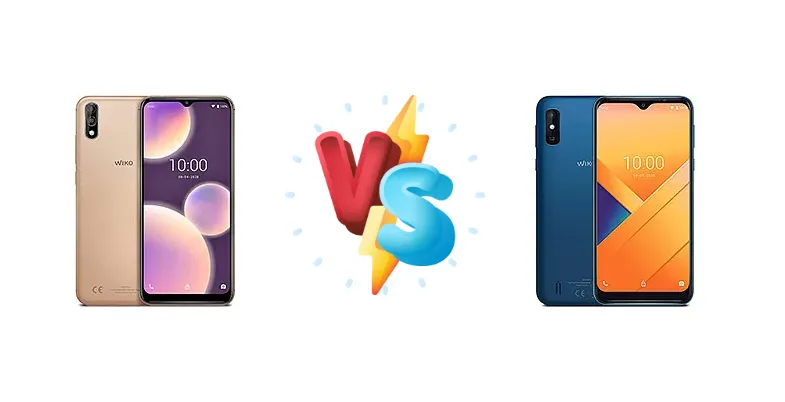
Wiko targets the ultra-budget smartphone market with both the View4 Lite and Y81. While both devices aim to provide essential smartphone functionality at a low price point, a key differentiator lies in their underlying chipsets. This comparison dissects the Mediatek Helio A25 in the View4 Lite against the Helio A20 in the Y81, revealing which device delivers a smoother user experience for everyday tasks.
🏆 Quick Verdict
For most users, the Wiko View4 Lite is the better choice. Its Mediatek Helio A25 chipset, featuring an octa-core CPU, provides a noticeable performance advantage over the Y81’s quad-core Helio A20. This translates to quicker app loading times and a more responsive overall experience, justifying a potential slight price premium.
| Network |
|---|
| 2G bands | GSM 850 / 900 / 1800 / 1900 | GSM 850 / 900 / 1800 / 1900 |
| 3G bands | HSDPA 850 / 900 / 1900 / 2100 | HSDPA 850 / 900 / 1900 / 2100 |
| 4G bands | 1, 3, 5, 7, 8, 20, 28, 40 | 1, 3, 5, 7, 8, 20, 40 |
| Speed | HSPA 42.2/5.76 Mbps, LTE Cat4 150/50 Mbps | HSPA 42.2/5.76 Mbps, LTE Cat4 150/50 Mbps |
| Technology | GSM / HSPA / LTE | GSM / HSPA / LTE |
| Launch |
|---|
| Announced | 2020. Released 2020 | 2020, August 18. Released 2020, August 18 |
| Status | Discontinued | Discontinued |
| Body |
|---|
| Dimensions | 167 x 76.8 x 8.5 mm (6.57 x 3.02 x 0.33 in) | 157.9 x 76.1 x 8.3 mm (6.22 x 3.00 x 0.33 in) |
| SIM | Nano-SIM + Nano-SIM | Nano-SIM + Nano-SIM |
| Weight | 174 g (6.14 oz) | 166 g (5.86 oz) |
| Display |
|---|
| Resolution | 720 x 1600 pixels, 20:9 ratio (~269 ppi density) | 720 x 1520 pixels, 19:9 ratio (~271 ppi density) |
| Size | 6.52 inches, 102.6 cm2 (~80.0% screen-to-body ratio) | 6.2 inches, 95.9 cm2 (~79.8% screen-to-body ratio) |
| Type | IPS LCD, 450 nits (peak) | IPS LCD |
| Platform |
|---|
| CPU | Octa-core (4x1.8 GHz Cortex-A53 & 4x1.5 GHz Cortex-A53) | Quad-core 1.8 GHz Cortex-A53 |
| Chipset | Mediatek MT6762D Helio A25 (12 nm) | Mediatek MT6761D Helio A20 (12 nm) |
| GPU | PowerVR GE8320 | PowerVR GE8300 |
| OS | Android 10 | Android 10 (Go edition) |
| Memory |
|---|
| Card slot | microSDXC | microSDXC |
| Internal | 32GB 2GB RAM, 64GB 2GB RAM | 32GB 2GB RAM |
| | eMMC 5.1 | eMMC 5.1 |
| Main Camera |
|---|
| Features | LED flash, HDR | LED flash, HDR, panorama |
| Single | - | 13 MP, AF |
| Triple | 13 MP
5 MP
2 MP | - |
| Video | 1080p@30fps | 1080p@30fps |
| Selfie camera |
|---|
| Single | 5 MP | 5 MP |
| Sound |
|---|
| 3.5mm jack | Yes | Yes |
| 35mm jack | Yes | Yes |
| Loudspeaker | Yes | Yes |
| Comms |
|---|
| Bluetooth | 4.2, A2DP, LE | 4.2, A2DP, LE |
| NFC | No | No |
| Positioning | GPS | GPS |
| Radio | FM radio | FM radio |
| USB | microUSB 2.0, OTG | microUSB 2.0, OTG |
| WLAN | Wi-Fi 802.11 b/g/n | Wi-Fi 802.11 b/g/n |
| Features |
|---|
| Sensors | Accelerometer, proximity, compass | Accelerometer, proximity, compass |
| Battery |
|---|
| Type | Li-Po 4000 mAh | Li-Ion 4000 mAh |
| Misc |
|---|
| Colors | Deep Blue, Deep Green, Deep Gold | Deep Blue, Gold, Green |
| Price | About 80 EUR | About 80 EUR |
| SAR EU | - | 0.56 W/kg (head) 1.61 W/kg (body) |
Wiko View4 Lite
- Faster octa-core processor for smoother multitasking
- Potentially better gaming performance
- More responsive user interface
- May have slightly reduced battery life compared to Y81
- Likely a slightly higher price point
Wiko Y81
- Lowest possible price point
- Potentially slightly longer battery life
- Simple and straightforward user experience
- Significantly slower performance
- Struggles with multitasking
- Laggy user interface
Display Comparison
Neither Wiko provides display specifications beyond resolution. Given their market segment, both likely utilize IPS LCD panels. The focus here isn't display quality, but rather the chipset's ability to efficiently render the UI. A more powerful chipset like the A25 in the View4 Lite will contribute to smoother scrolling and animations, even on a basic display.
Camera Comparison
Both devices likely feature similar, basic camera setups. Without detailed sensor information, it’s difficult to make a definitive comparison. However, the improved processing power of the Helio A25 in the View4 Lite *could* translate to slightly faster image processing and potentially better low-light performance, even with identical sensors. The real-world impact will be minimal, as both phones are geared towards casual photography.
Performance
The core difference lies in the CPU configuration. The Wiko View4 Lite’s Mediatek Helio A25 boasts an octa-core setup – four Cortex-A53 cores clocked at 1.8 GHz and four at 1.5 GHz. This contrasts sharply with the Wiko Y81’s Helio A20, which features a quad-core configuration of Cortex-A53 cores at 1.8 GHz. While both chipsets are built on a 12nm process, the doubled core count of the A25 provides a significant advantage in multi-threaded tasks. This means the View4 Lite will handle multiple apps running simultaneously, or more complex web pages, with less lag. The A25 also benefits from a slightly more capable integrated GPU, improving basic gaming performance.
Battery Life
Battery capacity isn’t specified, but given the target market, both phones likely feature batteries in the 3000-4000 mAh range. The Helio A25 in the View4 Lite, while more powerful, is also slightly more power-hungry. However, the performance gains likely outweigh the minor battery life difference. Charging wattage is also unspecified, suggesting both phones utilize slow charging speeds.
Buying Guide
Buy the Wiko View4 Lite if you prioritize responsiveness and multitasking, even for basic apps. It’s ideal for users who frequently switch between messaging, social media, and light web browsing. Buy the Wiko Y81 if your primary needs are limited to calls, texts, and very occasional, simple app usage, and you are seeking the absolute lowest possible price point.
Frequently Asked Questions
❓ Will the Wiko View4 Lite handle popular social media apps like Facebook and Instagram without lag?
Yes, the Helio A25 chipset in the View4 Lite is sufficiently powerful to run Facebook, Instagram, and similar apps smoothly. The octa-core CPU and improved GPU will provide a more responsive experience compared to the Y81, especially when scrolling through feeds or loading images.
❓ Is the Wiko Y81 suitable for someone who primarily uses their phone for calls and texts?
Absolutely. The Wiko Y81 is a perfectly adequate device for basic communication. Its quad-core Helio A20 chipset is sufficient for making calls, sending texts, and managing contacts. If your smartphone needs are minimal, the Y81 offers a very affordable solution.
❓ Can either of these phones run demanding games like PUBG Mobile?
Neither phone is well-suited for demanding games like PUBG Mobile. While they might be able to run the game at the lowest settings, expect significant lag and a poor overall gaming experience. These phones are designed for basic tasks, not gaming.