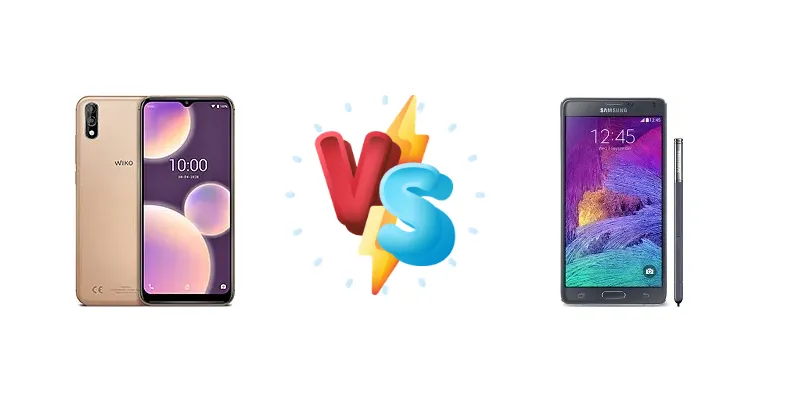
The smartphone landscape is vast, with options for every budget and need. Today, we're comparing two very different devices: the budget-friendly Wiko View4 Lite and the iconic Samsung Galaxy Note 4, a flagship from years past. Can a budget phone truly compete with a former champion?
🏆 Quick Verdict
The Samsung Galaxy Note 4 decisively wins this comparison. While the Wiko View4 Lite offers affordability, the Note 4's superior performance, display, and camera quality, coupled with its impressive battery life, make it the better choice despite its age. It's a testament to the Note 4's enduring quality.
| Network |
|---|
| 2G bands | GSM 850 / 900 / 1800 / 1900 | GSM 850 / 900 / 1800 / 1900 |
| 3G bands | HSDPA 850 / 900 / 1900 / 2100 | HSDPA 850 / 900 / 1900 / 2100 |
| 4G bands | 1, 3, 5, 7, 8, 20, 28, 40 | 1, 2, 3, 4, 5, 7, 8, 17, 20 - N910F, N910C |
| Speed | HSPA 42.2/5.76 Mbps, LTE Cat4 150/50 Mbps | HSPA 42.2/5.76 Mbps, LTE Cat4 150/50 Mbps (Exynos 5433)HSPA 42.2/5.76 Mbps, LTE Cat6 300/50 Mbps (Snapdragon 805) |
| Technology | GSM / HSPA / LTE | GSM / HSPA / LTE |
| | - | 1, 2, 3, 4, 5, 7, 8, 28 - N910U |
| Launch |
|---|
| Announced | 2020. Released 2020 | 2014, September 03. Released 2014, October |
| Status | Discontinued | Discontinued |
| Body |
|---|
| Build | - | Glass front (Gorilla Glass 4), plastic back, aluminum frame |
| Dimensions | 167 x 76.8 x 8.5 mm (6.57 x 3.02 x 0.33 in) | 153.5 x 78.6 x 8.5 mm (6.04 x 3.09 x 0.33 in) |
| SIM | Nano-SIM + Nano-SIM | Micro-SIM |
| Weight | 174 g (6.14 oz) | 176 g (6.21 oz) |
| | - | Stylus |
| Display |
|---|
| Protection | - | Corning Gorilla Glass 4 |
| Resolution | 720 x 1600 pixels, 20:9 ratio (~269 ppi density) | 1440 x 2560 pixels, 16:9 ratio (~518 ppi density) |
| Size | 6.52 inches, 102.6 cm2 (~80.0% screen-to-body ratio) | 5.7 inches, 88.5 cm2 (~73.4% screen-to-body ratio) |
| Type | IPS LCD, 450 nits (peak) | Super AMOLED |
| Platform |
|---|
| CPU | Octa-core (4x1.8 GHz Cortex-A53 & 4x1.5 GHz Cortex-A53) | Quad-core 2.7 GHz Krait 450 - Snapdragon 805Octa-core (4x1.3 GHz Cortex-A53 & 4x1.9 GHz Cortex-A57) - Exynos 5433 |
| Chipset | Mediatek MT6762D Helio A25 (12 nm) | Qualcomm APQ8084 Snapdragon 805 (28 nm)Exynos 5433 |
| GPU | PowerVR GE8320 | Adreno 420 (Snapdragon 805)Mali-T760 MP6 (Exynos 5433) |
| OS | Android 10 | Android 4.4.4 (KitKat), upgradable to 6.0.1 (Marshmallow) |
| Memory |
|---|
| Card slot | microSDXC | microSDXC (dedicated slot) |
| Internal | 32GB 2GB RAM, 64GB 2GB RAM | 32GB 3GB RAM |
| | eMMC 5.1 | eMMC 5.0 |
| Main Camera |
|---|
| Features | LED flash, HDR | LED flash, panorama, HDR |
| Single | - | 16 MP, f/2.2, 31mm (standard), 1/2.6", 1.12µm, AF, OIS |
| Triple | 13 MP
5 MP
2 MP | - |
| Video | 1080p@30fps | 4K@30fps, 1080p@30/60fps, stereo sound rec. |
| Selfie camera |
|---|
| Features | - | HDR |
| Single | 5 MP | 3.7 MP, f/1.9, 22mm (wide) |
| Video | - | 1440p@30fps |
| Sound |
|---|
| 3.5mm jack | Yes | Yes |
| 35mm jack | Yes | Yes |
| Loudspeaker | Yes | Yes |
| | - | 24-bit/192kHz audio
|
| Comms |
|---|
| Bluetooth | 4.2, A2DP, LE | 4.1, A2DP, EDR, LE |
| Infrared port | - | Yes |
| NFC | No | Yes |
| Positioning | GPS | GPS, GLONASS, BDS |
| Radio | FM radio | No |
| USB | microUSB 2.0, OTG | microUSB 2.0 (MHL 3 TV-out), OTG |
| WLAN | Wi-Fi 802.11 b/g/n | Wi-Fi 802.11 a/b/g/n/ac, dual-band, Wi-Fi Direct, hotspot |
| Features |
|---|
| Sensors | Accelerometer, proximity, compass | Fingerprint (front-mounted), accelerometer, gyro, proximity, compass, barometer, gesture, UV, heart rate, SpO2 |
| | - | ANT+
S-Voice natural language commands and dictation
Air gestures |
| Battery |
|---|
| Charging | - | 15W wired, QC2 |
| Music play | - | Up to 82 h |
| Talk time | - | Up to 20 h (3G) |
| Type | Li-Po 4000 mAh | Li-Ion 3220 mAh, removable |
| Misc |
|---|
| Colors | Deep Blue, Deep Green, Deep Gold | Frosted white, Charcoal black, Bronze Gold, Blossom Pink |
| Models | - | SM-N910C, SM-N910S, SM-N910H, SM-N910F, SM-N910G, SM-N910U, SM-N910K, SM-N916S, SM-N910L, SM-N916L, SM-N916K, SM-N910T3 |
| Price | About 80 EUR | About 350 EUR |
| SAR | - | 0.37 W/kg (head) 0.88 W/kg (body) |
| SAR EU | - | 0.37 W/kg (head) 0.38 W/kg (body) |
| Tests |
|---|
| Audio quality | - |
Noise -96.6dB / Crosstalk -94.2dB |
| Battery life | - |
Endurance rating 90h
|
| Camera | - |
Photo / Video |
| Display | - |
Contrast ratio: Infinity (nominal), 4.033 (sunlight) |
| Loudspeaker | - |
Voice 79dB / Noise 74dB / Ring 89dB
|
| Performance | - |
Basemark OS II 2.0: 1328Basemark X: 18684 |
Wiko View4 Lite
- Affordable
- Decent battery life
- Lightweight
- Low performance
- Basic camera
- Lower quality display
- Limited storage
Samsung Galaxy Note 4
- Powerful performance
- Excellent display
- Good camera
- Large battery
- Premium build quality
- Older model
- Potentially outdated software
- May lack latest features
- Availability may be limited
Display Comparison
The Samsung Galaxy Note 4 boasts a significantly better display. Its higher resolution, vibrant colors, and excellent contrast ratio (Infinity nominal, 4.033 sunlight) provide a superior viewing experience compared to the Wiko View4 Lite's likely lower resolution and less impressive color accuracy. The Note 4's larger screen size also contributes to its advantage.
Camera Comparison
While both phones offer Photo/Video capabilities, the Note 4's camera hardware and image processing are generally superior. Expect better image quality, dynamic range, and low-light performance from the Note 4. The Wiko View4 Lite's camera is adequate for basic snapshots but won't compete with the Note 4's capabilities.
Performance
Performance is where the Note 4 truly shines. Its Snapdragon 805 or Exynos 5433 chipset, paired with a quad/octa-core processor, offers considerably faster processing speeds and smoother multitasking than the Wiko View4 Lite's Helio A25. Expect noticeable lag on the View4 Lite with demanding apps or games.
Battery Life
Both phones boast an impressive endurance rating of 90h. However, considering the Note 4's more powerful hardware, its battery life is even more remarkable. The Wiko View4 Lite's lower power consumption is offset by its less demanding processor.
Buying Guide
Who should buy the Wiko View4 Lite? Users on a very tight budget who prioritize affordability over performance and features. Who should buy the Samsung Galaxy Note 4? Those seeking a reliable, powerful phone with a great display and camera, even if it's an older model, and who appreciate a larger screen.
Frequently Asked Questions
❓ Is the Samsung Galaxy Note 4 still worth buying in 2024?
Yes, if you prioritize performance and a good display over the latest features and software updates. It's a surprisingly capable phone for its age.
❓ What are the main differences between the Wiko View4 Lite and the Samsung Galaxy Note 4?
The Note 4 offers significantly better performance, a superior display, and a better camera, while the View4 Lite is much more affordable.