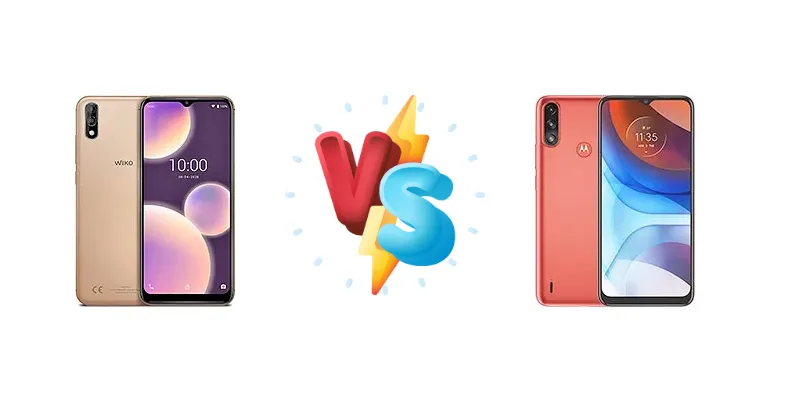
The Wiko View4 Lite and Motorola Moto E7i Power represent the ultra-budget end of the smartphone spectrum. Both aim to deliver essential functionality at the lowest possible price, but they take different approaches to achieving this. The key differentiator lies in their chipsets – a Mediatek Helio A25 in the Wiko versus a Unisoc SC9863A in the Motorola – impacting performance and efficiency.
🏆 Quick Verdict
For the average user prioritizing responsiveness and overall efficiency, the Wiko View4 Lite is the better choice. Its Mediatek Helio A25, built on a 12nm process, offers a more modern architecture and better performance per watt than the Motorola’s older 28nm Unisoc SC9863A, despite the clock speed differences.
| Network |
|---|
| 2G bands | GSM 850 / 900 / 1800 / 1900 | GSM 850 / 900 / 1800 / 1900 |
| 3G bands | HSDPA 850 / 900 / 1900 / 2100 | HSDPA 850 / 900 / 1700(AWS) / 1900 / 2100 |
| 4G bands | 1, 3, 5, 7, 8, 20, 28, 40 | LTE |
| Speed | HSPA 42.2/5.76 Mbps, LTE Cat4 150/50 Mbps | HSPA, LTE |
| Technology | GSM / HSPA / LTE | GSM / HSPA / LTE |
| Launch |
|---|
| Announced | 2020. Released 2020 | 2021, February 23 |
| Status | Discontinued | Available. Released 2021, March 15 |
| Body |
|---|
| Build | - | Glass front, plastic back, plastic frame |
| Dimensions | 167 x 76.8 x 8.5 mm (6.57 x 3.02 x 0.33 in) | 165.1 x 75.9 x 9.2 mm (6.5 x 2.99 x 0.36 in) |
| SIM | Nano-SIM + Nano-SIM | Nano-SIM + Nano-SIM |
| Weight | 174 g (6.14 oz) | 200 g (7.05 oz) |
| | - | Water-repellent design |
| Display |
|---|
| Resolution | 720 x 1600 pixels, 20:9 ratio (~269 ppi density) | 720 x 1600 pixels, 20:9 ratio (~270 ppi density) |
| Size | 6.52 inches, 102.6 cm2 (~80.0% screen-to-body ratio) | 6.51 inches, 102.3 cm2 (~81.7% screen-to-body ratio) |
| Type | IPS LCD, 450 nits (peak) | IPS LCD, 380 nits (typ) |
| Platform |
|---|
| CPU | Octa-core (4x1.8 GHz Cortex-A53 & 4x1.5 GHz Cortex-A53) | Octa-core (4x1.6 GHz Cortex-A55 & 4x1.2 GHz Cortex-A55) |
| Chipset | Mediatek MT6762D Helio A25 (12 nm) | Unisoc SC9863A (28 nm) |
| GPU | PowerVR GE8320 | IMG8322 |
| OS | Android 10 | Android 10 (Go edition) |
| Memory |
|---|
| Card slot | microSDXC | microSDXC (uses shared SIM slot) |
| Internal | 32GB 2GB RAM, 64GB 2GB RAM | 32GB 2GB RAM |
| | eMMC 5.1 | eMMC 5.1 |
| Main Camera |
|---|
| Dual | - | 13 MP, f/2.0, 26mm (wide), 1/3.1", 1.12µm, PDAF
2 MP (macro) |
| Features | LED flash, HDR | LED flash, HDR, panorama |
| Triple | 13 MP
5 MP
2 MP | - |
| Video | 1080p@30fps | 1080p@30fps |
| Selfie camera |
|---|
| Features | - | HDR |
| Single | 5 MP | 5 MP, f/2.2, 27mm (wide), 1.12µm |
| Video | - | 1080p@30fps |
| Sound |
|---|
| 3.5mm jack | Yes | Yes |
| 35mm jack | Yes | Yes |
| Loudspeaker | Yes | Yes |
| Comms |
|---|
| Bluetooth | 4.2, A2DP, LE | 4.2, A2DP |
| NFC | No | No |
| Positioning | GPS | GPS, GLONASS, GALILEO |
| Radio | FM radio | Unspecified |
| USB | microUSB 2.0, OTG | USB Type-C 2.0 |
| WLAN | Wi-Fi 802.11 b/g/n | Wi-Fi 802.11 b/g/n |
| Features |
|---|
| Sensors | Accelerometer, proximity, compass | Fingerprint (rear-mounted), accelerometer, proximity |
| Battery |
|---|
| Charging | - | 10W wired |
| Type | Li-Po 4000 mAh | Li-Ion 5000 mAh |
| Misc |
|---|
| Colors | Deep Blue, Deep Green, Deep Gold | Tahiti Blue, Coral Red |
| Models | - | XT2097-13 |
| Price | About 80 EUR | About 120 EUR |
Wiko View4 Lite
- More efficient processor (Mediatek Helio A25, 12nm)
- Potentially smoother multitasking
- Likely faster image processing
- Battery capacity not specified
- Charging speed not specified
Motorola Moto E7i Power
- Potentially larger battery capacity (implied by 'Power' branding)
- Eight Cortex-A55 cores
- Lower price point (potentially)
- Less efficient processor (Unisoc SC9863A, 28nm)
- Slower 10W charging
- Likely lower overall performance
Display Comparison
Neither device boasts a standout display. Details regarding panel type (IPS vs. TFT) and resolution are missing, but given the price point, IPS is likely on both. The focus here isn't on visual fidelity. The absence of high refresh rates is expected. The real difference, though, will be in color accuracy and brightness, which are difficult to assess without testing. Bezels are likely substantial on both, maximizing screen real estate within the budget constraints.
Camera Comparison
Both phones likely feature basic camera setups geared towards casual photography. Without specific sensor details, it’s difficult to make a definitive judgment. Expect a primary sensor on both, potentially accompanied by a depth or macro sensor (often of limited utility). Image processing will be basic, prioritizing speed over detail. The Wiko’s processor might offer slightly faster image processing due to its more capable chipset, but the difference will likely be minimal. Don't expect exceptional low-light performance from either.
Performance
The core of the difference lies in the chipsets. The Wiko View4 Lite’s Mediatek Helio A25 (12nm) utilizes Cortex-A53 cores, but benefits from a more modern manufacturing process. This 12nm node allows for greater transistor density and improved power efficiency compared to the Motorola’s Unisoc SC9863A (28nm). While the Motorola has eight Cortex-A55 cores, the older 28nm process and lower clock speeds (4x1.6 GHz vs 4x1.8 GHz on the Wiko) likely result in lower overall performance and higher power consumption. The A55 cores are more efficient *per core* than the A53, but the A25's process advantage is significant. This translates to smoother multitasking and a more responsive user experience on the Wiko.
Battery Life
Battery capacity is not specified for either device. However, the Motorola Moto E7i Power’s name suggests a focus on battery life. The 10W wired charging on the Motorola is a significant limitation. While a larger battery capacity could offset the slower charging, the Unisoc SC9863A’s less efficient architecture will likely consume more power, potentially negating any capacity advantage. The Wiko, with its more efficient Helio A25, may achieve comparable battery life with a smaller battery and still benefit from potentially faster charging (though charging speed is not specified).
Buying Guide
Buy the Wiko View4 Lite if you need a phone that feels reasonably snappy for everyday tasks like browsing, social media, and messaging, and you value a slightly more efficient processor. Buy the Motorola Moto E7i Power if battery life is your absolute top priority and you’re willing to accept a noticeable performance trade-off, especially if you frequently find yourself away from a charger and primarily use basic phone functions. The 10W charging on the Motorola also suggests a slower replenishment rate.
Frequently Asked Questions
❓ Will the Unisoc SC9863A in the Moto E7i Power struggle with popular apps like Facebook or WhatsApp?
The Unisoc SC9863A is an entry-level chipset. While it can handle basic apps like Facebook and WhatsApp, expect slower loading times and occasional lag, especially when multitasking. The Wiko View4 Lite’s Helio A25 will provide a noticeably smoother experience with these apps.
❓ Is the Wiko View4 Lite a good option for light gaming?
The Wiko View4 Lite can handle very basic 2D games, but don't expect to play demanding titles like PUBG Mobile or Call of Duty. The Helio A25’s integrated GPU is not powerful enough for smooth gameplay at higher settings. The Motorola’s GPU will likely perform similarly, if not worse, due to the processor’s overall limitations.
❓ How long will it take to fully charge the Motorola Moto E7i Power with its 10W charging?
Given the 10W charging and the likely battery capacity (estimated to be around 4000-5000mAh), expect a full charge to take approximately 3-4 hours. This is significantly slower than many modern smartphones.