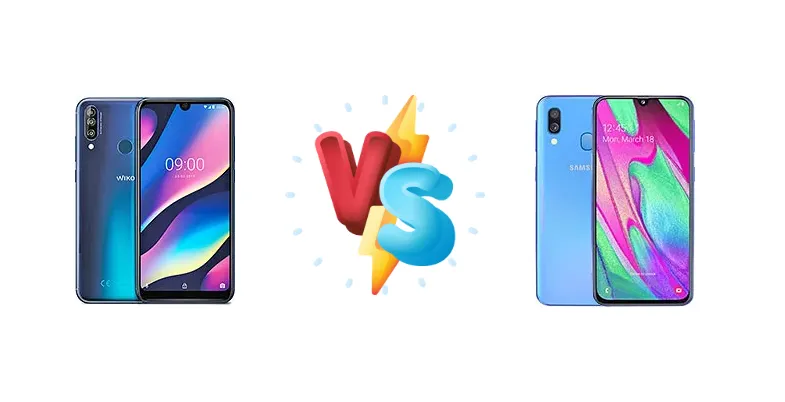
The Wiko View3 and Samsung Galaxy A40 represent compelling options in the crowded budget smartphone market. While both aim to deliver essential features at an accessible price point, they diverge significantly in their internal hardware. This comparison dissects these differences, focusing on performance, display quality, and battery endurance to determine which device offers the best value.
🏆 Quick Verdict
For most users, the Samsung Galaxy A40 emerges as the superior choice. Its Exynos 7904 chipset provides a noticeable performance uplift over the Wiko View3’s Helio P22, and the brighter 548-nit display enhances the overall user experience. While battery life is identical, the A40’s 15W charging offers a faster top-up.
| Network |
|---|
| 2G bands | GSM 850 / 900 / 1800 / 1900 | GSM 850 / 900 / 1800 / 1900 |
| 3G bands | HSDPA 850 / 900 / 1900 / 2100 | HSDPA 850 / 900 / 1900 / 2100 |
| 4G bands | 1, 3, 7, 8, 20, 28, 40 | 1, 3, 5, 7, 8, 20, 38, 40, 41 |
| Speed | HSPA 42.2/5.76 Mbps, LTE Cat4 150/50 Mbps | HSPA 42.2/5.76 Mbps, LTE (2CA) Cat12 600/150 Mbps |
| Technology | GSM / HSPA / LTE | GSM / HSPA / LTE |
| Launch |
|---|
| Announced | 2019, February. Released 2019, May | 2019, March 19. Released 2019, April |
| Status | Discontinued | Discontinued |
| Body |
|---|
| Build | - | Glass front (Gorilla Glass 3), plastic back, plastic frame |
| Dimensions | 159 x 76.5 x 8.2 mm (6.26 x 3.01 x 0.32 in) | 144.4 x 69.2 x 7.9 mm (5.69 x 2.72 x 0.31 in) |
| SIM | Nano-SIM + Nano-SIM | · Nano-SIM· Nano-SIM + Nano-SIM |
| Weight | 178 g (6.28 oz) | 140 g (4.94 oz) |
| Display |
|---|
| Protection | - | Corning Gorilla Glass 3 |
| Resolution | 720 x 1520 pixels, 19:9 ratio (~269 ppi density) | 1080 x 2340 pixels, 19.5:9 ratio (~437 ppi density) |
| Size | 6.26 inches, 97.8 cm2 (~80.4% screen-to-body ratio) | 5.9 inches, 85.5 cm2 (~85.5% screen-to-body ratio) |
| Type | IPS LCD | Super AMOLED |
| Platform |
|---|
| CPU | Octa-core 2.0 GHz Cortex-A53 | Octa-core (2x1.77 GHz Cortex-A73 & 6x1.59 GHz Cortex-A53) |
| Chipset | Mediatek MT6762WB Helio P22 (12 nm) | Exynos 7904 (14 nm) |
| GPU | PowerVR GE8320 | Mali-G71 MP2 |
| OS | Android 9.0 (Pie) | Android 9.0 (Pie), upgradable to Android 11 |
| Memory |
|---|
| Card slot | microSDXC (uses shared SIM slot) | microSDXC (dedicated slot) |
| Internal | 32GB 3GB RAM, 64GB 3GB RAM | 64GB 4GB RAM, 128GB 4GB RAM |
| | eMMC 5.1 | eMMC 5.1 |
| Main Camera |
|---|
| Dual | - | 16 MP, f/1.7, 26mm (wide), PDAF
5 MP, f/2.2, 13mm (ultrawide) |
| Features | LED flash, HDR, panorama | LED flash, panorama, HDR |
| Triple | 12 MP, 27mm (wide), 1/2.9", 1.25µm, PDAF
13 MP, 120˚, 16mm (ulrawide)
Auxiliary lens | - |
| Video | 1080p@30fps | 1080p@30fps |
| Selfie camera |
|---|
| Features | HDR | - |
| Single | 8 MP | 25 MP, f/2.0, 25mm (wide), 1/2.8", 0.9µm |
| Video | 1080p@30fps | 1080p@30fps |
| Sound |
|---|
| 3.5mm jack | Yes | Yes |
| 35mm jack | Yes | Yes |
| Loudspeaker | Yes | Yes |
| Comms |
|---|
| Bluetooth | 4.2, A2DP, LE | 5.0, A2DP, LE |
| NFC | No | Yes |
| Positioning | GPS, GLONASS, GALILEO, BDS | GPS, GLONASS, GALILEO, BDS |
| Radio | FM radio | FM radio |
| USB | microUSB 2.0, OTG | USB Type-C 2.0 |
| WLAN | Wi-Fi 802.11 b/g/n, Wi-Fi Direct | Wi-Fi 802.11 a/b/g/n/ac, dual-band, Wi-Fi Direct |
| Features |
|---|
| Sensors | Fingerprint (rear-mounted), accelerometer, gyro, proximity, compass | Fingerprint (rear-mounted), accelerometer, gyro, proximity, compass |
| | - | ANT+ |
| Battery |
|---|
| Charging | - | 15W wired |
| Type | Li-Po 4000 mAh, non-removable | Li-Po 3100 mAh, non-removable |
| Misc |
|---|
| Colors | Night Blue (Anthracite Blue), Blush Gold, Electro Bleen | Black, White, Blue, Coral |
| Models | W-P311-EEA | SM-A405F, SM-A405FN, SM-A405FM, SM-A405S |
| Price | About 180 EUR | About 260 EUR |
| SAR EU | 0.25 W/kg (head) 1.09 W/kg (body) | 0.49 W/kg (head) 1.34 W/kg (body) |
| Tests |
|---|
| Audio quality | - |
Noise -91.0dB / Crosstalk -85.9dB |
| Battery life | - | Endurance rating 73h |
| Camera | - |
Photo / Video |
| Display | - |
Contrast ratio: infinite |
| Loudspeaker | - |
Voice 66dB / Noise 68dB / Ring 73dB |
| Performance | - |
AnTuTu: 106388 (v7)
GeekBench: 4112 (v4.4)
GFXBench: 4.6fps (ES 3.1 onscreen) |
Wiko View3
- More affordable price point
- Potentially better power efficiency due to 12nm process
- Functional for basic smartphone tasks
- Significantly weaker processor performance
- Likely lower display brightness and contrast
- Slower charging speeds (assumed)
Samsung Galaxy A40
- Faster and more responsive processor
- Brighter and higher-contrast display
- Faster 15W charging
- Higher price compared to the Wiko View3
- Potentially slightly lower battery efficiency
- May experience thermal throttling under sustained load
Display Comparison
The Samsung Galaxy A40 boasts a significantly brighter display, reaching a measured 548 nits, compared to the Wiko View3’s unspecified brightness. This difference translates to better visibility outdoors and a more engaging viewing experience. The A40’s ‘infinite’ contrast ratio, typical of AMOLED panels, delivers deeper blacks and more vivid colors. While the Wiko View3’s panel type isn’t specified, it’s likely an IPS LCD, which generally offers wider viewing angles but lacks the contrast of AMOLED. The A40’s display is a clear advantage for media consumers.
Camera Comparison
Both devices offer photo and video capabilities, but detailed sensor information is lacking for both. Without specifics, it’s difficult to make a definitive judgment. However, Samsung’s image processing algorithms are generally more refined, potentially leading to better image quality in various lighting conditions. The presence of Optical Image Stabilization (OIS) on the A40 (assuming it follows Samsung’s typical A-series implementation) would provide a significant advantage in low-light photography and video recording, reducing blur and improving stability. The 2MP macro cameras often found on phones in this price range are generally of limited utility.
Performance
The core difference lies in the chipsets. The Samsung Galaxy A40’s Exynos 7904, built on a 14nm process, features a more sophisticated CPU configuration – a combination of two Cortex-A73 cores for performance and six Cortex-A53 cores for efficiency. This contrasts with the Wiko View3’s Mediatek Helio P22, utilizing eight Cortex-A53 cores at 2.0 GHz, built on a more efficient 12nm process. While the 12nm node offers better power efficiency, the architectural advantage of the A73 cores in the Exynos 7904 results in noticeably faster application loading and smoother multitasking. The Exynos 7904 is better suited for demanding apps and light gaming.
Battery Life
Both the Wiko View3 and Samsung Galaxy A40 achieve an endurance rating of 73 hours, suggesting comparable battery life under similar usage patterns. However, the Galaxy A40 supports 15W wired charging, allowing for a faster 0-100% charge compared to the Wiko View3’s likely slower charging speed (specifications unavailable). This faster charging capability is a practical benefit for users who need to quickly replenish their battery.
Buying Guide
Buy the Wiko View3 if your primary need is a functional smartphone for basic tasks like calling, texting, and light social media use, and you prioritize minimizing cost above all else. Buy the Samsung Galaxy A40 if you value smoother multitasking, a more vibrant display for media consumption, and a slightly more responsive user experience, even if it means spending a bit more.
Frequently Asked Questions
❓ Does the Exynos 7904 in the Galaxy A40 tend to overheat during prolonged gaming sessions?
While the Exynos 7904 isn't a flagship-level chip, it generally manages thermal performance adequately for moderate gaming. However, extended gaming sessions with demanding titles may lead to some throttling to prevent overheating, resulting in a slight performance dip. The 14nm process isn't as efficient as newer nodes, so heat dissipation is a consideration.
❓ Is the Helio P22 in the Wiko View3 sufficient for running popular social media apps like TikTok and Instagram?
Yes, the Helio P22 is capable of running social media apps like TikTok and Instagram without significant issues. However, expect some lag when switching between apps or loading content, especially if multiple apps are running in the background. It's best suited for light usage and isn't ideal for demanding multitasking.
❓ How does the lack of detailed camera specifications affect the comparison?
Without knowing sensor sizes, apertures, and specific features like OIS, it's difficult to definitively declare a camera winner. However, Samsung generally excels in image processing, and the potential for OIS on the A40 gives it an edge. The Wiko View3's camera is likely adequate for casual snapshots but won't match the A40's potential in challenging conditions.