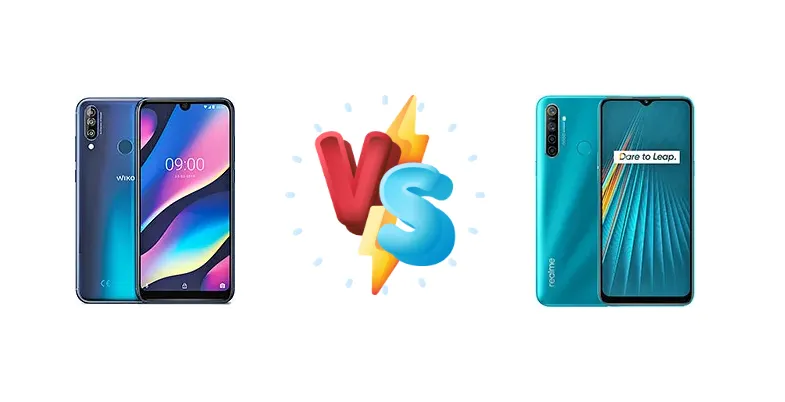
The sub-$150 smartphone market is fiercely competitive. The Wiko View3, powered by the Mediatek Helio P22, and the Realme 5i, featuring the Qualcomm Snapdragon 665, represent compelling options for budget-conscious buyers. This comparison dives deep into their core components to determine which device offers the best overall experience.
🏆 Quick Verdict
For most users, the Realme 5i emerges as the superior choice. The Snapdragon 665, built on an 11nm process, provides a noticeable performance advantage over the Wiko View3’s Helio P22, translating to smoother multitasking and a more responsive user interface. While both phones target the entry-level segment, the 5i’s chipset offers a longer software support lifespan.
| Network |
|---|
| 2G bands | GSM 850 / 900 / 1800 / 1900 | GSM 850 / 900 / 1800 / 1900 |
| 3G bands | HSDPA 850 / 900 / 1900 / 2100 | HSDPA 850 / 900 / 2100 |
| 4G bands | 1, 3, 7, 8, 20, 28, 40 | 1, 3, 5, 7, 8, 20, 28, 38, 40, 41 - Global |
| Speed | HSPA 42.2/5.76 Mbps, LTE Cat4 150/50 Mbps | HSPA, LTE (2CA) 450/50 Mbps |
| Technology | GSM / HSPA / LTE | GSM / HSPA / LTE |
| | - | 1, 3, 5, 8, 38, 40, 41 - India |
| Launch |
|---|
| Announced | 2019, February. Released 2019, May | 2020, January 06. Released 2020, January |
| Status | Discontinued | Discontinued |
| Body |
|---|
| Build | - | Glass front (Gorilla Glass), plastic back, plastic frame |
| Dimensions | 159 x 76.5 x 8.2 mm (6.26 x 3.01 x 0.32 in) | 164.4 x 75 x 9.3 mm (6.47 x 2.95 x 0.37 in) |
| SIM | Nano-SIM + Nano-SIM | Nano-SIM + Nano-SIM |
| Weight | 178 g (6.28 oz) | 195 g (6.88 oz) |
| Display |
|---|
| Protection | - | Corning Gorilla Glass (unspecified) |
| Resolution | 720 x 1520 pixels, 19:9 ratio (~269 ppi density) | 720 x 1600 pixels, 20:9 ratio (~269 ppi density) |
| Size | 6.26 inches, 97.8 cm2 (~80.4% screen-to-body ratio) | 6.52 inches, 102.6 cm2 (~83.2% screen-to-body ratio) |
| Type | IPS LCD | IPS LCD |
| Platform |
|---|
| CPU | Octa-core 2.0 GHz Cortex-A53 | Octa-core (4x2.0 GHz Kryo 260 Gold & 4x1.8 GHz Kryo 260 Silver) |
| Chipset | Mediatek MT6762WB Helio P22 (12 nm) | Qualcomm SDM665 Snapdragon 665 (11 nm) |
| GPU | PowerVR GE8320 | Adreno 610 |
| OS | Android 9.0 (Pie) | Android 9.0 (Pie), upgradable to Android 10, Realme UI |
| Memory |
|---|
| Card slot | microSDXC (uses shared SIM slot) | microSDXC (dedicated slot) |
| Internal | 32GB 3GB RAM, 64GB 3GB RAM | 32GB 3GB RAM, 64GB 4GB RAM, 128GB 4GB RAM |
| | eMMC 5.1 | eMMC |
| Main Camera |
|---|
| Features | LED flash, HDR, panorama | LED flash, HDR, panorama |
| Quad | - | 12 MP, f/1.8, (wide), 1/2.9", 1.25µm, PDAF
8 MP, f/2.3, 13mm (ultrawide)
2 MP (macro)
Auxiliary lens |
| Triple | 12 MP, 27mm (wide), 1/2.9", 1.25µm, PDAF
13 MP, 120˚, 16mm (ulrawide)
Auxiliary lens | - |
| Video | 1080p@30fps | 4K@30fps, 1080p@30fps, gyro-EIS |
| Selfie camera |
|---|
| Features | HDR | HDR, panorama |
| Single | 8 MP | 8 MP, f/2.0 |
| Video | 1080p@30fps | 1080p@30fps |
| Sound |
|---|
| 3.5mm jack | Yes | Yes |
| 35mm jack | Yes | Yes |
| Loudspeaker | Yes | Yes |
| Comms |
|---|
| Bluetooth | 4.2, A2DP, LE | 5.0, A2DP, LE |
| NFC | No | No |
| Positioning | GPS, GLONASS, GALILEO, BDS | GPS, GLONASS, GALILEO, BDS |
| Radio | FM radio | FM radio |
| USB | microUSB 2.0, OTG | microUSB 2.0, OTG |
| WLAN | Wi-Fi 802.11 b/g/n, Wi-Fi Direct | Wi-Fi 802.11 a/b/g/n/ac, dual-band, Wi-Fi Direct |
| Features |
|---|
| Sensors | Fingerprint (rear-mounted), accelerometer, gyro, proximity, compass | Fingerprint (rear-mounted), accelerometer, gyro, proximity, compass |
| Battery |
|---|
| Charging | - | 10W wired |
| Type | Li-Po 4000 mAh, non-removable | 5000 mAh |
| Misc |
|---|
| Colors | Night Blue (Anthracite Blue), Blush Gold, Electro Bleen | Blue, Green |
| Models | W-P311-EEA | RMX2030, RMX2032 |
| Price | About 180 EUR | About 170 EUR |
| SAR EU | 0.25 W/kg (head) 1.09 W/kg (body) | - |
Wiko View3
- Potentially lower price point
- Simple and easy-to-use interface
- Adequate for basic smartphone tasks
- Inferior processor performance
- Less efficient power consumption
- Limited gaming capabilities
Realme 5i
- Superior processor performance (Snapdragon 665)
- Better power efficiency
- Faster charging (10W)
- Likely longer software support
- Slightly higher price
- May not have a significantly better display
- Still a budget device with inherent limitations
Display Comparison
Neither device boasts a standout display. Given the context data focuses on processors, we can infer both likely utilize LCD panels common in this price bracket. The Realme 5i, benefiting from Realme’s broader market positioning, may have slightly better color calibration. However, without specific display specs, it’s reasonable to assume both offer similar viewing experiences – adequate for everyday use but not ideal for media consumption. Bezels are likely to be substantial on both devices.
Camera Comparison
Without detailed camera specifications, a direct comparison is difficult. However, it’s safe to assume both phones feature basic camera setups geared towards social media sharing. The Realme 5i, given Realme’s marketing focus on camera capabilities, likely benefits from more sophisticated image processing algorithms. The Helio P22’s ISP is less capable than the Snapdragon 665’s, potentially resulting in less dynamic range and detail in photos taken with the Wiko View3. The presence of a 10W charger on the Realme 5i suggests a slightly more refined overall user experience, potentially extending to camera software features.
Performance
The core difference lies in the chipsets. The Realme 5i’s Qualcomm Snapdragon 665 (11nm) is a clear upgrade over the Wiko View3’s Mediatek Helio P22 (12nm). The 11nm fabrication process of the Snapdragon 665 offers improved power efficiency and thermal performance. Furthermore, the Snapdragon 665 employs a Kryo CPU architecture with a mix of performance (Gold) and efficiency (Silver) cores – a design absent in the Helio P22’s homogenous Cortex-A53 setup. This translates to better multitasking and a smoother experience when switching between apps. The Snapdragon 665’s Adreno 610 GPU also provides a significant boost in graphics performance, making the Realme 5i more suitable for casual gaming.
Battery Life
Both phones likely feature battery capacities around 4000-5000mAh, typical for this price range. However, the Snapdragon 665’s superior power efficiency means the Realme 5i will likely deliver longer battery life under similar usage conditions. The Realme 5i’s 10W charging, while slow by modern standards, is a benefit over the Wiko View3, which likely lacks fast charging support. This means the Realme 5i will reach a full charge faster, minimizing downtime.
Buying Guide
Buy the Wiko View3 if you prioritize a simple, functional smartphone for basic tasks like calls, texts, and light social media use, and are on an extremely tight budget. Buy the Realme 5i if you value a more responsive experience, occasional gaming, and a chipset that’s likely to receive more software updates, even if it means spending slightly more.
Frequently Asked Questions
❓ Will the Realme 5i handle popular games like PUBG Mobile?
The Snapdragon 665 in the Realme 5i can run PUBG Mobile, but likely at lower graphics settings (Medium or Low) to maintain a stable frame rate. The Helio P22 in the Wiko View3 will struggle with PUBG Mobile, offering a significantly less enjoyable gaming experience.
❓ How long will software updates be available for each phone?
Realme generally provides better software support than Wiko. The Realme 5i is more likely to receive at least one major Android update (potentially Android 11 or 12), while the Wiko View3 may be limited to security patches. This is due to Realme's larger scale and commitment to software maintenance.
❓ Is the difference in performance between the Snapdragon 665 and Helio P22 noticeable in everyday use?
Yes, the difference is noticeable. The Snapdragon 665 offers a smoother and more responsive experience when multitasking, opening apps, and browsing the web. The Helio P22 can feel sluggish in comparison, especially with multiple apps open.