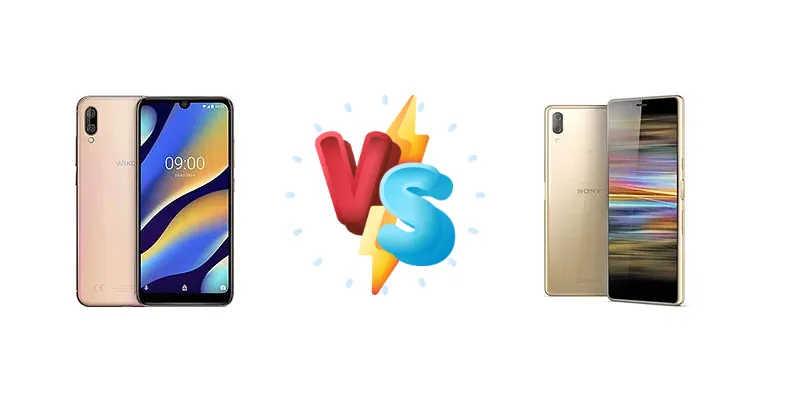
The Wiko View3 Lite and Sony Xperia L3 represent two approaches to the ultra-budget smartphone market. The Wiko aims for affordability above all else, while the Xperia L3 attempts to deliver a more polished experience with Sony’s software and a slightly more powerful chipset. This comparison dissects their key differences to determine which device offers the best value.
🏆 Quick Verdict
For the average user prioritizing overall performance and longevity, the Sony Xperia L3 is the better choice. Its Mediatek Helio P22, built on a 12nm process, offers a noticeable efficiency advantage over the Wiko View3 Lite’s 28nm Unisoc SC9863A, translating to smoother multitasking and potentially better battery life despite both phones having an 80h endurance rating.
| Network |
|---|
| 2G bands | GSM 850 / 900 / 1800 / 1900 | GSM 850 / 900 / 1800 / 1900 |
| 3G bands | HSDPA 850 / 900 / 1900 / 2100 | HSDPA 850 / 900 / 1900 / 2100 - I3312, I4312, I4332 |
| 4G bands | 1, 3, 5, 7, 8, 20, 28, 40 | 1, 2, 3, 5, 7, 8, 20, 38 - I3312, I4312 |
| Speed | HSPA 42.2/5.76 Mbps, LTE Cat4 150/50 Mbps | HSPA 42.2/5.76 Mbps, LTE (2CA) Cat6 300/50 Mbps |
| Technology | GSM / HSPA / LTE | GSM / HSPA / LTE |
| | - | 1, 2, 4, 5, 7, 8, 12, 13, 17, 28, 29 - I3322 |
| Launch |
|---|
| Announced | 2020. Released 2020 | 2019, February. Released 2019, February |
| Status | Discontinued | Discontinued |
| Body |
|---|
| Build | - | Glass front (Gorilla Glass 5), plastic back, plastic frame |
| Dimensions | 155.5 x 73 x 8.7 mm (6.12 x 2.87 x 0.34 in) | 154 x 72 x 8.9 mm (6.06 x 2.83 x 0.35 in) |
| SIM | Nano-SIM + Nano-SIM | · Nano-SIM· Nano-SIM + Nano-SIM |
| Weight | 160.1 g (5.64 oz) | 156 g (5.50 oz) |
| Display |
|---|
| Protection | - | Corning Gorilla Glass 5 |
| Resolution | 720 x 1560 pixels, 19.5:9 ratio (~282 ppi density) | 720 x 1440 pixels, 18:9 ratio (~282 ppi density) |
| Size | 6.09 inches, 91.0 cm2 (~80.2% screen-to-body ratio) | 5.7 inches, 83.8 cm2 (~75.6% screen-to-body ratio) |
| Type | IPS LCD | IPS LCD |
| Platform |
|---|
| CPU | Octa-core (4x1.6 GHz Cortex-A55 & 4x1.2 GHz Cortex-A55) | Octa-core 2.0 GHz Cortex-A53 |
| Chipset | Unisoc SC9863A (28 nm) | Mediatek MT6762 Helio P22 (12 nm) |
| GPU | IMG8322 | PowerVR GE8320 |
| OS | Android 9.0 Pie | Android 8.0 (Oreo) |
| Memory |
|---|
| Card slot | microSDXC | microSDXC (uses shared SIM slot) |
| Internal | 32GB 2GB RAM | 32GB 3GB RAM |
| | eMMC 5.1 | eMMC 5.1 |
| Main Camera |
|---|
| Dual | 13 MP, AF
2 MP | 13 MP, f/2.2, 26mm (wide), 1/3.0", PDAF
Auxiliary lens |
| Features | LED flash, HDR | LED flash, HDR, panorama |
| Video | 1080p@30fps | 1080p@30fps |
| Selfie camera |
|---|
| Single | 5 MP | 8 MP, f/2.0, 24mm (wide), 1/4.0", 1.12µm |
| Video | - | 1080p@30fps |
| Sound |
|---|
| 3.5mm jack | Yes | Yes |
| 35mm jack | Yes | Yes |
| Loudspeaker | Yes | Yes |
| Comms |
|---|
| Bluetooth | 4.2, A2DP, LE | 5.0, A2DP, LE |
| NFC | No | Yes |
| Positioning | GPS | GPS, GLONASS |
| Radio | FM radio | FM radio |
| USB | microUSB 2.0, OTG | USB Type-C 2.0 |
| WLAN | Wi-Fi 802.11 b/g/n | Wi-Fi 802.11 a/b/g/n, dual-band, Wi-Fi Direct |
| Features |
|---|
| Sensors | Accelerometer, proximity, compass | Fingerprint (side-mounted), accelerometer, proximity, compass |
| Battery |
|---|
| Charging | - | USB Power Delivery |
| Type | Li-Po 4000 mAh | Li-Ion 3300 mAh, non-removable |
| Misc |
|---|
| Colors | Night Blue (Anthracite Blue), Blush Gold, Arctic B | Black, Gold, Silver |
| Models | - | I3312, I4312, I4332, I3322 |
| Price | About 90 EUR | About 230 EUR |
| Tests |
|---|
| Audio quality | - |
Noise -91.9dB / Crosstalk -89.3dB |
| Battery life | - |
Endurance rating 80h
|
| Camera | - |
Photo / Video |
| Display | - |
Contrast ratio: 1818:1 (nominal) |
| Loudspeaker | - |
Voice 70dB / Noise 73dB / Ring 81dB
|
| Performance | - |
AnTuTu: 78894 (v7)
GFXBench: 5fps (ES 3.1 onscreen) |
Wiko View3 Lite
- Potentially lower price point
- Functional for basic smartphone tasks
- Acceptable battery endurance rating
- Less efficient chipset (28nm)
- Likely slower performance
- Limited long-term usability
Sony Xperia L3
- More efficient chipset (12nm)
- USB Power Delivery for faster charging
- Sony’s software optimizations
- Potentially smoother user experience
- May be slightly more expensive
- Camera performance likely similar to Wiko
- Still an entry-level device
Display Comparison
Both the Wiko View3 Lite and Sony Xperia L3 share a nominal contrast ratio of 1818:1, suggesting similar visual pop. However, detailed display specs like brightness (nits) and resolution are missing for the Wiko. Given the price point, neither is expected to offer exceptional color accuracy or HDR support. The Xperia L3’s display, while not groundbreaking, benefits from Sony’s image processing expertise, potentially offering a more refined viewing experience. The lack of information on the Wiko’s panel technology makes a definitive comparison difficult, but it’s likely a lower-cost IPS LCD.
Camera Comparison
Both devices are listed as having 'Photo / Video' capabilities, but specific details are absent. Given the market segment, expect basic camera performance. The absence of sensor size or aperture information makes a direct comparison impossible. It’s reasonable to assume both phones will struggle in low-light conditions. The inclusion of a 2MP macro lens on either device is likely a marketing gimmick, offering minimal practical benefit. Sony’s image processing algorithms may provide a slight edge to the Xperia L3, but the overall camera experience will be similar.
Performance
The core difference lies in the chipsets. The Sony Xperia L3’s Mediatek Helio P22 (12nm) boasts a 2.0 GHz octa-core Cortex-A53 CPU, while the Wiko View3 Lite utilizes the Unisoc SC9863A (28nm) with a split core configuration – 1.6 GHz Cortex-A55 and 1.2 GHz Cortex-A55. The 12nm fabrication process of the Helio P22 is significantly more efficient than the 28nm process of the Unisoc chip. This translates to less heat generation and improved power efficiency, meaning the Xperia L3 will likely sustain performance for longer periods without throttling. While both are octa-core, the Cortex-A53 architecture in the Helio P22 is generally more capable than the Cortex-A55 cores in the Wiko, resulting in a snappier user experience.
Battery Life
Interestingly, both the Wiko View3 Lite and Sony Xperia L3 are rated for 80 hours of endurance. However, this rating doesn’t tell the whole story. The Xperia L3’s more efficient Mediatek Helio P22 chipset will likely translate to more *usable* battery life, even with a potentially similar capacity. The Xperia L3 also supports USB Power Delivery, offering faster and more versatile charging options compared to the Wiko, which likely uses standard micro-USB charging. While 0-100% charge times aren’t specified, the Power Delivery support gives the Xperia L3 an advantage.
Buying Guide
Buy the Wiko View3 Lite if you need a functional smartphone for basic tasks like calls, texts, and light social media, and your budget is extremely limited. Buy the Sony Xperia L3 if you prefer a slightly more responsive user experience, appreciate Sony’s software optimizations, and value the potential for longer-term usability thanks to the more efficient processor.
Frequently Asked Questions
❓ Does the Unisoc SC9863A chip in the Wiko View3 Lite struggle with multitasking?
Yes, the Unisoc SC9863A, built on a 28nm process, is less efficient and has lower processing power compared to the Mediatek Helio P22 in the Xperia L3. This means the Wiko View3 Lite will likely exhibit noticeable slowdowns when running multiple apps simultaneously or switching between them frequently.
❓ Is USB Power Delivery on the Sony Xperia L3 a significant advantage?
Yes, USB Power Delivery allows the Xperia L3 to charge faster and is compatible with a wider range of chargers, including those used for laptops and tablets. This is a convenience feature that the Wiko View3 Lite likely lacks, relying on slower, standard micro-USB charging.
❓ How does the 28nm vs 12nm process affect the long-term performance of these phones?
A smaller fabrication process (like 12nm) means more transistors can be packed into the same space, leading to increased efficiency and reduced heat generation. The Xperia L3's 12nm Helio P22 will therefore be less prone to throttling and maintain performance for a longer period compared to the Wiko View3 Lite's 28nm Unisoc chip.