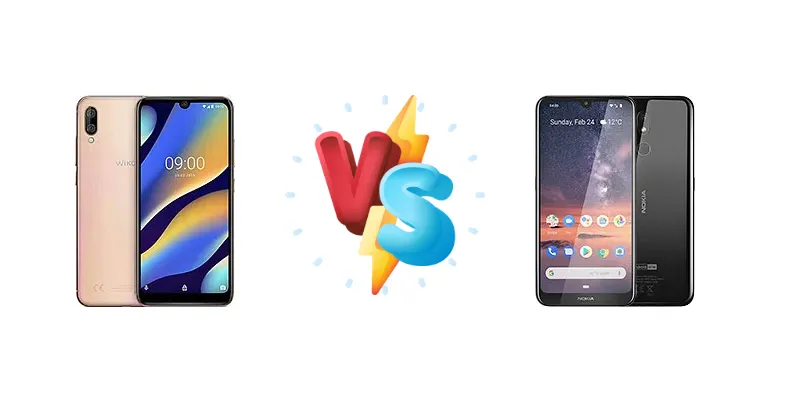
The Wiko View3 Lite and Nokia 3.2 represent the ultra-budget end of the Android spectrum. Both aim to deliver smartphone functionality at the lowest possible price point, but they take different approaches to achieving this. The Wiko prioritizes core count, while the Nokia focuses on chipset efficiency. This comparison dissects their key differences to determine which offers the best value.
🏆 Quick Verdict
For the average user prioritizing smooth daily tasks and battery life, the Nokia 3.2 is the better choice. Its Qualcomm Snapdragon 429, built on a 12nm process, offers superior efficiency compared to the Wiko View3 Lite’s 28nm Unisoc SC9863A, translating to longer runtimes and less heat. While the Wiko boasts more cores, the Nokia’s architecture delivers a more refined experience.
| Network |
|---|
| 2G bands | GSM 850 / 900 / 1800 / 1900 | GSM 850 / 900 / 1800 / 1900 |
| 3G bands | HSDPA 850 / 900 / 1900 / 2100 | HSDPA 850 / 900 / 2100 |
| 4G bands | 1, 3, 5, 7, 8, 20, 28, 40 | 1, 3, 5, 7, 8, 20, 28, 38, 40 - EMEA, APAC, MENA |
| Speed | HSPA 42.2/5.76 Mbps, LTE Cat4 150/50 Mbps | HSPA 42.2/5.76 Mbps, LTE Cat4 150/50 Mbps |
| Technology | GSM / HSPA / LTE | GSM / HSPA / LTE |
| | - | 1, 3, 5, 8, 40, 41 - India |
| Launch |
|---|
| Announced | 2020. Released 2020 | 2019, February 24. Released 2019, May 22 |
| Status | Discontinued | Discontinued |
| Body |
|---|
| Build | - | Glass front, plastic back, plastic frame |
| Dimensions | 155.5 x 73 x 8.7 mm (6.12 x 2.87 x 0.34 in) | 159.4 x 76.2 x 8.6 mm (6.28 x 3.00 x 0.34 in) |
| SIM | Nano-SIM + Nano-SIM | Nano-SIM + Nano-SIM |
| Weight | 160.1 g (5.64 oz) | 181 g (6.38 oz) |
| Display |
|---|
| Resolution | 720 x 1560 pixels, 19.5:9 ratio (~282 ppi density) | 720 x 1520 pixels, 19:9 ratio (~269 ppi density) |
| Size | 6.09 inches, 91.0 cm2 (~80.2% screen-to-body ratio) | 6.26 inches, 97.8 cm2 (~80.5% screen-to-body ratio) |
| Type | IPS LCD | IPS LCD |
| Platform |
|---|
| CPU | Octa-core (4x1.6 GHz Cortex-A55 & 4x1.2 GHz Cortex-A55) | Quad-core 1.8 GHz Cortex-A53 |
| Chipset | Unisoc SC9863A (28 nm) | Qualcomm SDM429 Snapdragon 429 (12 nm) |
| GPU | IMG8322 | Adreno 504 |
| OS | Android 9.0 Pie | Android 9.0 (Pie), upgradable to Android 11, Android One |
| Memory |
|---|
| Card slot | microSDXC | microSDXC (dedicated slot) |
| Internal | 32GB 2GB RAM | 16GB 2GB RAM, 32GB 3GB RAM, 64GB 3GB RAM |
| | eMMC 5.1 | eMMC 5.1 |
| Main Camera |
|---|
| Dual | 13 MP, AF
2 MP | - |
| Features | LED flash, HDR | LED flash |
| Single | - | 13 MP, f/2.2, 1/3.1", 1.12µm, AF |
| Video | 1080p@30fps | 1080p@30fps |
| Selfie camera |
|---|
| Single | 5 MP | 5 MP, f/2.2, 27mm (wide), 1/5.0", 1.12µm |
| Sound |
|---|
| 3.5mm jack | Yes | Yes |
| 35mm jack | Yes | Yes |
| Loudspeaker | Yes | Yes |
| Comms |
|---|
| Bluetooth | 4.2, A2DP, LE | 4.2, A2DP, LE, aptX |
| NFC | No | No |
| Positioning | GPS | GPS, GLONASS, BDS |
| Radio | FM radio | FM radio |
| USB | microUSB 2.0, OTG | microUSB 2.0, OTG |
| WLAN | Wi-Fi 802.11 b/g/n | Wi-Fi 802.11 b/g/n |
| Features |
|---|
| Sensors | Accelerometer, proximity, compass | Fingerprint (rear-mounted, 32/3GB only), accelerometer, proximity |
| Battery |
|---|
| Charging | - | 10W wired |
| Type | Li-Po 4000 mAh | Li-Ion 4000 mAh, non-removable |
| Misc |
|---|
| Colors | Night Blue (Anthracite Blue), Blush Gold, Arctic B | Black, Steel |
| Models | - | TA-1156, TA-1159, TA-1164 |
| Price | About 90 EUR | About 140 EUR |
| SAR EU | - | 0.24 W/kg (head) 1.63 W/kg (body) |
Wiko View3 Lite
- Octa-core processor offers theoretical multi-tasking benefits.
- Potentially lower initial purchase price.
- May offer more storage options (depending on variant).
- Less efficient 28nm chipset leads to higher power consumption.
- Potential for thermal throttling under load.
- Unisoc chipset may receive less software support.
Nokia 3.2
- More efficient 12nm Snapdragon 429 chipset.
- Better thermal management and sustained performance.
- Nokia’s reputation for software updates (even on budget devices).
- 10W charging provides a reasonable charging speed.
- Quad-core processor may struggle with extremely demanding multi-tasking.
- Potentially slightly higher initial purchase price.
- Basic camera performance.
Display Comparison
Neither device is expected to deliver a stunning visual experience. Specific display specs are unavailable for the Wiko View3 Lite, but given its price point, it likely utilizes a TN or low-quality IPS panel. The Nokia 3.2, similarly, doesn't boast high-end display features. The key difference lies in the processing power needed to drive the display; the more efficient Snapdragon 429 in the Nokia 3.2 will consume less power rendering the UI and apps, indirectly benefiting display-related battery drain.
Camera Comparison
Both phones are unlikely to excel in photography. Details on camera sensors are limited, but both will likely feature basic sensors for capturing passable images in good lighting conditions. The focus should not be on image quality, but on the software processing. Nokia’s image processing tends to be more natural, while Wiko’s may lean towards over-sharpening. Given the limited processing power of both chipsets, complex image processing algorithms are unlikely to be employed extensively.
Performance
The core architectural difference is stark. The Wiko View3 Lite’s Unisoc SC9863A features an octa-core configuration with a split design: four Cortex-A55 cores clocked at 1.6 GHz and four at 1.2 GHz. This aims for multi-tasking prowess. However, the Nokia 3.2’s Snapdragon 429 utilizes a quad-core Cortex-A53 setup clocked at 1.8 GHz. While fewer cores, the A53 architecture is more performant per core than the A55, and crucially, the 12nm manufacturing process is significantly more efficient than the Wiko’s 28nm node. This means the Nokia 3.2 will likely exhibit less thermal throttling under sustained load and deliver a more consistent experience. The larger process node on the Wiko will generate more heat, potentially impacting sustained performance.
Battery Life
Battery capacity is not specified for either device. However, the Nokia 3.2’s 10W charging and the Snapdragon 429’s superior power efficiency are significant advantages. The 12nm process node directly translates to lower power consumption during everyday tasks. The Wiko View3 Lite, with its less efficient chipset, will likely require more frequent charging, even with a potentially larger battery capacity. Expect the Nokia 3.2 to achieve a longer screen-on time and overall usage duration.
Buying Guide
Buy the Wiko View3 Lite if you absolutely need the theoretical advantage of eight cores for heavily multi-threaded tasks, and are willing to accept potentially shorter battery life and more heat. Buy the Nokia 3.2 if you prioritize a consistently smooth user experience, longer battery life, and a more reputable brand known for software support, even within the budget segment.
Frequently Asked Questions
❓ Will the Wiko View3 Lite struggle with popular apps like Facebook or WhatsApp?
While the Wiko View3 Lite can likely run these apps, the less efficient Unisoc chipset and limited RAM may result in noticeable lag and slower loading times, especially with multiple apps open simultaneously. The Nokia 3.2’s Snapdragon 429 will provide a smoother experience for these common tasks.
❓ Is the Nokia 3.2 a good choice for playing mobile games?
The Nokia 3.2 is suitable for casual mobile gaming, but don't expect high frame rates or the ability to run graphically demanding titles. The Snapdragon 429 can handle less intensive games, but sustained gaming will likely lead to some thermal throttling. The Wiko View3 Lite's extra cores won't necessarily translate to better gaming performance due to the less efficient architecture.
❓ How long will the battery last on each phone with typical usage?
With typical usage (browsing, social media, calls), the Nokia 3.2 is expected to last a full day on a single charge due to the efficient Snapdragon 429. The Wiko View3 Lite, with its less efficient chipset, may require charging before the end of the day, especially with heavier use.