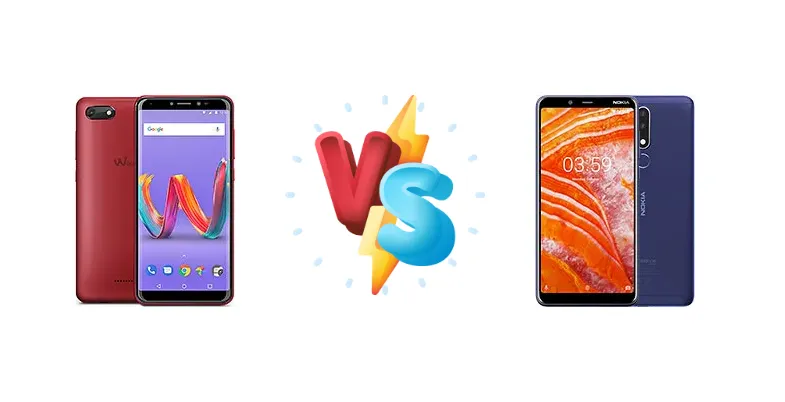
The Wiko Tommy3 Plus and Nokia 3.1 Plus represent the lower end of the smartphone market, targeting users prioritizing affordability. However, despite similar price points, a significant difference in chipset architecture separates these two devices, impacting performance and overall user experience. This comparison dives deep into the specifics to determine which phone delivers the best value.
🏆 Quick Verdict
For most users, the Nokia 3.1 Plus is the superior choice. Its Mediatek Helio P22 (or Snapdragon 439 in the US) chipset, built on a more efficient 12nm process and featuring an octa-core CPU, provides a noticeable performance boost over the Wiko Tommy3 Plus’s quad-core Mediatek MT6739WA. While both phones are entry-level, the Nokia offers a smoother, more responsive experience.
| Network |
|---|
| 2G bands | GSM 850 / 900 / 1800 / 1900 | GSM 850 / 900 / 1800 / 1900 |
| 3G bands | HSDPA 850 / 900 / 1900 / 2100 | HSDPA 850 / 900 / 1900 / 2100 |
| 4G bands | 1, 3, 7, 20 | 2, 4, 5, 12, 14, 29, 30 - USA |
| Speed | HSPA 42.2/5.76 Mbps, LTE Cat4 150/50 Mbps | HSPA 42.2/5.76 Mbps, LTE Cat4 150/50 Mbps |
| Technology | GSM / HSPA / LTE | GSM / HSPA / LTE |
| | - | HSDPA 850 / 1700(AWS) / 1900 - USA |
| Launch |
|---|
| Announced | 2019. Released 2019 | 2018, October. Released 2018, October |
| Status | Discontinued | Discontinued |
| Body |
|---|
| Build | - | Glass front, aluminum back, aluminum frame |
| Dimensions | 147.6 x 71.3 x 8.4 mm (5.81 x 2.81 x 0.33 in) | 156.9 x 76.4 x 8.2 mm (6.18 x 3.01 x 0.32 in) |
| SIM | Dual SIM (Micro-SIM, dual stand-by) | Nano-SIM + Nano-SIM |
| Weight | 150 g (5.29 oz) | 180 g (6.35 oz) |
| Display |
|---|
| Resolution | 720 x 1440 pixels, 18:9 ratio (~295 ppi density) | 720 x 1440 pixels, 18:9 ratio (~268 ppi density) |
| Size | 5.45 inches, 76.7 cm2 (~72.8% screen-to-body ratio) | 6.0 inches, 92.9 cm2 (~77.5% screen-to-body ratio) |
| Type | IPS LCD | IPS LCD |
| Platform |
|---|
| CPU | Quad-core 1.3 GHz Cortex-A53 | Octa-core 2.0 GHz Cortex-A53 - GlobalOcta-core (4x1.95 GHz Cortex-A53 & 4x1.45 GHz Cortex A53) - USA |
| Chipset | Mediatek MT6739WA (28 nm) | Mediatek MT6762 Helio P22 (12 nm) - GlobalQualcomm SDM439 Snapdragon 439 (12 nm) - USA |
| GPU | PowerVR GE8100 | PowerVR GE8320 - GlobalAdreno 505 - USA |
| OS | Android 8.1 (Oreo) | Android 8.1 (Oreo), upgradable to Android 10, Android One |
| Memory |
|---|
| Card slot | microSDXC | microSDXC (dedicated slot) |
| Internal | 16GB 2GB RAM | 16GB 2GB RAM, 32GB 2GB RAM, 32GB 3GB RAM |
| | eMMC 5.1 | eMMC 5.1 |
| Main Camera |
|---|
| Dual | - | 13 MP, f/2.0, AF
Auxiliary lens |
| Features | LED flash, HDR, panorama | LED flash, HDR, panorama |
| Single | 13 MP, AF | - |
| Video | 1080p@30fps | 1080p@30fps |
| Selfie camera |
|---|
| Features | LED flash | LED flash, HDR |
| Single | 5 MP | 8 MP, f/2.2 |
| Video | - | 720p@30fps |
| Sound |
|---|
| 3.5mm jack | Yes | Yes |
| 35mm jack | Yes | Yes |
| Loudspeaker | Yes | Yes |
| | eMMC 5.1 | - |
| Comms |
|---|
| Bluetooth | 4.2, A2DP, LE | 4.1, A2DP, LE |
| NFC | No | Yes (USA, APAC & EMEA) |
| Positioning | GPS | GPS, GLONASS, BDS, GALILEO |
| Radio | FM radio | FM radio |
| USB | microUSB 2.0, OTG | microUSB 2.0, OTG |
| WLAN | Wi-Fi 802.11 b/g/n | Wi-Fi 802.11 b/g/n, Wi-Fi Direct |
| Features |
|---|
| Languages | Anthracite Matte, Anthracite Mirror, Gold, Cherry | - |
| Sensors | Accelerometer, proximity, compass | Fingerprint (rear-mounted), accelerometer, gyro, proximity, compass |
| Battery |
|---|
| Charging | - | 10W wired |
| Type | Li-Po 2900 mAh | Li-Ion 3500 mAh, non-removable |
| Misc |
|---|
| Colors | - | Blue, White, Gray |
| Models | - | TA-1118, TA-1125, TA-1113, TA-1117, TA-1124, TA-1125 |
| Price | About 80 EUR | About 120 EUR |
| SAR EU | - | 0.41 W/kg (head) 1.58 W/kg (body) |
Wiko Tommy3 Plus
- Potentially lower price point
- Simple and straightforward user experience
- May be more readily available in certain regions
- Significantly weaker performance
- Less power efficient chipset
- Likely slower app loading times
Nokia 3.1 Plus
- Faster and more responsive performance
- More power-efficient chipset
- Better multitasking capabilities
- 10W charging support
- May be slightly more expensive
- Still an entry-level device with limitations
Display Comparison
Neither Wiko nor Nokia provide detailed display specifications beyond size. However, given the price bracket, both likely utilize IPS LCD panels. The key difference lies in the underlying processing power driving the display. The Nokia 3.1 Plus’s more capable chipset can handle display tasks more efficiently, potentially resulting in smoother animations. Bezels are expected to be substantial on both devices, reflecting their budget nature. Color accuracy is unlikely to be a strong point on either.
Camera Comparison
Camera performance on both devices is expected to be modest. Detailed sensor information is unavailable, but both likely feature a primary camera paired with a depth sensor. The Wiko Tommy3 Plus’s camera is likely to struggle in low-light conditions due to the less powerful ISP within the MT6739WA chipset. The Nokia 3.1 Plus, with its more advanced chipset, should offer slightly better image processing and potentially improved low-light performance. The presence of a 2MP macro camera on either device is largely a marketing gimmick and unlikely to deliver significant improvements in image quality.
Performance
The Nokia 3.1 Plus boasts a significant advantage in processing power. Its Mediatek Helio P22 (global) or Qualcomm Snapdragon 439 (US) is built on a 12nm process, offering improved power efficiency compared to the Wiko Tommy3 Plus’s 28nm Mediatek MT6739WA. The octa-core CPU in the Nokia (2.0 GHz Cortex-A53) versus the quad-core 1.3 GHz Cortex-A53 in the Wiko translates to faster app loading times, smoother multitasking, and a more responsive user interface. The US variant of the Nokia 3.1 Plus features a slightly different CPU configuration (4x1.95 GHz & 4x1.45 GHz), but still outperforms the Wiko. This difference is crucial for users who plan to use their phones for anything beyond basic communication.
Battery Life
Battery capacity is not specified for either device. However, the Nokia 3.1 Plus benefits from the 12nm process of its chipset, leading to improved power efficiency. This means the Nokia is likely to achieve comparable or better battery life despite potentially having a similar capacity battery to the Wiko. The Nokia 3.1 Plus also supports 10W wired charging, which, while slow by modern standards, is a standard feature in this price range. The Wiko Tommy3 Plus charging speed is unknown, but likely similar.
Buying Guide
Buy the Wiko Tommy3 Plus if you absolutely need the lowest possible price and your smartphone usage is limited to basic tasks like calls, texts, and light social media. Buy the Nokia 3.1 Plus if you value a more fluid user experience, occasional multitasking, and the potential for running slightly more demanding apps without significant lag. The Nokia’s more powerful chipset makes it a better long-term investment.
Frequently Asked Questions
❓ Will the Nokia 3.1 Plus handle popular social media apps like Facebook and Instagram smoothly?
Yes, the Nokia 3.1 Plus’s Helio P22/Snapdragon 439 chipset is sufficiently powerful to run social media apps smoothly, even with multiple apps open. The Wiko Tommy3 Plus may experience noticeable lag when multitasking with these apps.
❓ Is the Nokia 3.1 Plus a good choice for playing mobile games?
The Nokia 3.1 Plus can handle casual mobile games without issue. However, for more demanding titles, you’ll likely need to lower graphics settings to achieve a playable frame rate. The Wiko Tommy3 Plus will struggle with even moderately demanding games.
❓ Does the Nokia 3.1 Plus support software updates?
As a Nokia device, the 3.1 Plus was part of the Android One program, guaranteeing at least two years of Android version updates and three years of security patches. This is a significant advantage over the Wiko Tommy3 Plus, which is unlikely to receive regular software updates.
❓ What version of Android do these phones run?
The Nokia 3.1 Plus launched with Android Go Edition, a lightweight version of Android designed for devices with limited resources. The Wiko Tommy3 Plus likely runs a standard version of Android, but potentially an older version with fewer features.