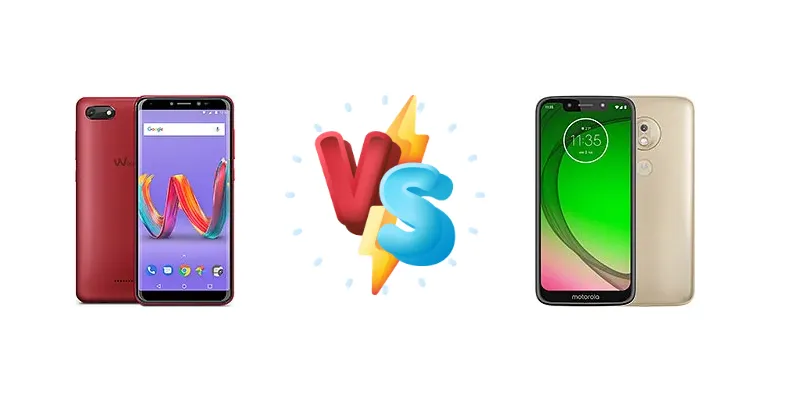
The sub-$150 smartphone market is fiercely competitive. Both the Motorola Moto G7 Play and the Wiko Tommy3 Plus aim to deliver essential smartphone functionality at an accessible price. However, they take distinctly different approaches to achieving this, primarily through their chipset choices. This comparison dissects those differences, revealing which phone offers the best value for your money.
🏆 Quick Verdict
For most users, the Motorola Moto G7 Play is the superior choice. Its Qualcomm Snapdragon 632 chipset provides significantly better performance than the Wiko Tommy3 Plus’s Mediatek MT6739WA, translating to a smoother user experience and improved app responsiveness. While battery life is comparable, the G7 Play’s processing power makes it the more versatile device.
| Network |
|---|
| 2G bands | GSM 850 / 900 / 1800 / 1900 | GSM 850 / 900 / 1800 / 1900 |
| 3G bands | HSDPA 850 / 900 / 1900 / 2100 | HSDPA 850 / 900 / 1700(AWS) / 1900 / 2100 |
| 4G bands | 1, 3, 7, 20 | 1, 2, 3, 4, 5, 7, 8, 20, 28, 38, 40, 41 - Europe |
| Speed | HSPA 42.2/5.76 Mbps, LTE Cat4 150/50 Mbps | HSPA 42.2/5.76 Mbps, LTE (2CA) Cat7 300/50 Mbps |
| Technology | GSM / HSPA / LTE | GSM / HSPA / LTE |
| | - | 1, 2, 3, 4, 5, 7, 8, 12, 13, 14, 17, 20, 25, 26, 29, 30, 38, 39, 40, 41, 41, 66, 71 - USA |
| Launch |
|---|
| Announced | 2019. Released 2019 | 2019, February. Released 2019, March |
| Status | Discontinued | Discontinued |
| Body |
|---|
| Build | - | Glass front (Gorilla Glass 3), plastic back, plastic frame |
| Dimensions | 147.6 x 71.3 x 8.4 mm (5.81 x 2.81 x 0.33 in) | 147.3 x 71.5 x 8 mm (5.80 x 2.81 x 0.31 in) |
| SIM | Dual SIM (Micro-SIM, dual stand-by) | · Nano-SIM· Nano-SIM + Nano-SIM |
| Weight | 150 g (5.29 oz) | 149 g (5.26 oz) |
| | - | Splash resistant (market dependent) |
| Display |
|---|
| Protection | - | Corning Gorilla Glass 3 (market dependent) |
| Resolution | 720 x 1440 pixels, 18:9 ratio (~295 ppi density) | 720 x 1512 pixels, 19:9 ratio (~294 ppi density) |
| Size | 5.45 inches, 76.7 cm2 (~72.8% screen-to-body ratio) | 5.7 inches, 81.4 cm2 (~77.3% screen-to-body ratio) |
| Type | IPS LCD | IPS LCD |
| Platform |
|---|
| CPU | Quad-core 1.3 GHz Cortex-A53 | Octa-core (4x1.8 GHz Kryo 250 Gold & 4x1.8 GHz Kryo 250 Silver) |
| Chipset | Mediatek MT6739WA (28 nm) | Qualcomm SDM632 Snapdragon 632 (14 nm) |
| GPU | PowerVR GE8100 | Adreno 506 |
| OS | Android 8.1 (Oreo) | Android 9.0 (Pie), upgradable to Android 10 |
| Memory |
|---|
| Card slot | microSDXC | microSDXC (dedicated slot) |
| Internal | 16GB 2GB RAM | 32GB 2GB RAM, 32GB 3GB RAM |
| | eMMC 5.1 | eMMC 5.1 |
| Main Camera |
|---|
| Features | LED flash, HDR, panorama | LED flash, panorama, HDR |
| Single | 13 MP, AF | 13 MP, f/2.0, 1/3.1", 1.12µm, PDAF |
| Video | 1080p@30fps | 4K@30fps, 1080p@30fps |
| Selfie camera |
|---|
| Features | LED flash | LED flash |
| Single | 5 MP | 8 MP, f/2.2, 1/4.0", 1.12µm |
| Video | - | 1080p@30fps |
| Sound |
|---|
| 3.5mm jack | Yes | Yes |
| 35mm jack | Yes | Yes |
| Loudspeaker | Yes | Yes |
| | eMMC 5.1 | - |
| Comms |
|---|
| Bluetooth | 4.2, A2DP, LE | 4.2, A2DP, LE |
| NFC | No | No |
| Positioning | GPS | GPS, GLONASS |
| Radio | FM radio | FM radio |
| USB | microUSB 2.0, OTG | USB Type-C 2.0, OTG |
| WLAN | Wi-Fi 802.11 b/g/n | Wi-Fi 802.11 b/g/n |
| Features |
|---|
| Languages | Anthracite Matte, Anthracite Mirror, Gold, Cherry | - |
| Sensors | Accelerometer, proximity, compass | Fingerprint (rear-mounted), accelerometer, gyro, proximity, compass |
| Battery |
|---|
| Charging | - | 10W wired |
| Type | Li-Po 2900 mAh | Li-Ion 3000 mAh, non-removable |
| Misc |
|---|
| Colors | - | Deep indigo, Fine Gold, Starry Black |
| Models | - | XT1952-4, XT1952-5 |
| Price | About 80 EUR | About 160 EUR |
| SAR | - | 0.74 W/kg (head) 1.40 W/kg (body) |
| SAR EU | - | 0.84 W/kg (head) 0.85 W/kg (body) |
| Tests |
|---|
| Audio quality | - |
Noise -90.0dB / Crosstalk -92.9dB |
| Battery life | - | Endurance rating 103h |
| Camera | - |
Photo / Video |
| Display | - |
Contrast ratio: 1468:1 (nominal), 3.180 (sunlight) |
| Loudspeaker | - |
Voice 66dB / Noise 74dB / Ring 81dB |
| Performance | - |
AnTuTu: 97230 (v7)
GeekBench: 4154 (v4.4)
GFXBench: 7.7fps (ES 3.1 onscreen) |
Wiko Tommy3 Plus
- Potentially lower price point
- Acceptable battery life
- Functional for basic tasks
- Significantly weaker processor
- Less efficient chipset
- Limited long-term performance
Motorola Moto G7 Play
- Superior processor performance
- More efficient chipset
- Better long-term usability
- 10W charging support
- May be slightly more expensive
- Camera specs are basic
- Display details are limited
Display Comparison
Both the Wiko Tommy3 Plus and Motorola Moto G7 Play share a contrast ratio of 1468:1 (nominal) and 3180:1 (sunlight), suggesting similar outdoor visibility. However, the context data lacks specifics on screen resolution, size, or panel type for the Wiko Tommy3 Plus. The G7 Play, while also lacking detailed specs here, benefits from Motorola’s generally competent display calibration. Without knowing the Wiko’s panel technology, it’s difficult to assess color accuracy or viewing angles, but the G7 Play likely offers a more refined visual experience.
Camera Comparison
Both phones are listed as having 'Photo / Video' capabilities, but lack any specific details regarding sensor size, aperture, or features. Given the budget nature of both devices, image quality is unlikely to be a standout feature on either. It’s reasonable to assume both will perform adequately in good lighting conditions, but struggle in low light. The absence of any mention of OIS or advanced image processing suggests a focus on basic functionality. Without further information, it’s impossible to declare a clear winner in this category.
Performance
The performance gap is the most significant differentiator. The Motorola Moto G7 Play’s Qualcomm Snapdragon 632 (14nm) is an octa-core processor built on a more efficient manufacturing process than the Wiko Tommy3 Plus’s Mediatek MT6739WA (28nm). The Snapdragon 632’s Kryo 250 cores – split between performance and efficiency – provide a substantial uplift in CPU and GPU performance. The 28nm process of the MT6739WA will likely result in higher power consumption and potentially more thermal throttling under sustained load. Users intending to play even moderately demanding games will find the G7 Play far more capable.
Battery Life
Both the Wiko Tommy3 Plus and Motorola Moto G7 Play achieve an endurance rating of 103 hours, indicating comparable battery life under similar usage patterns. However, the Snapdragon 632’s 14nm process is more power-efficient than the MT6739WA’s 28nm process. The G7 Play also supports 10W wired charging, while charging speed for the Wiko Tommy3 Plus is unknown. While total battery capacity isn’t specified, the G7 Play’s efficiency gives it an edge in real-world usage, especially with moderate to heavy use.
Buying Guide
Buy the Wiko Tommy3 Plus if you prioritize absolute minimal cost and only need a phone for basic tasks like calls, texts, and light social media. It’s a functional device for those on the tightest of budgets. Buy the Motorola Moto G7 Play if you value a more responsive user experience, occasional gaming, and a phone that will feel less sluggish over time. The G7 Play offers a better balance of features and performance for everyday use.
Frequently Asked Questions
❓ Will the Motorola Moto G7 Play handle popular games like PUBG Mobile?
The Snapdragon 632 in the Moto G7 Play is capable of running PUBG Mobile, but you’ll likely need to use lower graphics settings for a smooth experience. The Wiko Tommy3 Plus’s Mediatek MT6739WA will struggle significantly with PUBG, even on the lowest settings.
❓ How much does the Mediatek MT6739WA chipset impact app loading times compared to the Snapdragon 632?
App loading times on the Wiko Tommy3 Plus will be noticeably slower due to the MT6739WA’s weaker CPU and GPU. The Snapdragon 632 offers a much more responsive experience, with apps launching faster and multitasking feeling smoother.
❓ Is the battery life difference between the two phones significant in real-world use?
While both phones have a 103-hour endurance rating, the Moto G7 Play’s more efficient Snapdragon 632 chipset will likely translate to longer real-world battery life, especially with moderate to heavy usage. The Wiko Tommy3 Plus may require more frequent charging.