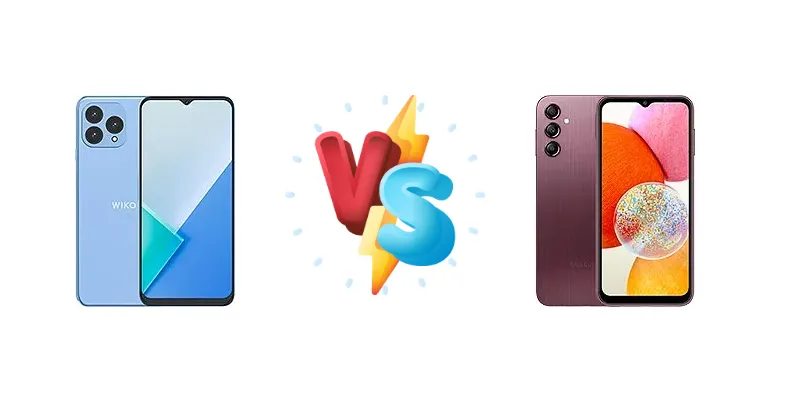
The sub-$200 smartphone market is fiercely competitive. The Wiko T60 and Samsung Galaxy A14 both aim to deliver essential features at an accessible price point, but they take different approaches to achieving this. The Wiko T60 relies on a Mediatek MT8788V chipset, while the Samsung Galaxy A14 offers a choice between the Mediatek Helio G80 and the Exynos 850, creating a nuanced comparison for budget-conscious buyers.
🏆 Quick Verdict
For most users, the Samsung Galaxy A14 (specifically the Exynos 850 version if available) is the better choice. While the Wiko T60 offers a respectable CPU configuration, the potential for a more efficient 8nm Exynos 850 in the A14, coupled with Samsung’s software optimization and brand recognition, provides a smoother and more reliable user experience.
| Network |
|---|
| 2G bands | GSM 850 / 900 / 1800 / 1900 | GSM 850 / 900 / 1800 / 1900 |
| 3G bands | HSDPA 850 / 900 / 1700(AWS) / 1900 / 2100 | HSDPA 850 / 900 / 2100 |
| 4G bands | 1, 2, 3, 4, 5, 7, 8, 12, 13, 17, 18, 19, 20, 26, 28, 38, 39, 40, 41, 66 | 1, 3, 5, 7, 8, 20, 28, 38, 40, 41 |
| Speed | HSPA, LTE | HSPA, LTE |
| Technology | GSM / HSPA / LTE | GSM / HSPA / LTE |
| Launch |
|---|
| Announced | 2023, June 23 | 2023, February 28 |
| Status | Available. Released 2023, June 23 | Available. Released 2023, March 27 |
| Body |
|---|
| Build | - | Glass front, plastic back, plastic frame |
| Dimensions | 165.8 x 75.8 x 9.8 mm (6.53 x 2.98 x 0.39 in) | 167.7 x 78 x 9.1 mm (6.60 x 3.07 x 0.36 in) |
| SIM | Nano-SIM + Nano-SIM | · Nano-SIM· Nano-SIM + Nano-SIM |
| Weight | 217 g (7.65 oz) | 201 g (7.09 oz) |
| Display |
|---|
| Protection | Corning Gorilla Glass | - |
| Resolution | 1080 x 2408 pixels, 20:9 ratio (~401 ppi density) | 1080 x 2408 pixels, 20:9 ratio (~400 ppi density) |
| Size | 6.58 inches, 104.3 cm2 (~83.0% screen-to-body ratio) | 6.6 inches, 104.9 cm2 (~80.2% screen-to-body ratio) |
| Type | IPS LCD | PLS LCD |
| Platform |
|---|
| CPU | Octa-core (4x2.0 GHz Cortex-A73 & 4x2.0 GHz Cortex-A53) | Octa-core (2x2.0 GHz Cortex-A75 & 6x1.8 GHz Cortex-A55) - Version AOcta-core (4x2.0 GHz Cortex-A55 & 4x2.0 GHz Cortex-A55) - Version B |
| Chipset | Mediatek MT8788V/WA (12 nm) | Mediatek MT6769 Helio G80 (12 nm) - Version AExynos 850 (8 nm) - Version B |
| GPU | - | Mali-G52 MC2 |
| OS | Android 13 | Android 13, upgradable to Android 15, One UI 7 |
| Memory |
|---|
| Card slot | microSDXC | microSDXC (dedicated slot) |
| Internal | 256GB 8GB RAM | 64GB 4GB RAM, 128GB 4GB RAM, 128GB 6GB RAM |
| Main Camera |
|---|
| Features | LED flash, HDR, panorama | LED flash, panorama, HDR |
| Single | - | 13 MP, f/2.0, (wide) |
| Triple | 48 MP, (wide), AF
2 MP (macro)
0.3 MP | 50 MP, f/1.8, 26mm (wide), 1/2.75", 0.64µm, PDAF
5 MP, f/2.2, 17mm (ultrawide), 1/5.0", 1.12µm
2 MP (macro) |
| Video | 1080p@30fps | 1080p@30fps |
| Selfie camera |
|---|
| Single | 24 MP | 13 MP, f/2.0, 26mm (wide), 1/3.1", 1.12µm |
| Video | 1080p@30fps | 1080p@30fps |
| Sound |
|---|
| 3.5mm jack | - | Yes |
| 35mm jack | Yes | Yes |
| Loudspeaker | Yes | Yes |
| Comms |
|---|
| Bluetooth | 4.2, A2DP | 5.1 or 5.3, A2DP, LE |
| NFC | Yes | Yes (market/region dependent) |
| Positioning | GPS, GLONASS, GALILEO | GPS, GALILEO, GLONASS, BDS, QZSS |
| Radio | Unspecified | Unspecified |
| USB | USB Type-C 2.0 | USB Type-C 2.0 |
| WLAN | Wi-Fi 802.11 a/b/g/n/ac, dual-band | Wi-Fi 802.11 a/b/g/n/ac, dual-band, Wi-Fi Direct |
| Features |
|---|
| Sensors | Fingerprint (side-mounted), accelerometer, gyro, proximity, compass | Fingerprint (side-mounted), accelerometer, proximity, compass |
| Battery |
|---|
| Charging | - | 15W wired |
| Type | Li-Po 5200 mAh | Li-Po 5000 mAh |
| Misc |
|---|
| Colors | Black, Purple, Blue | Black, Dark Red, Silver, Green |
| Models | - | SM-A145F, SM-A145F/DSN, SM-A145M, SM-A145M/DS, SM-A145P, SM-A145R |
| Price | - | € 85.76 / $ 147.60 / £ 79.95 |
| SAR EU | - | 0.46 W/kg (head) 1.37 W/kg (body) |
Wiko T60
- Potentially lower price point
- Decent CPU performance for basic tasks
- Likely large battery capacity
- Less established brand reputation
- Older chipset architecture
- Potentially less efficient power consumption
Samsung Galaxy A14
- Samsung brand reliability
- Potential for Exynos 850 variant (superior performance)
- Better software optimization
- Slower 15W charging
- May be slightly more expensive
- Helio G80 version offers less performance gain
Display Comparison
Neither device boasts a standout display. Both are likely to utilize LCD panels, common in this price bracket. The key difference lies in potential panel calibration and brightness. While specific nit ratings are unavailable, Samsung generally excels in display quality, suggesting the A14 may offer slightly more vibrant colors and better outdoor visibility. Bezels are expected to be similar, prioritizing cost-effectiveness over premium aesthetics.
Camera Comparison
Camera performance is likely to be similar, with both phones focusing on affordability. The Wiko T60’s camera specs are unknown, but we can assume a primary sensor around 13-16MP. The Samsung Galaxy A14 typically features a 50MP main sensor, providing a potential advantage in detail capture, especially in good lighting conditions. Both phones will likely include auxiliary lenses (depth, macro) of limited utility. Image processing will be a key factor; Samsung’s software typically offers more refined results, with better dynamic range and noise reduction. OIS (Optical Image Stabilization) is unlikely on either device.
Performance
The performance gap is the most significant differentiator. The Wiko T60’s Mediatek MT8788V, built on a 12nm process, features a Cortex-A73/A53 core configuration. This is a capable setup for everyday tasks, but the Cortex-A73 cores are older architecture. The Samsung Galaxy A14’s Helio G80 (also 12nm) utilizes Cortex-A75 cores, offering a performance advantage in single-core tasks. Crucially, the A14’s Exynos 850 variant (8nm) represents a substantial leap in efficiency and sustained performance. The smaller node allows for higher transistor density and reduced heat generation, meaning less throttling during prolonged use. The A14’s CPU configuration (2x A75 & 6x A55) is optimized for a balance of power and efficiency, potentially leading to smoother multitasking.
Battery Life
Battery life will depend heavily on usage patterns and chipset efficiency. While mAh ratings are not provided, both phones likely house batteries in the 5000mAh range. The Samsung Galaxy A14’s 15W charging is relatively slow compared to some competitors. However, the potential efficiency gains of the Exynos 850 could offset this, resulting in comparable or even better real-world battery endurance. The Wiko T60’s less efficient chipset may require more frequent charging.
Buying Guide
Buy the Wiko T60 if you prioritize a potentially lower price and are comfortable with a less-established brand. It’s suitable for basic tasks like calling, texting, and light social media use. Buy the Samsung Galaxy A14 if you value a more polished software experience, potentially better performance (especially with the Exynos 850 variant), and the peace of mind that comes with a well-known brand. It’s ideal for users who want a phone that can handle moderate multitasking and occasional gaming.
Frequently Asked Questions
❓ Does the Samsung Galaxy A14's Exynos 850 chip overheat during extended gaming sessions?
The Exynos 850, built on an 8nm process, is significantly more thermally efficient than the Mediatek MT8788V in the Wiko T60. While it won't deliver flagship-level gaming performance, it's less prone to throttling and overheating during moderate gaming, offering a more consistent experience.
❓ Is the 2MP macro camera on either phone worth using?
Generally, 2MP macro cameras on budget phones offer limited utility. Image quality is often poor, lacking detail and sharpness. They are best used in ideal lighting conditions and should not be expected to produce professional-looking macro shots. The Samsung Galaxy A14's 50MP main sensor will likely provide more usable close-up images with digital zoom.
❓ Can the Samsung Galaxy A14 run PUBG Mobile at 60fps?
The Samsung Galaxy A14 with the Helio G80 can likely run PUBG Mobile at balanced graphics settings and medium frame rates (around 40-50fps). The Exynos 850 version should offer a more stable 60fps experience at lower settings. The Wiko T60 will likely struggle to maintain a consistent 30fps, requiring significant graphics compromises.
❓ What version of Android does each phone ship with, and what is the update policy?
The Samsung Galaxy A14 typically ships with a newer version of Android and benefits from Samsung's commitment to software updates, offering at least a few years of security patches and potentially one major Android version upgrade. Wiko's update policy is less predictable, and the T60 may receive fewer updates over its lifespan.