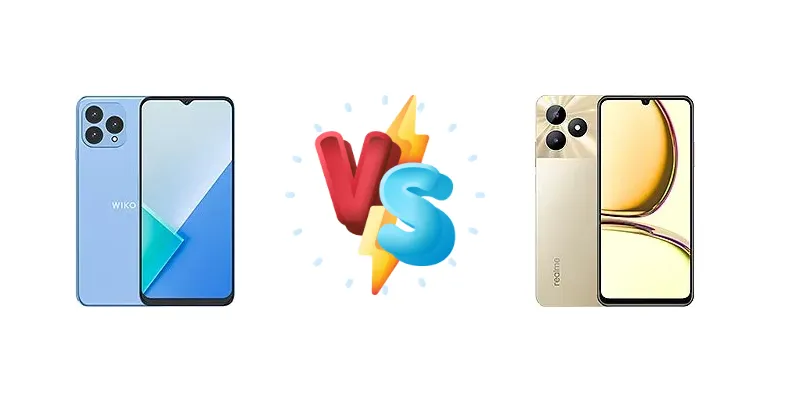
The Wiko T60 and Realme C53 (India) represent two distinct approaches to the ultra-budget smartphone market. The Wiko T60 leverages a Mediatek MT8788V chipset, while the Realme C53 opts for the Unisoc Tiger T612. This comparison dissects their core components to determine which device delivers superior performance and value for everyday tasks and light gaming.
🏆 Quick Verdict
For the average user prioritizing consistent performance in daily tasks, the Wiko T60 emerges as the slightly better choice. Its Mediatek MT8788V, featuring Cortex-A73 cores, offers a performance edge over the Realme C53’s Tiger T612, despite the latter’s 18W charging capability. However, the Realme C53’s faster charging is a significant benefit for those frequently needing a quick power boost.
| Network |
|---|
| 2G bands | GSM 850 / 900 / 1800 / 1900 | GSM 850 / 900 / 1800 / 1900 |
| 3G bands | HSDPA 850 / 900 / 1700(AWS) / 1900 / 2100 | HSDPA 850 / 900 / 2100 |
| 4G bands | 1, 2, 3, 4, 5, 7, 8, 12, 13, 17, 18, 19, 20, 26, 28, 38, 39, 40, 41, 66 | 1, 3, 5, 8, 38, 40, 41 |
| Speed | HSPA, LTE | HSPA, LTE |
| Technology | GSM / HSPA / LTE | GSM / HSPA / LTE |
| Launch |
|---|
| Announced | 2023, June 23 | 2023, July 19 |
| Status | Available. Released 2023, June 23 | Available. Released 2023, July 26 |
| Body |
|---|
| Build | - | Glass front, plastic frame, plastic back |
| Dimensions | 165.8 x 75.8 x 9.8 mm (6.53 x 2.98 x 0.39 in) | 167.2 x 76.7 x 8 mm (6.58 x 3.02 x 0.31 in) |
| SIM | Nano-SIM + Nano-SIM | Nano-SIM + Nano-SIM |
| Weight | 217 g (7.65 oz) | 186 g (6.56 oz) |
| Display |
|---|
| Protection | Corning Gorilla Glass | - |
| Resolution | 1080 x 2408 pixels, 20:9 ratio (~401 ppi density) | 1080 x 2400 pixels, 20:9 ratio (~390 ppi density) |
| Size | 6.58 inches, 104.3 cm2 (~83.0% screen-to-body ratio) | 6.74 inches, 109.7 cm2 (~85.5% screen-to-body ratio) |
| Type | IPS LCD | IPS LCD, 90Hz, 560 nits (peak) |
| Platform |
|---|
| CPU | Octa-core (4x2.0 GHz Cortex-A73 & 4x2.0 GHz Cortex-A53) | Octa-core (2x1.8 GHz Cortex-A75 & 6x1.8 GHz Cortex-A55) |
| Chipset | Mediatek MT8788V/WA (12 nm) | Unisoc Tiger T612 (12 nm) |
| GPU | - | Mali-G57 |
| OS | Android 13 | Android 13, Realme UI |
| Memory |
|---|
| Card slot | microSDXC | microSDXC (dedicated slot) |
| Internal | 256GB 8GB RAM | 64GB 6GB RAM, 128GB 4GB RAM, 128GB 6GB RAM |
| Main Camera |
|---|
| Dual | - | 108 MP, (wide), PDAF
Auxiliary lens |
| Features | LED flash, HDR, panorama | LED flash, HDR, panorama |
| Triple | 48 MP, (wide), AF
2 MP (macro)
0.3 MP | - |
| Video | 1080p@30fps | 1080p@30fps |
| Selfie camera |
|---|
| Features | - | HDR |
| Single | 24 MP | 8 MP, (wide) |
| Video | 1080p@30fps | 720p@30fps |
| Sound |
|---|
| 35mm jack | Yes | Yes |
| Loudspeaker | Yes | Yes |
| Comms |
|---|
| Bluetooth | 4.2, A2DP | 5.0, A2DP, LE |
| NFC | Yes | No |
| Positioning | GPS, GLONASS, GALILEO | GPS, GLONASS, GALILEO |
| Radio | Unspecified | Unspecified |
| USB | USB Type-C 2.0 | USB Type-C 2.0 |
| WLAN | Wi-Fi 802.11 a/b/g/n/ac, dual-band | Wi-Fi 802.11 a/b/g/n/ac, dual-band |
| Features |
|---|
| Sensors | Fingerprint (side-mounted), accelerometer, gyro, proximity, compass | Fingerprint (side-mounted), accelerometer, gyro, proximity, compass |
| Battery |
|---|
| Charging | - | 18W wired |
| Type | Li-Po 5200 mAh | 5000 mAh |
| Misc |
|---|
| Colors | Black, Purple, Blue | Gold, Black |
| Models | - | RMX3762 |
| Price | - | About 110 EUR |
Wiko T60
- Potentially better CPU performance due to Cortex-A73 cores.
- Likely longer battery life if it has a larger capacity.
- More responsive multitasking experience.
- Likely slower charging speeds.
- May lack software features found on Realme devices.
Realme C53 (India)
- Faster 18W wired charging.
- Realme UI offers a feature-rich software experience.
- Potentially better camera software processing.
- Slightly weaker CPU performance compared to the Wiko T60.
- May experience more lag during heavy multitasking.
Display Comparison
Neither device boasts a standout display. Both utilize panels likely around 6.6 inches, typical for this price bracket. Specifics like resolution and panel type (IPS vs. TFT) are missing, but we can assume both are 720p+ to balance performance and battery life. The absence of high refresh rates is expected. The real difference will likely be in color calibration and peak brightness, areas where neither is expected to excel.
Camera Comparison
Camera performance is likely to be similar on both devices, relying heavily on software processing. Details on sensor sizes and apertures are unavailable, but given the price point, we can expect a primary sensor around 13MP. The Realme C53 may include a dedicated night mode, a common feature in Realme’s software. The inclusion of a 2MP macro lens on either device is largely a marketing tactic, offering limited practical benefit due to the low resolution and lack of autofocus. Image quality will be acceptable for social media sharing in good lighting conditions, but struggles in low light are anticipated.
Performance
The core of this comparison lies in the chipsets. The Wiko T60’s Mediatek MT8788V utilizes a combination of four Cortex-A73 cores clocked at 2.0 GHz and four Cortex-A53 cores, also at 2.0 GHz. This architecture provides a stronger foundation for demanding tasks compared to the Realme C53’s Unisoc Tiger T612. The Tiger T612 features two Cortex-A75 cores at 1.8 GHz and six Cortex-A55 cores at 1.8 GHz. While the A75 is individually more powerful than the A73, the Wiko T60’s four A73 cores offer greater parallel processing capability. This translates to smoother multitasking and potentially better performance in graphically intensive applications. The 12nm fabrication process is shared by both, suggesting similar thermal characteristics, but the architectural advantage favors the Wiko T60.
Battery Life
Battery capacity is not specified for the Wiko T60, but it’s likely around 5000mAh, standard for this segment. The Realme C53, however, stands out with its 18W wired charging. While not exceptionally fast, it’s a significant advantage over the likely 10W charging on the Wiko T60. This means the Realme C53 can replenish its battery much faster, reducing downtime. The larger battery capacity of the Wiko T60 (if it exists) could offset the slower charging, providing longer overall usage, but the convenience of the Realme C53’s faster charging is a compelling factor.
Buying Guide
Buy the Wiko T60 if you need a phone that feels more responsive during multitasking and app switching, and if you value sustained performance over rapid charging. Buy the Realme C53 (India) if you prioritize quick charging and are willing to trade a small amount of processing power for the convenience of getting back up to 100% faster. Both are excellent choices for first-time smartphone users or those seeking a reliable secondary device.
Frequently Asked Questions
❓ Will the Unisoc Tiger T612 in the Realme C53 struggle with popular apps like WhatsApp and Facebook?
While the Tiger T612 is an entry-level chipset, it's capable of running everyday apps like WhatsApp and Facebook without significant issues. However, expect some slowdowns when multitasking or running multiple apps simultaneously. The Wiko T60’s MT8788V will handle these tasks more smoothly.
❓ Is the 18W charging on the Realme C53 a game-changer for battery anxiety?
For users who frequently find themselves with a low battery, the 18W charging on the Realme C53 is a significant benefit. It allows for a substantial charge in a short amount of time, reducing the need to be tethered to a charger for extended periods. While the Wiko T60 may have a larger battery, the faster charging of the Realme C53 provides more convenience.
❓ Can either of these phones handle basic mobile gaming like PUBG Mobile or Call of Duty Mobile?
Both phones can *run* these games, but expect to play at the lowest graphics settings and potentially experience frame rate drops. The Wiko T60’s slightly more powerful CPU may offer a marginally better gaming experience, but neither phone is designed for serious mobile gaming.