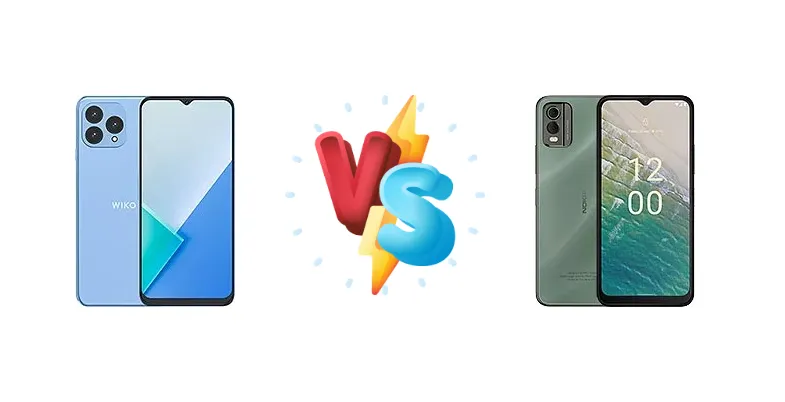
The Wiko T60 and Nokia C32 represent two compelling options in the ultra-budget smartphone segment. While both aim to deliver essential smartphone functionality at an accessible price point, they diverge significantly in their internal hardware, particularly in their chipsets. This comparison will dissect those differences to determine which device offers the best value for your money.
🏆 Quick Verdict
For the average user prioritizing responsiveness and multitasking, the Wiko T60 emerges as the stronger choice. Its Mediatek MT8788V chipset, built on a more efficient 12nm process, provides a noticeable performance uplift over the Nokia C32’s Unisoc SC9863A1, despite the Nokia’s potentially better software optimization.
| Network |
|---|
| 2G bands | GSM 850 / 900 / 1800 / 1900 | GSM 850 / 900 / 1800 / 1900 |
| 3G bands | HSDPA 850 / 900 / 1700(AWS) / 1900 / 2100 | HSDPA 850 / 900 / 2100 |
| 4G bands | 1, 2, 3, 4, 5, 7, 8, 12, 13, 17, 18, 19, 20, 26, 28, 38, 39, 40, 41, 66 | LTE |
| Speed | HSPA, LTE | HSPA, LTE |
| Technology | GSM / HSPA / LTE | GSM / HSPA / LTE |
| Launch |
|---|
| Announced | 2023, June 23 | 2023, February 25 |
| Status | Available. Released 2023, June 23 | Available. Released 2023, February 25 |
| Body |
|---|
| Build | - | Glass front, glass back, plastic frame |
| Dimensions | 165.8 x 75.8 x 9.8 mm (6.53 x 2.98 x 0.39 in) | 164.6 x 75.9 x 8.6 mm (6.48 x 2.99 x 0.34 in) |
| SIM | Nano-SIM + Nano-SIM | · Nano-SIM· Nano-SIM + Nano-SIM |
| Weight | 217 g (7.65 oz) | 199.4 g (7.02 oz) |
| | - | Splash and dust resistant |
| Display |
|---|
| Protection | Corning Gorilla Glass | Scratch-resistant glass |
| Resolution | 1080 x 2408 pixels, 20:9 ratio (~401 ppi density) | 720 x 1600 pixels, 20:9 ratio (~270 ppi density) |
| Size | 6.58 inches, 104.3 cm2 (~83.0% screen-to-body ratio) | 6.5 inches, 102.0 cm2 (~81.6% screen-to-body ratio) |
| Type | IPS LCD | IPS LCD |
| Platform |
|---|
| CPU | Octa-core (4x2.0 GHz Cortex-A73 & 4x2.0 GHz Cortex-A53) | Octa-core (4x1.6 GHz Cortex-A55 & 4x1.2 GHz Cortex-A55) |
| Chipset | Mediatek MT8788V/WA (12 nm) | Unisoc SC9863A1 (22 nm) |
| GPU | - | IMG8322 |
| OS | Android 13 | Android 13 |
| Memory |
|---|
| Card slot | microSDXC | microSDXC (dedicated slot) |
| Internal | 256GB 8GB RAM | 64GB 3GB RAM, 64GB 4GB RAM, 128GB 4GB RAM, 128GB 6GB RAM |
| | - | eMMC 5.1 |
| Main Camera |
|---|
| Dual | - | 50 MP, (wide), AF
2 MP (macro) |
| Features | LED flash, HDR, panorama | LED flash, HDR |
| Single | - | 8 MP |
| Triple | 48 MP, (wide), AF
2 MP (macro)
0.3 MP | - |
| Video | 1080p@30fps | 1080p@30fps |
| Selfie camera |
|---|
| Single | 24 MP | 8 MP |
| Video | 1080p@30fps | Yes |
| Sound |
|---|
| 3.5mm jack | - | Yes |
| 35mm jack | Yes | Yes |
| Loudspeaker | Yes | Yes |
| Comms |
|---|
| Bluetooth | 4.2, A2DP | 5.2, A2DP |
| NFC | Yes | No |
| Positioning | GPS, GLONASS, GALILEO | GPS |
| Radio | Unspecified | Wireless FM radio |
| USB | USB Type-C 2.0 | USB Type-C 2.0 |
| WLAN | Wi-Fi 802.11 a/b/g/n/ac, dual-band | Wi-Fi 802.11 b/g/n |
| Features |
|---|
| Sensors | Fingerprint (side-mounted), accelerometer, gyro, proximity, compass | Fingerprint (side-mounted), accelerometer, proximity |
| Battery |
|---|
| Charging | - | 10W wired |
| Type | Li-Po 5200 mAh | Li-Po 5000 mAh |
| Misc |
|---|
| Colors | Black, Purple, Blue | Charcoal, Autumn Green, Beach Pink |
| Price | - | $ 129.00 / £ 73.99 / € 104.99 |
Wiko T60
- Significantly more powerful CPU for smoother performance
- More efficient 12nm chipset
- Potentially better image processing capabilities
- Battery capacity is unknown
- Charging speed is unspecified
Nokia C32
- Large 5000mAh battery for extended usage
- Clean Android experience (typical of Nokia)
- Potentially better software optimization
- Significantly weaker CPU performance
- Slow 10W charging
- Less efficient 22nm chipset
Display Comparison
Neither Wiko nor Nokia provide display specifications beyond the basic screen size. However, given the price bracket, it's safe to assume both utilize IPS LCD panels. The lack of information prevents a detailed comparison of brightness, color accuracy, or refresh rates. The Nokia C32's potential for software optimization *might* lead to better color calibration, but this is speculative. Bezels are likely to be substantial on both devices, reflecting their budget nature.
Camera Comparison
Detailed camera specifications are absent for both devices. However, budget phones in this price range typically prioritize megapixel count over sensor size and image quality. It’s reasonable to expect both phones to feature a primary camera, potentially accompanied by a depth or macro sensor. Without knowing sensor sizes or lens apertures, it’s difficult to assess image quality. The Wiko T60’s more powerful ISP (Image Signal Processor) within the MT8788V chipset *could* offer slightly better image processing, but this is dependent on software tuning.
Performance
The core difference lies in the chipsets. The Wiko T60’s Mediatek MT8788V (12nm) features an octa-core configuration with four Cortex-A73 cores clocked at 2.0 GHz, paired with four Cortex-A53 cores at the same speed. This architecture is significantly more capable than the Nokia C32’s Unisoc SC9863A1 (22nm), which uses four Cortex-A55 cores at 1.6 GHz and another four at 1.2 GHz. The 12nm fabrication process of the MT8788V also contributes to better power efficiency. The A73 cores in the Wiko T60 will deliver substantially faster single-core and multi-core performance, resulting in quicker app launches and smoother operation. The Unisoc chip, while efficient, is geared towards basic tasks and will struggle with more demanding applications.
Battery Life
Battery capacity is not specified for the Wiko T60, but the Nokia C32 features a 5000mAh battery. However, the Nokia C32 is limited to 10W wired charging, meaning a full charge will take a considerable amount of time. The Wiko T60’s power consumption will likely be higher due to its more powerful processor, but the difference may be offset by efficient software optimization. Without knowing the Wiko T60’s battery capacity, it’s difficult to definitively declare a winner, but the Nokia C32’s larger battery provides a theoretical advantage in longevity, albeit with a slow charging speed.
Buying Guide
Buy the Wiko T60 if you need a phone capable of handling more demanding apps, light gaming, and smoother multitasking. Its more powerful CPU architecture will translate to a more fluid user experience. Buy the Nokia C32 if you prioritize a clean Android experience and are primarily focused on basic communication tasks like calls, texts, and light social media browsing, and are willing to accept slower performance.
Frequently Asked Questions
❓ Will the Unisoc SC9863A1 in the Nokia C32 struggle with popular apps like Facebook or WhatsApp?
While the Nokia C32 can run these apps, you may experience noticeable lag and slower loading times, especially with multiple apps open simultaneously. The Unisoc SC9863A1 is designed for basic tasks and isn't optimized for demanding applications.
❓ Is the 10W charging on the Nokia C32 a significant drawback?
Yes, 10W charging is quite slow by modern standards. Expect a full charge to take several hours, potentially over 3-4 hours from a completely depleted battery. This is a significant inconvenience if you frequently need to top up your phone quickly.
❓ Can the Wiko T60 handle light gaming?
The Wiko T60, with its Cortex-A73 cores, is capable of handling light gaming, such as casual puzzle games or older titles. However, don't expect to run graphically intensive games at high settings. Frame rates will likely be limited, and you may experience some stuttering.
❓ What kind of software experience can I expect from the Nokia C32?
Nokia typically offers a near-stock Android experience with minimal bloatware. This results in a cleaner, faster, and more user-friendly interface. However, software optimization may not fully compensate for the weaker hardware.