
Wiko T60 vs. Motorola Moto G Play (2023): A Deep Dive into Budget Chipsets
| Phones Images | |||||
|---|---|---|---|---|---|
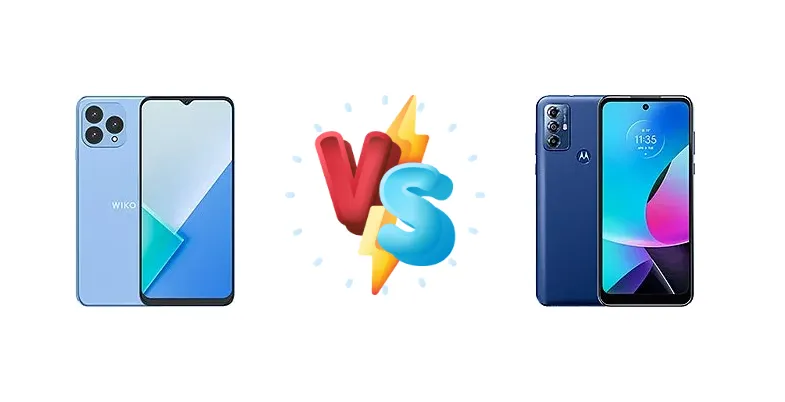
|
🏆 Quick Verdict
For the average user prioritizing responsiveness and multitasking, the Wiko T60 is the better choice. Its Mediatek MT8788V, featuring Cortex-A73 cores, provides a noticeable performance advantage over the Moto G Play’s Helio G37. However, the Moto G Play’s 10W charging offers a slight convenience factor.
| PHONES | ||
|---|---|---|
| Phone Names | Wiko T60 | Motorola Moto G Play (2023) |
| Network | ||
|---|---|---|
| 2G bands | GSM 850 / 900 / 1800 / 1900 | GSM 850 / 900 / 1800 / 1900 |
| 3G bands | HSDPA 850 / 900 / 1700(AWS) / 1900 / 2100 | HSDPA 850 / 900 / 1700(AWS) / 1900 / 2100 |
| 4G bands | 1, 2, 3, 4, 5, 7, 8, 12, 13, 17, 18, 19, 20, 26, 28, 38, 39, 40, 41, 66 | 1, 2, 3, 4, 5, 7, 8, 12, 13, 14, 17, 18, 19, 20, 25, 26, 29, 30, 38, 39, 40, 41, 66, 71 |
| Speed | HSPA, LTE | HSPA, LTE |
| Technology | GSM / HSPA / LTE | GSM / CDMA / HSPA / LTE |
| - | CDMA 800 / 1900 | |
| Launch | ||
|---|---|---|
| Announced | 2023, June 23 | 2022, December 08 |
| Status | Available. Released 2023, June 23 | Available. Released 2022, December 12 |
| Body | ||
|---|---|---|
| Build | - | Plastic frame, plastic back |
| Dimensions | 165.8 x 75.8 x 9.8 mm (6.53 x 2.98 x 0.39 in) | 167.2 x 76.5 x 9.4 mm (6.58 x 3.01 x 0.37 in) |
| SIM | Nano-SIM + Nano-SIM | Nano-SIM |
| Weight | 217 g (7.65 oz) | 203 g (7.20 oz) |
| - | Water-repellent coating | |
| Display | ||
|---|---|---|
| Protection | Corning Gorilla Glass | - |
| Resolution | 1080 x 2408 pixels, 20:9 ratio (~401 ppi density) | 720 x 1600 pixels, 20:9 ratio (~270 ppi density) |
| Size | 6.58 inches, 104.3 cm2 (~83.0% screen-to-body ratio) | 6.5 inches, 102.0 cm2 (~79.7% screen-to-body ratio) |
| Type | IPS LCD | IPS LCD, 90Hz |
| Platform | ||
|---|---|---|
| CPU | Octa-core (4x2.0 GHz Cortex-A73 & 4x2.0 GHz Cortex-A53) | Octa-core (4x2.3 GHz Cortex-A53 & 4x1.8 GHz Cortex-A53) |
| Chipset | Mediatek MT8788V/WA (12 nm) | Mediatek MT6765 Helio G37 (12 nm) |
| GPU | - | PowerVR GE8320 |
| OS | Android 13 | Android 12 |
| Memory | ||
|---|---|---|
| Card slot | microSDXC | microSDXC (dedicated slot) |
| Internal | 256GB 8GB RAM | 32GB 3GB RAM |
| - | eMMC 5.1 | |
| Main Camera | ||
|---|---|---|
| Features | LED flash, HDR, panorama | LED flash, HDR, panorama |
| Triple | 48 MP, (wide), AF 2 MP (macro) 0.3 MP | 16 MP, f/2.2, (wide), 1.12µm, PDAF 2 MP (macro) Auxiliary lens |
| Video | 1080p@30fps | 1080p@30/60fps |
| Selfie camera | ||
|---|---|---|
| Features | - | HDR |
| Single | 24 MP | 5 MP, f/2.4, (wide), 1.12µm |
| Video | 1080p@30fps | 1080p@30fps |
| Sound | ||
|---|---|---|
| 3.5mm jack | - | Yes |
| 35mm jack | Yes | Yes |
| Loudspeaker | Yes | Yes |
| Comms | ||
|---|---|---|
| Bluetooth | 4.2, A2DP | 5.0, A2DP, LE |
| NFC | Yes | No |
| Positioning | GPS, GLONASS, GALILEO | GPS, GLONASS |
| Radio | Unspecified | No |
| USB | USB Type-C 2.0 | USB Type-C 2.0 |
| WLAN | Wi-Fi 802.11 a/b/g/n/ac, dual-band | Wi-Fi 802.11 a/b/g/n/ac, dual-band |
| Features | ||
|---|---|---|
| Sensors | Fingerprint (side-mounted), accelerometer, gyro, proximity, compass | Fingerprint (rear-mounted), accelerometer, proximity, barometer |
| Battery | ||
|---|---|---|
| Charging | - | 10W wired |
| Type | Li-Po 5200 mAh | Li-Po 5000 mAh |
| Misc | ||
|---|---|---|
| Colors | Black, Purple, Blue | Deep Indigo |
| Models | - | XT2271-1, XT2271-3, XT2271-5, XT2271-4 |
| Price | - | $ 54.00 / C$ 129.00 |
Wiko T60
- More powerful CPU for smoother multitasking
- Cortex-A73 cores offer a performance advantage
- Potentially better battery efficiency due to chipset architecture
- Charging speed is likely slow (unconfirmed)
- Limited brand recognition compared to Motorola
Motorola Moto G Play (2023)
- 10W charging provides some convenience
- Motorola’s brand reputation for software support (albeit limited)
- Generally easier to find replacement parts/accessories
- Less powerful CPU resulting in slower performance
- Helio G37 chipset struggles with demanding tasks
- Lower single-core performance impacts app responsiveness
Display Comparison
Neither Wiko nor Motorola provide display specifications beyond resolution in their marketing materials. Assuming typical IPS LCD panels for this price bracket, color accuracy and viewing angles will likely be similar. The absence of high refresh rates or advanced features like LTPO is standard. Bezels are expected to be substantial on both devices, impacting the overall screen-to-body ratio. Without detailed specs, a clear winner is impossible to determine.
Camera Comparison
Detailed camera specifications are lacking for both devices. However, given the price point, expectations should be tempered. Both likely feature a primary camera and potentially a depth or macro sensor. Without knowing sensor sizes, apertures, or image processing capabilities, a direct comparison is difficult. The focus should be on real-world image quality, which will likely be adequate for casual snapshots in good lighting conditions. The absence of Optical Image Stabilization (OIS) on either device suggests low-light performance will be limited.
Performance
The core difference lies in the chipsets. The Wiko T60’s Mediatek MT8788V utilizes a combination of four Cortex-A73 cores clocked at 2.0 GHz and four Cortex-A53 cores, also at 2.0 GHz. This architecture provides a significant uplift in single-core and multi-core performance compared to the Motorola Moto G Play (2023)’s Helio G37. The G37 features four Cortex-A53 cores at 2.3 GHz and another four at 1.8 GHz. While the G37’s higher clock speed on the A53 cores might offer a slight boost in some tasks, the A73 cores in the T60 are substantially more powerful. This translates to faster app loading times, smoother scrolling, and a more responsive user experience on the Wiko T60. Both are built on a 12nm process, suggesting similar power efficiency, but the T60’s architecture is more efficient at handling complex tasks.
Battery Life
Battery capacity is not specified for either device. However, the Motorola Moto G Play (2023) includes 10W wired charging, while the Wiko T60’s charging speed is unknown but likely similar. The slower charging speed of the Moto G Play means a longer time to reach a full charge, potentially offsetting any slight advantage in battery capacity. Without knowing the mAh ratings, it’s difficult to definitively say which phone offers better battery life, but the T60’s more efficient chipset could contribute to longer usage times.
Buying Guide
Buy the Wiko T60 if you need a phone capable of handling more demanding apps and multitasking without significant slowdowns. It’s ideal for users who stream video, browse with multiple tabs, or occasionally play casual games. Buy the Motorola Moto G Play (2023) if you prioritize simplicity, a known brand reputation for software updates (though limited), and are content with basic smartphone functionality – primarily calls, texts, and light social media use.