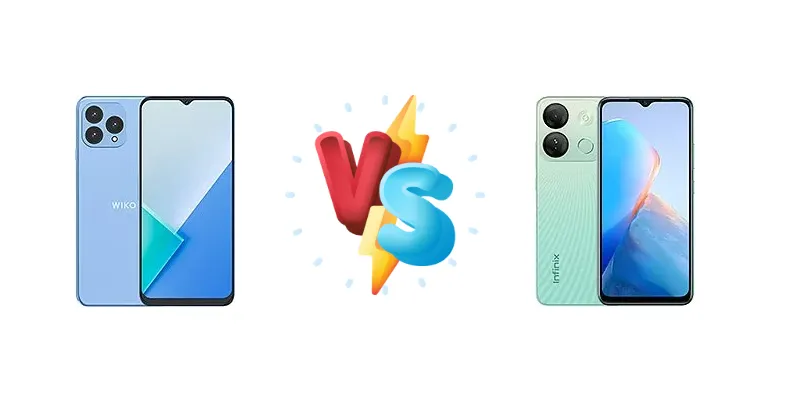
The Wiko T60 and Infinix Smart 7 HD represent the fiercely competitive sub-$150 smartphone market. While both aim to deliver essential functionality at an accessible price, they take different approaches to achieving this. The Wiko T60 boasts a more powerful, albeit older, chipset, while the Infinix Smart 7 HD focuses on basic usability and affordability. This comparison will dissect their key differences to determine which device offers the best value.
🏆 Quick Verdict
For users prioritizing responsiveness and multitasking, the Wiko T60 is the clear winner. Its Mediatek MT8788V chipset, with its Cortex-A73 cores, provides a significantly more fluid experience than the Infinix Smart 7 HD’s unspecified octa-core CPU. However, the Infinix Smart 7 HD may appeal to those seeking the absolute lowest price point and minimal feature requirements.
| Network |
|---|
| 2G bands | GSM 850 / 900 / 1800 / 1900 | GSM 850 / 900 / 1800 / 1900 |
| 3G bands | HSDPA 850 / 900 / 1700(AWS) / 1900 / 2100 | HSDPA 850 / 900 / 2100 |
| 4G bands | 1, 2, 3, 4, 5, 7, 8, 12, 13, 17, 18, 19, 20, 26, 28, 38, 39, 40, 41, 66 | 1, 3, 5, 8, 38, 40, 41 |
| Speed | HSPA, LTE | HSPA, LTE |
| Technology | GSM / HSPA / LTE | GSM / HSPA / LTE |
| | - | 1, 2, 3, 4, 5, 7, 8, 20, 28, 38, 40, 41 |
| Launch |
|---|
| Announced | 2023, June 23 | 2023, April 14 |
| Status | Available. Released 2023, June 23 | Available. Released 2023, April 14 |
| Body |
|---|
| Build | - | Glass front, plastic back, plastic frame |
| Dimensions | 165.8 x 75.8 x 9.8 mm (6.53 x 2.98 x 0.39 in) | 163.9 x 75.5 x 8.7 mm (6.45 x 2.97 x 0.34 in) |
| SIM | Nano-SIM + Nano-SIM | Nano-SIM + Nano-SIM |
| Weight | 217 g (7.65 oz) | 196.5 g (6.95 oz) |
| Display |
|---|
| Protection | Corning Gorilla Glass | - |
| Resolution | 1080 x 2408 pixels, 20:9 ratio (~401 ppi density) | 720 x 1612 pixels, 20:9 ratio (~267 ppi density) |
| Size | 6.58 inches, 104.3 cm2 (~83.0% screen-to-body ratio) | 6.6 inches, 104.6 cm2 (~84.6% screen-to-body ratio) |
| Type | IPS LCD | IPS LCD, 500 nits |
| Platform |
|---|
| CPU | Octa-core (4x2.0 GHz Cortex-A73 & 4x2.0 GHz Cortex-A53) | Octa-core 1.6 GHz |
| Chipset | Mediatek MT8788V/WA (12 nm) | - |
| OS | Android 13 | Android 12 (Go edition) |
| Memory |
|---|
| Card slot | microSDXC | microSDXC (dedicated slot) |
| Internal | 256GB 8GB RAM | 64GB 2GB RAM |
| | - | UFS 2.1 |
| Main Camera |
|---|
| Dual | - | 8 MP, f/2.0
0.08 MP, (depth) |
| Features | LED flash, HDR, panorama | Dual-LED flash, HDR, panorama |
| Single | - | 8 MP, f/2.0
Auxiliary lens |
| Triple | 48 MP, (wide), AF
2 MP (macro)
0.3 MP | - |
| Video | 1080p@30fps | 1080p@30fps |
| Selfie camera |
|---|
| Features | - | LED flash |
| Single | 24 MP | 5 MP, f/2.0 |
| Video | 1080p@30fps | 720p@30fps |
| Sound |
|---|
| 3.5mm jack | - | Yes |
| 35mm jack | Yes | Yes |
| Loudspeaker | Yes | Yes |
| Comms |
|---|
| Bluetooth | 4.2, A2DP | 5.0, A2DP, LE |
| NFC | Yes | No |
| Positioning | GPS, GLONASS, GALILEO | GPS |
| Radio | Unspecified | FM radio |
| USB | USB Type-C 2.0 | microUSB 2.0, OTG |
| WLAN | Wi-Fi 802.11 a/b/g/n/ac, dual-band | Wi-Fi 802.11 b/g/n |
| Features |
|---|
| Sensors | Fingerprint (side-mounted), accelerometer, gyro, proximity, compass | Fingerprint (rear-mounted), accelerometer, proximity |
| Battery |
|---|
| Charging | - | 10W wired |
| Type | Li-Po 5200 mAh | 5000 mAh |
| Misc |
|---|
| Colors | Black, Purple, Blue | Ink Black, Silk Blue, Jade White, Green Apple |
| Models | - | X6516 |
| Price | - | About 110 EUR |
Wiko T60
- More powerful processor for smoother performance
- Potentially better image processing capabilities
- More responsive user experience
- Likely higher price point
- Potentially shorter battery life under heavy load
Infinix Smart 7 HD
- Lower price point
- Potentially longer battery life during basic usage
- Simpler user experience
- Significantly slower performance
- Slow 10W charging
- Limited multitasking capabilities
Display Comparison
Information regarding the displays of both devices is missing. Given the price point, it's reasonable to assume both utilize LCD panels with 720p+ resolution. However, the Wiko T60's chipset may allow for slightly smoother scrolling and animations. Without specific data on brightness, color accuracy, or refresh rates, a definitive comparison is impossible, but the Wiko T60's processing power *could* translate to better image processing for display output.
Camera Comparison
Both devices likely feature basic camera setups geared towards casual photography. Without detailed sensor information, it’s difficult to make a precise comparison. However, the Wiko T60’s more powerful chipset could enable more sophisticated image processing algorithms, potentially resulting in better dynamic range and noise reduction. The prevalence of 2MP macro/depth sensors on both devices suggests limited utility; these are often included for marketing purposes rather than genuine photographic benefit. The primary sensor's aperture and size would be the key differentiators, but this data is unavailable.
Performance
The Wiko T60’s Mediatek MT8788V (12nm) chipset is the defining advantage here. Its octa-core configuration, featuring four 2.0 GHz Cortex-A73 cores and four 2.0 GHz Cortex-A53 cores, provides a substantial performance uplift compared to the Infinix Smart 7 HD’s 1.6 GHz octa-core CPU. The Cortex-A73 cores are significantly more powerful than the cores typically found in CPUs at this price point, resulting in faster app loading times and smoother multitasking. The 12nm process node, while not cutting-edge, is more efficient than older nodes, potentially offering better thermal management. The Infinix Smart 7 HD’s CPU, lacking specific architectural details, likely relies on less powerful Cortex-A53 cores across all eight, leading to noticeable slowdowns under moderate load.
Battery Life
The Infinix Smart 7 HD’s 10W wired charging is a significant limitation. While battery capacity is unknown for both devices, the slower charging speed suggests a longer time to reach a full charge. The Wiko T60’s more powerful chipset will likely consume more power during intensive tasks, but its efficiency could offset this during lighter usage. Without knowing the battery capacities, it’s impossible to determine which device offers superior overall battery life, but the Infinix Smart 7 HD’s lower performance demands could translate to longer standby times.
Buying Guide
Buy the Wiko T60 if you need a smartphone capable of handling moderate multitasking, streaming video, and light gaming without significant lag. It’s ideal for users who value performance over absolute rock-bottom pricing. Buy the Infinix Smart 7 HD if you prioritize simplicity, extended battery life for basic tasks (calls, texts), and are on a very tight budget where every dollar counts. It’s best suited for first-time smartphone users or those needing a reliable secondary device.
Frequently Asked Questions
❓ Will the Wiko T60 be able to run popular social media apps like TikTok and Instagram smoothly?
Yes, the Wiko T60’s Mediatek MT8788V chipset should handle TikTok and Instagram without significant lag. The Cortex-A73 cores provide enough processing power for these apps, although demanding features like filters and live streaming might experience some slowdown.
❓ Is the 10W charging on the Infinix Smart 7 HD a major drawback?
Yes, 10W charging is relatively slow by modern standards. Expect it to take several hours to fully charge the device from 0%. This is best suited for overnight charging or topping up the battery when not in active use. If fast charging is a priority, the Wiko T60 is the better choice, though its charging speed is also not specified.
❓ Can I expect to play demanding games like PUBG Mobile on either of these phones?
While technically possible, PUBG Mobile will likely be unplayable at acceptable frame rates on both devices. The Wiko T60 might allow for very low settings and frame rates, but the experience will likely be choppy. The Infinix Smart 7 HD’s weaker processor will struggle even more.