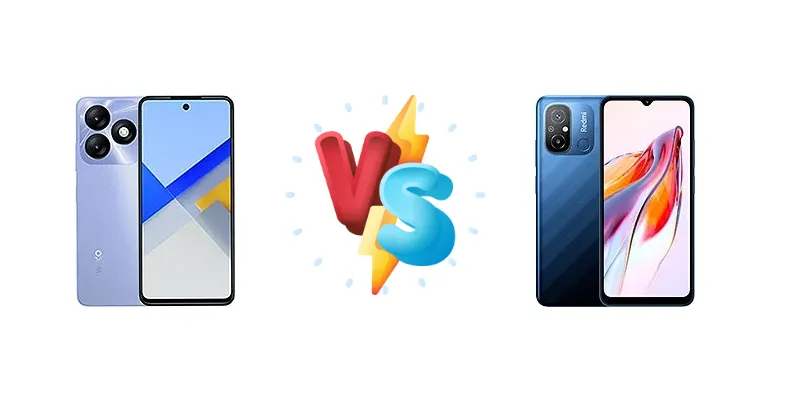
The Wiko T40 and Xiaomi Redmi 12C represent compelling options in the ultra-budget smartphone segment. Both devices leverage the Mediatek Helio G85 chipset, but diverge in key areas like charging speed and potential feature sets. This comparison dissects these differences to determine which phone delivers the best value for your money.
🏆 Quick Verdict
For most users, the Wiko T40 emerges as the slightly better choice. While both phones share the same Helio G85 processor, the T40’s 18W charging significantly reduces downtime compared to the Redmi 12C’s slower 10W charging. This makes the T40 more practical for daily use.
| Network |
|---|
| 2G bands | GSM 850 / 900 / 1800 / 1900 | GSM 850 / 900 / 1800 / 1900 |
| 3G bands | HSDPA 850 / 900 / 1900 / 2100 | HSDPA 850 / 900 / 2100 |
| 4G bands | 1, 3, 5, 7, 8, 20, 28, 38, 40, 41 | 1, 3, 5, 7, 8, 20, 28, 38, 40, 41 - International |
| Speed | HSPA, LTE | HSPA, LTE |
| Technology | GSM / HSPA / LTE | GSM / CDMA / HSPA / EVDO / LTE |
| | - | CDMA2000 1xEV-DO |
| Launch |
|---|
| Announced | 2025 | 2022, December 31 |
| Status | Available. Released 2025 | Available. Released 2023, January 01 |
| Body |
|---|
| Dimensions | 164.2 x 75.3 x 8.8 mm (6.46 x 2.96 x 0.35 in) | 168.8 x 76.4 x 8.8 mm (6.65 x 3.01 x 0.35 in) |
| SIM | Nano-SIM + Nano-SIM | Nano-SIM + Nano-SIM |
| Weight | 183 g (6.46 oz) | 192 g (6.77 oz) |
| Display |
|---|
| Resolution | 720 x 1612 pixels, 20:9 ratio (~269 ppi density) | 720 x 1650 pixels (~268 ppi density) |
| Size | 6.56 inches, 103.4 cm2 (~83.6% screen-to-body ratio) | 6.71 inches, 106.5 cm2 (~82.6% screen-to-body ratio) |
| Type | IPS LCD, 90Hz | IPS LCD, 500 nits (typ) |
| Platform |
|---|
| CPU | Octa-core (2x2.0 GHz Cortex-A75 & 6x1.8 GHz Cortex-A55) | Octa-core (2x2.0 GHz Cortex-A75 & 6x1.8 GHz Cortex-A55) |
| Chipset | Mediatek Helio G85 (12 nm) | Mediatek MT6769Z Helio G85 (12 nm) |
| GPU | Mali-G52 MC2 | Mali-G52 MC2 |
| OS | Android 14 | Android 12, MIUI 13 |
| Memory |
|---|
| Card slot | Unspecified | microSDXC (dedicated slot) |
| Internal | 128GB, 256GB | 32GB 2GB RAM, 32GB 3GB RAM, 32GB 4GB RAM, 64GB 3GB RAM, 64GB 4GB RAM, 128GB 3GB RAM, 128GB 4GB RAM, 128GB 6GB RAM |
| | - | eMMC 5.1 |
| Main Camera |
|---|
| Dual | - | 50 MP, (wide), PDAF
0.08 MP (depth) |
| Features | LED flash | LED flash, HDR |
| Single | 50 MP
Auxiliary lens | 50 MP, f/1.8, (wide), 1/2.76", PDAF
Auxiliary lens |
| Video | 1080p@30fps | 1080p@30fps |
| Selfie camera |
|---|
| Single | 8 MP | 5 MP, f/2.2, (wide) |
| Video | Yes | 1080p@30fps |
| Sound |
|---|
| 3.5mm jack | - | Yes |
| 35mm jack | Yes | Yes |
| Loudspeaker | Yes | Yes |
| Comms |
|---|
| Bluetooth | 5.2, A2DP, LE | 5.1, A2DP, LE |
| NFC | No | Yes (market/region dependent) |
| Positioning | GPS, GLONASS, GALILEO | GPS, GLONASS, BDS, GALILEO |
| Radio | Unspecified | FM radio |
| USB | USB Type-C, OTG | microUSB 2.0 |
| WLAN | Wi-Fi 802.11 a/b/g/n/ac | Wi-Fi 802.11 a/b/g/n/ac, dual-band, Wi-Fi Direct |
| Features |
|---|
| Sensors | Fingerprint (side-mounted), accelerometer | Fingerprint (rear-mounted), accelerometer |
| | - | Virtual proximity sensing |
| Battery |
|---|
| Charging | 18W wired
Reverse wired | 10W wired |
| Type | 5000 mAh | Li-Po 5000 mAh |
| Misc |
|---|
| Colors | Sunrise Violet, Champagne Gold, Sky Mirror, Dark Blue | Graphite Gray, Ocean Blue, Mint Green, Lavender Purple |
| Models | - | 22120RN86G, 22120RN86I, 22126RN91Y, 2212ARNC4L |
| Price | - | £ 132.99 / € 107.41 |
| SAR | - | 1.08 W/kg (head) 0.64 W/kg (body) |
| SAR EU | - | 0.98 W/kg (head) 0.99 W/kg (body) |
Wiko T40
- Faster 18W charging for quicker top-ups.
- Reverse wired charging for added versatility.
- Potentially better thermal management (unconfirmed).
- Battery capacity not specified.
- Camera specifications are unknown.
Xiaomi Redmi 12C
- Likely lower price point.
- Established Xiaomi ecosystem.
- Potentially wider availability.
- Slower 10W charging.
- No reverse wired charging.
- 2MP macro camera is likely of limited utility.
Display Comparison
Neither Wiko nor Xiaomi provide display specifications beyond the basic panel type. Given the price point, both likely utilize LCD panels. The absence of details like peak brightness (nits) or color gamut coverage suggests a focus on cost reduction. Bezels are expected to be noticeable on both devices, and color accuracy will likely be standard for this segment. Without further data, it's safe to assume display quality is comparable and not a major differentiating factor.
Camera Comparison
Camera details are sparse for both devices. The focus is likely on basic image capture rather than advanced photography features. Without sensor size or aperture information, it’s difficult to assess image quality. The presence of a 2MP macro camera on the Redmi 12C is a common, but often underwhelming, addition in this price range. Image processing algorithms will likely be the primary differentiator, but without sample images, it’s impossible to determine which phone produces more pleasing results. Expect adequate performance in well-lit conditions, but struggles in low light.
Performance
Both the Wiko T40 and Xiaomi Redmi 12C are powered by the Mediatek Helio G85 (12 nm) chipset, featuring an octa-core CPU configuration with 2x2.0 GHz Cortex-A75 and 6x1.8 GHz Cortex-A55 cores. This means CPU performance will be virtually identical between the two. The GPU performance will also be the same. However, thermal management could differ based on chassis design and cooling solutions, which are unknown. The shared chipset implies similar performance in everyday tasks like browsing, social media, and light gaming. RAM configurations are not specified, but will heavily influence multitasking capabilities.
Battery Life
The battery capacity is not specified for either device. However, the key difference lies in charging speed. The Wiko T40 supports 18W wired charging, while the Redmi 12C is limited to 10W. This translates to significantly faster charging times for the T40. While a larger battery capacity on the Redmi 12C could partially offset this, the convenience of quicker top-ups offered by the T40 is a substantial advantage. The T40 also includes reverse wired charging, allowing it to act as a power bank for other devices – a feature absent on the Redmi 12C.
Buying Guide
Buy the Wiko T40 if you prioritize faster charging and the convenience of reverse wired charging, making it ideal for users who frequently travel or rely heavily on their phone throughout the day. Buy the Xiaomi Redmi 12C if you are looking for the absolute lowest price point and are willing to accept slower charging speeds and a potentially more basic software experience. Both are good choices for first-time smartphone users or those needing a reliable secondary device.
Frequently Asked Questions
❓ Does the Wiko T40's 18W charging make a significant difference in real-world use?
Yes, the 18W charging on the Wiko T40 will noticeably reduce charging times compared to the Redmi 12C's 10W charging. While exact 0-100% times are unavailable, you can expect to spend considerably less time tethered to a charger with the T40, especially for quick top-ups throughout the day.
❓ Is the reverse wired charging feature on the Wiko T40 useful for everyday scenarios?
The reverse wired charging feature is surprisingly practical. It allows you to use the Wiko T40 as a power bank to charge accessories like wireless earbuds or even another smartphone in emergencies. While not a replacement for a dedicated power bank, it's a convenient feature to have when you're on the go.
❓ Given they both have the Helio G85, will I notice a performance difference between the Wiko T40 and Redmi 12C when gaming?
You likely won't notice a significant performance difference in gaming between the two phones, as they share the same Helio G85 chipset and GPU. However, sustained gaming performance could vary slightly depending on each phone's thermal management capabilities, which are currently unknown. Expect similar frame rates and graphical settings in most games.