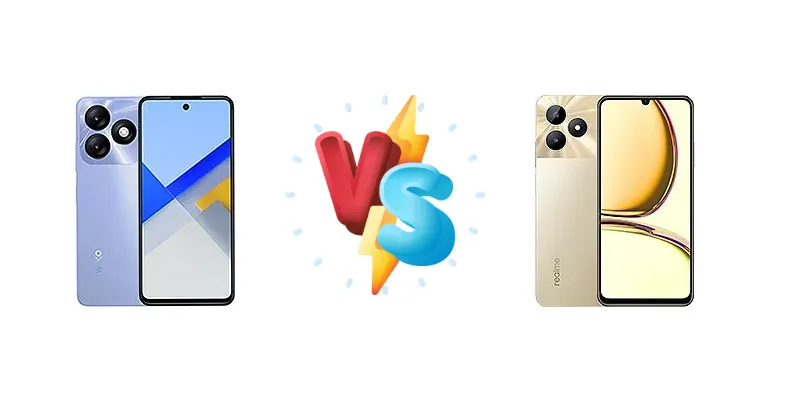
The sub-$150 smartphone market is fiercely competitive. Both the Wiko T40 and the Realme C53 (specifically the India variant) aim to deliver essential features at an accessible price. However, they take different approaches to achieving this, primarily through their choice of chipset. This comparison dives deep into the nuances of the Mediatek Helio G85 in the Wiko T40 versus the Unisoc Tiger T612 in the Realme C53, helping you determine which device best suits your needs.
🏆 Quick Verdict
For the average user prioritizing consistent performance in everyday tasks and slightly better gaming capabilities, the Wiko T40 emerges as the stronger choice. Its Helio G85 chipset, while not a powerhouse, offers a more mature architecture and generally smoother experience than the Unisoc Tiger T612 found in the Realme C53. However, the Realme C53 remains a viable option for basic usage.
| Network |
|---|
| 2G bands | GSM 850 / 900 / 1800 / 1900 | GSM 850 / 900 / 1800 / 1900 |
| 3G bands | HSDPA 850 / 900 / 1900 / 2100 | HSDPA 850 / 900 / 2100 |
| 4G bands | 1, 3, 5, 7, 8, 20, 28, 38, 40, 41 | 1, 3, 5, 8, 38, 40, 41 |
| Speed | HSPA, LTE | HSPA, LTE |
| Technology | GSM / HSPA / LTE | GSM / HSPA / LTE |
| Launch |
|---|
| Announced | 2025 | 2023, July 19 |
| Status | Available. Released 2025 | Available. Released 2023, July 26 |
| Body |
|---|
| Build | - | Glass front, plastic frame, plastic back |
| Dimensions | 164.2 x 75.3 x 8.8 mm (6.46 x 2.96 x 0.35 in) | 167.2 x 76.7 x 8 mm (6.58 x 3.02 x 0.31 in) |
| SIM | Nano-SIM + Nano-SIM | Nano-SIM + Nano-SIM |
| Weight | 183 g (6.46 oz) | 186 g (6.56 oz) |
| Display |
|---|
| Resolution | 720 x 1612 pixels, 20:9 ratio (~269 ppi density) | 1080 x 2400 pixels, 20:9 ratio (~390 ppi density) |
| Size | 6.56 inches, 103.4 cm2 (~83.6% screen-to-body ratio) | 6.74 inches, 109.7 cm2 (~85.5% screen-to-body ratio) |
| Type | IPS LCD, 90Hz | IPS LCD, 90Hz, 560 nits (peak) |
| Platform |
|---|
| CPU | Octa-core (2x2.0 GHz Cortex-A75 & 6x1.8 GHz Cortex-A55) | Octa-core (2x1.8 GHz Cortex-A75 & 6x1.8 GHz Cortex-A55) |
| Chipset | Mediatek Helio G85 (12 nm) | Unisoc Tiger T612 (12 nm) |
| GPU | Mali-G52 MC2 | Mali-G57 |
| OS | Android 14 | Android 13, Realme UI |
| Memory |
|---|
| Card slot | Unspecified | microSDXC (dedicated slot) |
| Internal | 128GB, 256GB | 64GB 6GB RAM, 128GB 4GB RAM, 128GB 6GB RAM |
| Main Camera |
|---|
| Dual | - | 108 MP, (wide), PDAF
Auxiliary lens |
| Features | LED flash | LED flash, HDR, panorama |
| Single | 50 MP
Auxiliary lens | - |
| Video | 1080p@30fps | 1080p@30fps |
| Selfie camera |
|---|
| Features | - | HDR |
| Single | 8 MP | 8 MP, (wide) |
| Video | Yes | 720p@30fps |
| Sound |
|---|
| 35mm jack | Yes | Yes |
| Loudspeaker | Yes | Yes |
| Comms |
|---|
| Bluetooth | 5.2, A2DP, LE | 5.0, A2DP, LE |
| NFC | No | No |
| Positioning | GPS, GLONASS, GALILEO | GPS, GLONASS, GALILEO |
| Radio | Unspecified | Unspecified |
| USB | USB Type-C, OTG | USB Type-C 2.0 |
| WLAN | Wi-Fi 802.11 a/b/g/n/ac | Wi-Fi 802.11 a/b/g/n/ac, dual-band |
| Features |
|---|
| Sensors | Fingerprint (side-mounted), accelerometer | Fingerprint (side-mounted), accelerometer, gyro, proximity, compass |
| Battery |
|---|
| Charging | 18W wired
Reverse wired | 18W wired |
| Type | 5000 mAh | 5000 mAh |
| Misc |
|---|
| Colors | Sunrise Violet, Champagne Gold, Sky Mirror, Dark Blue | Gold, Black |
| Models | - | RMX3762 |
| Price | - | About 110 EUR |
Wiko T40
- Slightly more powerful CPU (Helio G85)
- Reverse wired charging capability
- Potentially better optimized chipset drivers
- Brand recognition may be lower than Realme
- Limited information on display specifications
Realme C53 (India)
- Stronger brand presence in India
- Potentially lower price point (depending on retailer)
- 18W fast charging
- Unisoc Tiger T612 may exhibit performance limitations
- Lower CPU clock speeds compared to Wiko T40
Display Comparison
Neither Wiko nor Realme provide detailed display specifications beyond the basic panel type. Given the price point, both likely utilize IPS LCD panels. The absence of information regarding peak brightness, color gamut coverage, or refresh rates suggests a focus on cost reduction. Bezels are expected to be relatively substantial on both devices. Without further data, it's difficult to definitively declare a winner; display quality will likely be similar and adequate for basic consumption.
Camera Comparison
Detailed camera specifications are unavailable for either device. However, given the price bracket, expectations should be tempered. Both are likely to feature a primary camera alongside depth or macro sensors of limited utility. Image quality will heavily rely on software processing, and the chipset's ISP (Image Signal Processor) capabilities. The Helio G85 in the Wiko T40 *may* offer slightly better ISP performance due to Mediatek’s broader experience in mobile imaging, but this is speculative without detailed testing. Focusing on the primary sensor resolution and aperture would be more informative than speculating about the 2MP auxiliary lenses.
Performance
The core difference lies in the chipsets. The Wiko T40’s Mediatek Helio G85 (12nm) features a dual-core Cortex-A75 setup clocked at 2.0 GHz, paired with six Cortex-A55 cores at 1.8 GHz. The Realme C53’s Unisoc Tiger T612 (also 12nm) uses a similar configuration – dual Cortex-A75 cores, but clocked slightly lower at 1.8 GHz, alongside six Cortex-A55 cores at 1.8 GHz. While both are octa-core CPUs, the higher clock speed of the A75 cores in the Helio G85 gives it a slight edge in single-core performance, translating to snappier app launches and smoother UI navigation. The G85 also benefits from a more mature driver ecosystem, potentially leading to better optimization. The Realme C53's Unisoc chip, while improving, may exhibit more noticeable slowdowns under sustained load.
Battery Life
Both the Wiko T40 and Realme C53 feature 18W wired charging. While the wattage is identical, the actual charging time will depend on battery capacity and power delivery efficiency. Without knowing the battery capacity of each device, it’s difficult to predict 0-100% charge times. However, the 12nm process node of both chipsets suggests relatively similar power efficiency. The inclusion of reverse wired charging on the Wiko T40 is a minor advantage, allowing it to act as a power bank for other devices.
Buying Guide
Buy the Wiko T40 if you need a phone that can handle moderate multitasking, occasional gaming, and benefits from a slightly more established chipset ecosystem. Buy the Realme C53 (India) if you prioritize a brand with wider service availability in India and are primarily focused on basic communication tasks like calls, messaging, and light social media browsing, and are willing to accept potentially lower performance in demanding applications.
Frequently Asked Questions
❓ Will the Unisoc Tiger T612 in the Realme C53 struggle with popular apps like WhatsApp and Facebook?
While the Unisoc T612 can handle basic apps like WhatsApp and Facebook, users may experience occasional lag or slowdowns when multitasking or using more demanding features within these apps. The Helio G85 in the Wiko T40 offers a smoother experience for these common tasks.
❓ Is the gaming performance on either of these phones suitable for PUBG Mobile or Call of Duty Mobile?
Both phones will struggle to deliver a consistently smooth gaming experience in PUBG Mobile or Call of Duty Mobile. You'll likely need to play at the lowest graphics settings and accept frame rate drops. The Wiko T40's Helio G85 will provide a slightly better, but still limited, gaming experience compared to the Realme C53.
❓ Does the Wiko T40's reverse wired charging work with all smartphones?
The Wiko T40's reverse wired charging is compatible with most smartphones that support charging via USB-C. However, the charging speed will be limited to 5W, so it's best suited for providing a small emergency charge rather than fully charging another device.