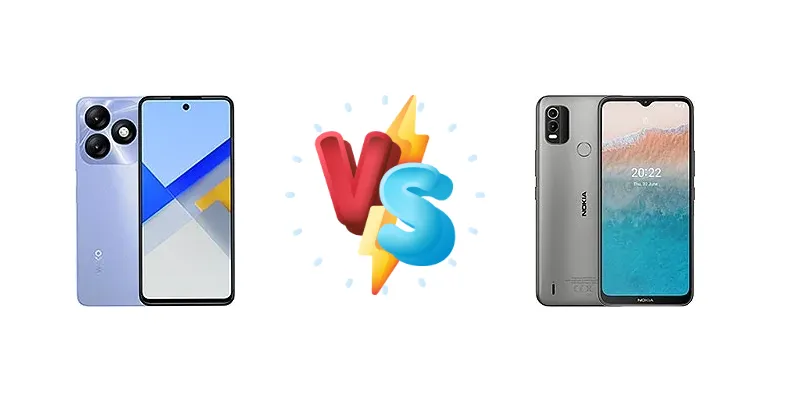
The Wiko T40 and Nokia C21 Plus represent two distinct approaches to the ultra-budget smartphone market. The Wiko T40 prioritizes processing power with its Mediatek Helio G85, while the Nokia C21 Plus focuses on a more conservative, efficiency-focused approach with the Unisoc SC9863A. This comparison dissects these choices to determine which device delivers the best value for your money.
🏆 Quick Verdict
For users prioritizing performance and faster charging, the Wiko T40 is the clear winner. Its Helio G85 chipset offers a significantly more responsive experience, especially for gaming and multitasking. While the Nokia C21 Plus offers a slightly more refined software experience, it’s hampered by its slower processor and limited 10W charging.
| Network |
|---|
| 2G bands | GSM 850 / 900 / 1800 / 1900 | GSM 850 / 900 / 1800 / 1900 |
| 3G bands | HSDPA 850 / 900 / 1900 / 2100 | HSDPA 850 / 900 / 2100 |
| 4G bands | 1, 3, 5, 7, 8, 20, 28, 38, 40, 41 | LTE |
| Speed | HSPA, LTE | HSPA 42.2/5.76 Mbps, LTE Cat4 150/50 Mbps |
| Technology | GSM / HSPA / LTE | GSM / HSPA / LTE |
| | - | HSDPA 850 / 900 / 1700(AWS) / 1900 / 2100 |
| Launch |
|---|
| Announced | 2025 | 2022, February 28 |
| Status | Available. Released 2025 | Available. Released 2022, April 29 |
| Body |
|---|
| Build | - | Glass front, aluminum frame, plastic back |
| Dimensions | 164.2 x 75.3 x 8.8 mm (6.46 x 2.96 x 0.35 in) | 164.8 x 75.9 x 8.6 mm (6.49 x 2.99 x 0.34 in) |
| SIM | Nano-SIM + Nano-SIM | · Nano-SIM· Nano-SIM + Nano-SIM |
| Weight | 183 g (6.46 oz) | 178 g or 191 g (6.28 oz) |
| | - | Splash protection |
| Display |
|---|
| Protection | - | Scratch-resistant glass |
| Resolution | 720 x 1612 pixels, 20:9 ratio (~269 ppi density) | 720 x 1600 pixels, 20:9 ratio (~269 ppi density) |
| Size | 6.56 inches, 103.4 cm2 (~83.6% screen-to-body ratio) | 6.52 inches, 102.6 cm2 (~82.1% screen-to-body ratio) |
| Type | IPS LCD, 90Hz | IPS LCD |
| Platform |
|---|
| CPU | Octa-core (2x2.0 GHz Cortex-A75 & 6x1.8 GHz Cortex-A55) | Octa-core (4x1.6 GHz Cortex-A55 & 4x1.2 GHz Cortex-A55) |
| Chipset | Mediatek Helio G85 (12 nm) | Unisoc SC9863A (28 nm) |
| GPU | Mali-G52 MC2 | IMG8322 |
| OS | Android 14 | Android 11 (Go edition) |
| Memory |
|---|
| Card slot | Unspecified | microSDXC (dedicated slot) |
| Internal | 128GB, 256GB | 32GB 2GB RAM, 32GB 3GB RAM, 64GB 2GB RAM, 64GB 3GB RAM, 64GB 4GB RAM |
| | - | eMMC 5.1 |
| Main Camera |
|---|
| Dual | - | 13 MP, (wide), AF
Auxiliary lens |
| Features | LED flash | LED flash, HDR, panorama |
| Single | 50 MP
Auxiliary lens | 5 MP |
| Video | 1080p@30fps | 1080p@30fps |
| Selfie camera |
|---|
| Features | - | LED flash |
| Single | 8 MP | 5 MP |
| Video | Yes | 720p |
| Sound |
|---|
| 3.5mm jack | - | Yes |
| 35mm jack | Yes | Yes |
| Loudspeaker | Yes | Yes |
| Comms |
|---|
| Bluetooth | 5.2, A2DP, LE | 4.2, A2DP |
| NFC | No | No |
| Positioning | GPS, GLONASS, GALILEO | GPS |
| Radio | Unspecified | FM radio |
| USB | USB Type-C, OTG | microUSB 2.0 |
| WLAN | Wi-Fi 802.11 a/b/g/n/ac | Wi-Fi 802.11 b/g/n |
| Features |
|---|
| Sensors | Fingerprint (side-mounted), accelerometer | Fingerprint (rear-mounted), accelerometer, proximity |
| Battery |
|---|
| Charging | 18W wired
Reverse wired | 10W wired |
| Type | 5000 mAh | Li-Ion 4000/5050 mAh |
| Misc |
|---|
| Colors | Sunrise Violet, Champagne Gold, Sky Mirror, Dark Blue | Dark Cyan, Warm Gray |
| Models | - | TA-1433, TA-1431, TA-1426, TA-1424 |
| Price | - | About 120 EUR |
| SAR | - | 0.57 W/kg (head) 0.65 W/kg (body) |
| SAR EU | - | 0.40 W/kg (head) 0.99 W/kg (body) |
Wiko T40
- Significantly faster processor for smoother performance
- Faster 18W charging for quicker top-ups
- Potentially better image processing due to the Helio G85 ISP
- May generate more heat under heavy load due to the 12nm process
- Software updates may be less frequent compared to Nokia
Nokia C21 Plus
- Potentially better battery life due to the more efficient (though slower) processor
- Clean Android experience with guaranteed updates (typical of Nokia)
- Lower price point (likely)
- Slow 10W charging is a significant drawback
- Unisoc SC9863A processor struggles with demanding tasks
- Limited gaming capabilities
Display Comparison
Neither device boasts a standout display. Both likely utilize LCD panels, common in this price bracket. However, details like resolution and brightness are missing. The focus here is on internal differences. The more powerful GPU in the Wiko T40 *could* translate to smoother scrolling and animations, even if the panel itself is similar. Bezels are likely comparable, given the similar target price points.
Camera Comparison
Camera performance is likely to be similar in real-world usage, given the expected sensor quality in this price range. Details on sensor sizes and apertures are unavailable, but both phones likely feature basic camera setups. The Wiko T40’s more powerful ISP (Image Signal Processor) within the Helio G85 *may* offer slightly better image processing, particularly in low-light conditions, but this is speculative. Any 2MP macro or depth sensors on either device should be considered marketing features rather than significant photographic tools.
Performance
The performance gap is the most significant differentiator. The Wiko T40’s Mediatek Helio G85, built on a 12nm process, features a core configuration of 2x2.0 GHz Cortex-A75 and 6x1.8 GHz Cortex-A55 cores. This is a substantial upgrade over the Nokia C21 Plus’s Unisoc SC9863A, which uses a 28nm process and an octa-core setup of 4x1.6 GHz Cortex-A55 and 4x1.2 GHz Cortex-A55 cores. The larger process node of the Unisoc chip and slower core speeds will result in noticeably slower app loading times and a less fluid user experience. The Helio G85’s Cortex-A75 cores provide a significant boost in single-core performance, crucial for everyday tasks.
Battery Life
While battery capacity isn’t specified, both phones likely feature batteries in the 4000-5000 mAh range. However, the charging speeds are drastically different. The Wiko T40 supports 18W wired charging, allowing for significantly faster top-ups compared to the Nokia C21 Plus’s slow 10W charging. This means the Wiko T40 can recover a substantial amount of battery life in a shorter time, a crucial advantage for users who rely heavily on their phones throughout the day.
Buying Guide
Buy the Wiko T40 if you need a phone capable of handling moderate gaming, streaming, and multitasking without significant lag. It’s ideal for users who value responsiveness and quick charging. Buy the Nokia C21 Plus if you prioritize a simple, clean Android experience and long battery life for basic tasks like calls, texts, and light social media use, and are willing to sacrifice performance.
Frequently Asked Questions
❓ Will the Unisoc SC9863A in the Nokia C21 Plus struggle with popular apps like WhatsApp and Facebook?
While the Nokia C21 Plus can run these apps, you may experience noticeable lag when switching between them or loading media. The Unisoc SC9863A is designed for basic tasks, and multitasking can strain its resources. The Wiko T40’s Helio G85 will provide a much smoother experience.
❓ How long will it take to fully charge the Wiko T40 with the 18W charger?
Assuming a 5000mAh battery (a common size for this class of phone), a full charge with the 18W charger should take approximately 2-2.5 hours. This is significantly faster than the Nokia C21 Plus, which could take 4+ hours with its 10W charger.
❓ Is the Wiko T40 suitable for playing mobile games like PUBG Mobile or Call of Duty Mobile?
The Wiko T40 can run these games, but you’ll likely need to lower the graphics settings to medium or low to achieve playable frame rates. The Helio G85 is a capable gaming chip for its price range, but it’s not a flagship-level performer. The Nokia C21 Plus will struggle significantly with these titles.