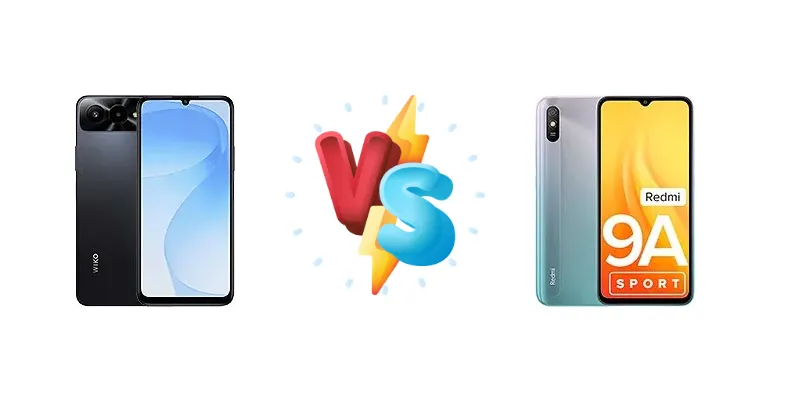
The Wiko T30 and Xiaomi Redmi 9A Sport represent two approaches to the ultra-budget smartphone market. The Redmi 9A Sport focuses on established brand recognition and a streamlined experience, while the Wiko T30 attempts to disrupt with a more modern chipset. This comparison dives deep into the core differences, focusing on how the underlying hardware impacts real-world performance and value.
🏆 Quick Verdict
For most users, the Wiko T30 emerges as the stronger choice. Its Mediatek Dimensity 6300 chipset, built on a 6nm process, delivers significantly improved CPU and GPU performance compared to the Redmi 9A Sport’s Helio G25. While the Redmi 9A Sport offers a familiar experience, the T30’s superior processing power justifies the potential price difference.
| Network |
|---|
| 2G bands | GSM 850 / 900 / 1800 / 1900 | GSM 850 / 900 / 1800 / 1900 |
| 3G bands | HSDPA 850 / 900 / 1700(AWS) / 1900 / 2100 | HSDPA 850 / 900 / 2100 |
| 4G bands | 1, 2, 3, 5, 7, 8, 20, 28, 38, 40, 41 | 1, 3, 5, 8, 40, 41 |
| 5G bands | 1, 3, 5, 7, 8, 20, 28, 38, 41, 77, 78 SA/NSA | - |
| Speed | HSPA, LTE, 5G | HSPA, LTE |
| Technology | GSM / CDMA / HSPA / LTE / 5G | GSM / HSPA / LTE |
| Launch |
|---|
| Announced | 2025, October 15 | 2021, September 28 |
| Status | Available. Released 2025, October | Available. Released 2021, September 28 |
| Body |
|---|
| Dimensions | 168.8 x 78.1 x 8.5 mm (6.65 x 3.07 x 0.33 in) | 164.9 x 77.1 x 9 mm (6.49 x 3.04 x 0.35 in) |
| SIM | Nano-SIM + Nano-SIM | Nano-SIM + Nano-SIM |
| Weight | 199.6 g (7.05 oz) | 194 g (6.84 oz) |
| | - | Water-repellent coating |
| Display |
|---|
| Resolution | 720 x 1600 pixels, 20:9 ratio (~260 ppi density) | 720 x 1600 pixels, 20:9 ratio (~269 ppi density) |
| Size | 6.75 inches, 110.0 cm2 (~83.4% screen-to-body ratio) | 6.53 inches, 102.9 cm2 (~81.0% screen-to-body ratio) |
| Type | IPS LCD, 120Hz | IPS LCD, 400 nits (typ) |
| Platform |
|---|
| CPU | Octa-core (2x2.4 GHz Cortex-A76 & 6x2.0 GHz Cortex-A55) | Octa-core (4x2.0 GHz Cortex-A53 & 4x1.5 GHz Cortex-A53) |
| Chipset | Mediatek Dimensity 6300 (6 nm) | Mediatek MT6762G Helio G25 (12 nm) |
| GPU | Mali-G57 MC2 | PowerVR GE8320 |
| OS | Android 15 | Android 10, MIUI 12 |
| Memory |
|---|
| Card slot | Unspecified | microSDXC (dedicated slot) |
| Internal | 128GB 4GB RAM, 256GB 8GB RAM | 32GB 2GB RAM, 32GB 3GB RAM |
| | - | eMMC 5.1 |
| Main Camera |
|---|
| Features | LED flash | LED flash, HDR |
| Single | 50 MP | 13 MP, f/2.2, 28mm (wide), 1.0µm, PDAF |
| Video | 1080p@30fps | 1080p@30/60fps |
| Selfie camera |
|---|
| Features | - | HDR |
| Single | 5 MP | 5 MP, f/2.2, (wide), 1.12µm |
| Video | Yes | 1080p@30fps |
| Sound |
|---|
| 3.5mm jack | - | Yes |
| 35mm jack | Yes | Yes |
| Loudspeaker | Yes | Yes |
| Comms |
|---|
| Bluetooth | 5.2, A2DP, LE | 5.0, A2DP, LE |
| NFC | No | No |
| Positioning | GPS, GLONASS, GALILEO | GPS, GLONASS, BDS |
| Radio | Unspecified | FM radio |
| USB | USB Type-C | microUSB 2.0, OTG |
| WLAN | Wi-Fi 802.11 a/b/g/n/ac | Wi-Fi 802.11 a/b/g/n, Wi-Fi Direct |
| Features |
|---|
| Sensors | Fingerprint (side-mounted), accelerometer | Accelerometer, proximity |
| Battery |
|---|
| Charging | 18W wired | 10W wired |
| Type | 5000 mAh | Li-Po 5000 mAh |
| Misc |
|---|
| Colors | Black, White | Carbon Black, Coral Green, Metallic Blue |
| Price | - | About 100 EUR |
Wiko T30
- Significantly faster processor (Dimensity 6300)
- More efficient 6nm process for better battery life
- Faster 18W charging
- Potentially better image processing
- Less established brand recognition
- Display specifications unknown
Xiaomi Redmi 9A Sport
- Familiar Xiaomi brand
- Potentially lower price point
- Simple and streamlined user experience
- Wide availability
- Outdated and less powerful Helio G25 chipset
- Inefficient 12nm process
- Slow 10W charging
- Limited performance headroom
Display Comparison
Neither device boasts a standout display. Details regarding panel type, resolution, and refresh rate are absent for both, suggesting both likely utilize standard LCD panels. However, the focus should be on performance differences. The more powerful GPU in the Wiko T30 *could* translate to smoother scrolling and faster rendering of UI elements, even on a similar display.
Camera Comparison
Without detailed camera specifications, a direct comparison is difficult. However, the chipset plays a role. The Dimensity 6300’s more powerful ISP (Image Signal Processor) will likely result in better image processing, including noise reduction and dynamic range. While both phones likely feature basic camera setups, the T30 has the potential to capture more detailed and visually appealing photos, especially in challenging lighting conditions. The absence of OIS on either device suggests reliance on software stabilization.
Performance
The core difference lies in the chipsets. The Wiko T30’s Mediatek Dimensity 6300 (6nm) is a substantial upgrade over the Redmi 9A Sport’s Helio G25 (12nm). The Dimensity 6300 features a more modern CPU architecture – Cortex-A76 cores alongside A55s – compared to the G25’s all-A53 configuration. This translates to a significant performance advantage in CPU-intensive tasks. The 6nm process also contributes to better power efficiency. The G25’s 12nm process is older and less efficient, meaning it will likely generate more heat and consume more power for the same level of performance. This impacts sustained performance and battery life.
Battery Life
The Redmi 9A Sport’s 10W charging is significantly slower than the Wiko T30’s 18W charging. While battery capacity isn’t specified, the Dimensity 6300’s superior power efficiency means the T30 will likely achieve comparable or better battery life despite potentially having a smaller battery. The faster charging on the T30 also means less downtime plugged into the wall.
Buying Guide
Buy the Wiko T30 if you prioritize responsiveness for everyday tasks, occasional gaming, and future-proofing. The Dimensity 6300 provides a smoother experience with demanding apps and offers a longer usable lifespan. Buy the Xiaomi Redmi 9A Sport if you are a very basic user who primarily needs a phone for calls, texts, and light social media, and value brand familiarity and potentially lower initial cost above all else.
Frequently Asked Questions
❓ Will the Wiko T30 handle popular apps like WhatsApp and Facebook smoothly?
Yes, the Mediatek Dimensity 6300’s octa-core CPU and improved architecture will handle everyday apps like WhatsApp and Facebook with ease. The increased processing power ensures a fluid and responsive experience, even with multiple apps open.
❓ Is the Helio G25 in the Redmi 9A Sport sufficient for casual gaming?
The Helio G25 can handle very basic, less demanding games. However, for more graphically intensive titles, you’ll likely experience significant frame rate drops and lag. The Wiko T30, with its Dimensity 6300, offers a much better gaming experience.
❓ How long will it take to fully charge each phone?
With 18W charging, the Wiko T30 should fully charge in approximately 2-3 hours, depending on battery capacity. The Redmi 9A Sport’s 10W charging will take considerably longer, likely exceeding 4 hours.
❓ Does the Wiko T30 support software updates?
Wiko’s software update track record is less established than Xiaomi’s. While the Dimensity 6300 is a modern chipset, long-term software support remains a potential concern. Xiaomi generally provides more consistent updates for its devices.