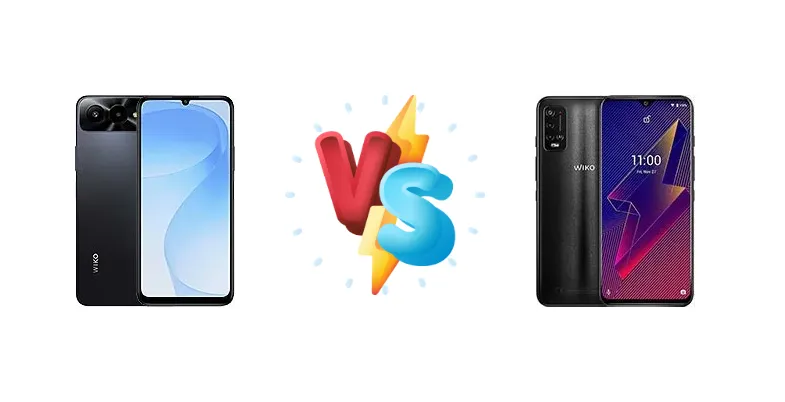
Wiko targets the budget and entry-level smartphone markets with the T30 and Power U20. While both aim to deliver value, they diverge significantly in their core components. The T30 leverages a more modern and powerful Mediatek Dimensity 6300 chipset, while the Power U20 relies on the older, less efficient Helio G35. This comparison will dissect these differences, helping you determine which Wiko phone best suits your needs.
🏆 Quick Verdict
For most users, the Wiko T30 is the superior choice. Its Mediatek Dimensity 6300 chipset provides a substantial performance uplift over the Power U20’s Helio G35, translating to smoother multitasking, faster app loading, and a more responsive user experience. While the Power U20 offers slightly slower charging, the performance gap justifies the small trade-off.
| Network |
|---|
| 2G bands | GSM 850 / 900 / 1800 / 1900 | CDMA 800 / 1700 / 1900 |
| 3G bands | HSDPA 850 / 900 / 1700(AWS) / 1900 / 2100 | HSDPA 850 / 900 / 1900 / 2100 |
| 4G bands | 1, 2, 3, 5, 7, 8, 20, 28, 38, 40, 41 | 1, 3, 5, 7, 8, 20, 28, 40 |
| 5G bands | 1, 3, 5, 7, 8, 20, 28, 38, 41, 77, 78 SA/NSA | - |
| Speed | HSPA, LTE, 5G | HSPA 42.2/5.76 Mbps, LTE Cat4 150/50 Mbps |
| Technology | GSM / CDMA / HSPA / LTE / 5G | CDMA / HSPA / LTE |
| Launch |
|---|
| Announced | 2025, October 15 | 2021, June |
| Status | Available. Released 2025, October | Available. Released 2021, June |
| Body |
|---|
| Dimensions | 168.8 x 78.1 x 8.5 mm (6.65 x 3.07 x 0.33 in) | 173.8 x 78.6 x 9.5 mm (6.84 x 3.09 x 0.37 in) |
| SIM | Nano-SIM + Nano-SIM | Nano-SIM + Nano-SIM |
| Weight | 199.6 g (7.05 oz) | 210 g (7.41 oz) |
| Display |
|---|
| Resolution | 720 x 1600 pixels, 20:9 ratio (~260 ppi density) | 720 x 1640 pixels (~270 ppi density) |
| Size | 6.75 inches, 110.0 cm2 (~83.4% screen-to-body ratio) | 6.82 inches, 104.8 cm2 (~76.7% screen-to-body ratio) |
| Type | IPS LCD, 120Hz | IPS LCD |
| Platform |
|---|
| CPU | Octa-core (2x2.4 GHz Cortex-A76 & 6x2.0 GHz Cortex-A55) | Octa-core (4x2.3 GHz Cortex-A53 & 4x1.8 GHz Cortex-A53) |
| Chipset | Mediatek Dimensity 6300 (6 nm) | Mediatek MT6765G Helio G35 (12 nm) |
| GPU | Mali-G57 MC2 | PowerVR GE8320 |
| OS | Android 15 | Android 11 |
| Memory |
|---|
| Card slot | Unspecified | microSDXC |
| Internal | 128GB 4GB RAM, 256GB 8GB RAM | 32GB 3GB RAM, 64GB 3GB RAM |
| Main Camera |
|---|
| Features | LED flash | LED flash, HDR |
| Single | 50 MP | 5 MP |
| Triple | - | 13 MP, AF
2 MP
Auxiliary lens |
| Video | 1080p@30fps | 1080p@30fps |
| Selfie camera |
|---|
| Single | 5 MP | 5 MP |
| Video | Yes | - |
| Sound |
|---|
| 3.5mm jack | - | Yes |
| 35mm jack | Yes | Yes |
| Loudspeaker | Yes | Yes |
| Comms |
|---|
| Bluetooth | 5.2, A2DP, LE | 4.2, A2DP |
| NFC | No | No |
| Positioning | GPS, GLONASS, GALILEO | GPS, GLONASS, GALILEO, BDS |
| Radio | Unspecified | No |
| USB | USB Type-C | microUSB 2.0, OTG |
| WLAN | Wi-Fi 802.11 a/b/g/n/ac | Wi-Fi 802.11 b/g/n |
| Features |
|---|
| Sensors | Fingerprint (side-mounted), accelerometer | Fingerprint (side-mounted), accelerometer, proximity |
| Battery |
|---|
| Charging | 18W wired | 15W wired |
| Type | 5000 mAh | Li-Ion 6000 mAh |
| Misc |
|---|
| Colors | Black, White | Slate Grey, Navy Blue, Mint |
| Models | - | W-V750BN-EEA |
| Price | - | About 120 EUR |
| SAR | - | 0.58 W/kg (head) 1.29 W/kg (body) |
Wiko T30
- Significantly faster processor for smoother performance
- More power-efficient chipset for longer battery life
- Faster 18W wired charging
- Potentially better image processing
- Likely a higher price point than the Power U20
- May not offer significantly better camera quality without detailed specs
Wiko Power U20
- Lower price point, making it very accessible
- Sufficient for basic smartphone tasks
- Acceptable battery life for light usage
- 15W charging is adequate for casual users
- Slow processor struggles with demanding apps
- Less efficient chipset leads to shorter battery life under load
- Limited multitasking capabilities
- Potentially poor gaming performance
Display Comparison
Neither Wiko provides display specifications beyond size. However, given the price points, we can assume both utilize LCD panels. The key difference lies in the underlying performance of the devices driving them. A faster processor like the Dimensity 6300 in the T30 will result in smoother animations and transitions, enhancing the perceived visual experience even on a similar panel. Bezels are likely comparable, reflecting the budget nature of both devices.
Camera Comparison
Without detailed camera specifications, a direct comparison is difficult. However, it’s safe to assume both phones feature basic camera setups geared towards casual photography. The image signal processor (ISP) within the Dimensity 6300 of the T30 is likely more advanced, potentially leading to better image processing, noise reduction, and dynamic range. Any differences in sensor size or lens quality would further accentuate this advantage. The presence of a more powerful processor allows for faster image processing and potentially more advanced features.
Performance
The performance disparity is the most significant factor in this comparison. The Wiko T30’s Mediatek Dimensity 6300, built on a 6nm process, features a modern CPU configuration with 2x 2.4 GHz Cortex-A76 cores and 6x 2.0 GHz Cortex-A55 cores. This contrasts sharply with the Power U20’s Helio G35, fabricated on a less efficient 12nm process, and utilizing 4x 2.3 GHz Cortex-A53 cores and 4x 1.8 GHz Cortex-A53 cores. The Cortex-A76 cores in the T30 offer significantly higher single-core performance, crucial for responsive app launches and general usability. The 6nm process also contributes to better thermal efficiency, reducing the likelihood of performance throttling during sustained workloads. The Power U20 will struggle with demanding tasks and multitasking.
Battery Life
While specific battery capacities aren't provided, the difference in chipset efficiency is paramount. The 6nm Dimensity 6300 in the T30 is inherently more power-efficient than the 12nm Helio G35 in the Power U20. This means the T30 will likely deliver comparable or even better battery life despite potentially having a similar capacity. The T30 also supports 18W wired charging, compared to the Power U20’s 15W, resulting in slightly faster charging times. However, the efficiency gains of the Dimensity 6300 are more impactful than the charging speed difference.
Buying Guide
Buy the Wiko T30 if you prioritize a fluid user experience, enjoy occasional gaming, or frequently use demanding applications. The Dimensity 6300’s architecture will handle these tasks with ease. Buy the Wiko Power U20 if your primary needs are basic communication – calls, texts, and light social media – and you’re on a very tight budget. The Helio G35 is sufficient for these simple tasks, and the slightly slower charging may not be a significant concern.
Frequently Asked Questions
❓ Will the Wiko Power U20 struggle with popular apps like TikTok or Instagram?
Yes, the Helio G35 in the Power U20 is a relatively weak processor. While it can run these apps, you may experience noticeable lag, slow loading times, and occasional stutters, especially when multitasking or using the apps for extended periods. The T30's Dimensity 6300 will provide a much smoother experience.
❓ Is the 18W charging on the Wiko T30 a significant improvement over the Power U20's 15W?
While not a massive difference, the 18W charging on the T30 will reduce charging times by a noticeable margin. Combined with the more efficient Dimensity 6300 chipset, which reduces the frequency of needing to charge, the T30 offers a better overall charging experience.
❓ Can the Wiko Power U20 handle basic mobile games?
The Power U20 can handle very basic, less demanding mobile games. However, for more graphically intensive titles, you'll likely need to lower the graphics settings significantly and still experience frame rate drops. The Dimensity 6300 in the T30 offers a much more capable gaming experience.