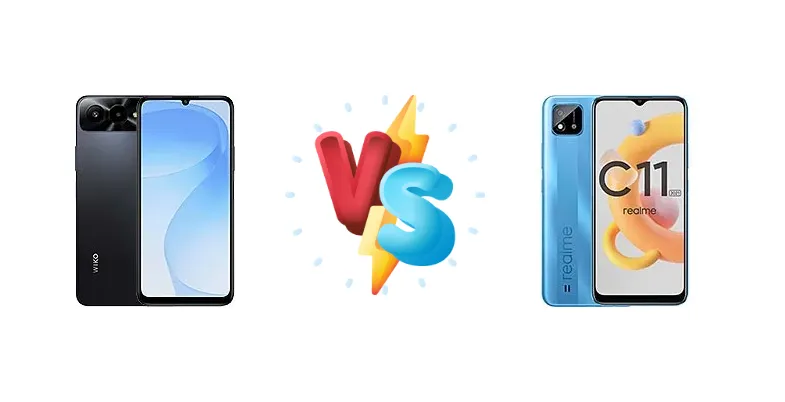
The Wiko T30 and Realme C11 (2021) represent opposite ends of the budget smartphone spectrum. The T30 aims to deliver a more modern experience with a newer chipset, while the C11 (2021) focuses on providing essential functionality at the lowest possible price. This comparison dissects their key differences to help you determine which device best suits your needs.
🏆 Quick Verdict
For most users, the Wiko T30 is the superior choice. Its Mediatek Dimensity 6300 chipset provides a substantially faster and more responsive experience than the Realme C11’s Unisoc SC9863A. While the C11 offers reverse wired charging, the T30’s performance advantage justifies the likely price difference.
| Network |
|---|
| 2G bands | GSM 850 / 900 / 1800 / 1900 | GSM 850 / 900 / 1800 / 1900 |
| 3G bands | HSDPA 850 / 900 / 1700(AWS) / 1900 / 2100 | HSDPA 850 / 900 / 1900 / 2100 |
| 4G bands | 1, 2, 3, 5, 7, 8, 20, 28, 38, 40, 41 | 1, 3, 5, 8, 38, 40, 41 |
| 5G bands | 1, 3, 5, 7, 8, 20, 28, 38, 41, 77, 78 SA/NSA | - |
| Speed | HSPA, LTE, 5G | HSPA, LTE |
| Technology | GSM / CDMA / HSPA / LTE / 5G | GSM / HSPA / LTE |
| Launch |
|---|
| Announced | 2025, October 15 | 2021, June 28 |
| Status | Available. Released 2025, October | Available. Released 2021, June 28 |
| Body |
|---|
| Build | - | Glass front, plastic frame, plastic back |
| Dimensions | 168.8 x 78.1 x 8.5 mm (6.65 x 3.07 x 0.33 in) | 165.2 x 76.4 x 8.9 mm (6.50 x 3.01 x 0.35 in) |
| SIM | Nano-SIM + Nano-SIM | Nano-SIM + Nano-SIM |
| Weight | 199.6 g (7.05 oz) | 190 g (6.70 oz) |
| | - | Splash resistant design |
| Display |
|---|
| Resolution | 720 x 1600 pixels, 20:9 ratio (~260 ppi density) | 720 x 1600 pixels, 20:9 ratio (~269 ppi density) |
| Size | 6.75 inches, 110.0 cm2 (~83.4% screen-to-body ratio) | 6.52 inches, 102.6 cm2 (~81.3% screen-to-body ratio) |
| Type | IPS LCD, 120Hz | IPS LCD, 400 nits (typ) |
| Platform |
|---|
| CPU | Octa-core (2x2.4 GHz Cortex-A76 & 6x2.0 GHz Cortex-A55) | Octa-core (4x1.6 GHz Cortex-A55 & 4x1.2 GHz Cortex-A55) |
| Chipset | Mediatek Dimensity 6300 (6 nm) | Unisoc SC9863A (28 nm) |
| GPU | Mali-G57 MC2 | IMG8322 |
| OS | Android 15 | Android 11, Realme Go UI |
| Memory |
|---|
| Card slot | Unspecified | microSDXC (dedicated slot) |
| Internal | 128GB 4GB RAM, 256GB 8GB RAM | 32GB 2GB RAM, 64GB 4GB RAM |
| | - | eMMC 5.1 |
| Main Camera |
|---|
| Features | LED flash | LED flash, HDR, panorama |
| Single | 50 MP | 8 MP, f/2.0, (wide), AF |
| Video | 1080p@30fps | 1080p@30fps |
| Selfie camera |
|---|
| Features | - | HDR, panorama |
| Single | 5 MP | 5 MP, f/2.2, (wide) |
| Video | Yes | 1080p@30fps |
| Sound |
|---|
| 3.5mm jack | - | Yes |
| 35mm jack | Yes | Yes |
| Loudspeaker | Yes | Yes |
| Comms |
|---|
| Bluetooth | 5.2, A2DP, LE | 4.2, A2DP |
| NFC | No | No |
| Positioning | GPS, GLONASS, GALILEO | GPS, GLONASS, GALILEO, BDS |
| Radio | Unspecified | Unspecified |
| USB | USB Type-C | microUSB 2.0, OTG |
| WLAN | Wi-Fi 802.11 a/b/g/n/ac | Wi-Fi 802.11 b/g/n |
| Features |
|---|
| Sensors | Fingerprint (side-mounted), accelerometer | Accelerometer, gyro, proximity, compass |
| Battery |
|---|
| Charging | 18W wired | 10W wired
Reverse wired |
| Type | 5000 mAh | 5000 mAh |
| Misc |
|---|
| Colors | Black, White | Cool Blue, Cool Grey |
| Models | - | RMX3231 |
| Price | - | About 80 EUR |
Wiko T30
- Significantly faster processor (Dimensity 6300)
- Faster 18W wired charging
- More efficient 6nm chipset
- Lacks reverse charging functionality
- Potentially higher price point
Realme C11 (2021)
- Reverse wired charging capability
- Lower price point
- Simple and straightforward user experience
- Slow Unisoc SC9863A processor
- Slow 10W wired charging
- Less efficient 28nm chipset
Display Comparison
Neither device boasts a standout display. Given the context data focuses on internals, we can infer both likely utilize LCD panels common in this price bracket. The Realme C11 (2021) likely has a lower resolution display to further reduce costs. The absence of any mention of high refresh rates or advanced panel technology on either device suggests a focus on minimizing bill of materials. Expect standard 60Hz refresh rates on both.
Camera Comparison
Without detailed camera specifications, it’s difficult to make a definitive judgment. However, the chipset difference suggests the Wiko T30 will have a more capable image signal processor (ISP), leading to better image processing and potentially improved low-light performance. Given the market segment, both phones likely feature a primary camera accompanied by lower-resolution auxiliary lenses (depth or macro). The T30’s more powerful processor will likely handle computational photography tasks, like HDR, more effectively.
Performance
The performance gap is the most significant differentiator. The Wiko T30’s Mediatek Dimensity 6300, built on a 6nm process, is a far more capable chipset than the Realme C11 (2021)’s Unisoc SC9863A, fabricated on a dated 28nm node. The Dimensity 6300’s octa-core configuration, featuring two high-performance Cortex-A76 cores clocked at 2.4GHz, provides a substantial advantage in CPU-intensive tasks compared to the C11’s four Cortex-A55 cores at 1.6GHz and another four at 1.2GHz. This translates to faster app launches, smoother multitasking, and a more responsive overall experience. The 6nm process also contributes to better power efficiency, potentially offsetting the higher clock speeds.
Battery Life
The Wiko T30’s 18W wired charging is a clear advantage over the Realme C11 (2021)’s 10W charging. While battery capacity isn’t specified, the faster charging speed will significantly reduce the time required to replenish the battery. The Realme C11 (2021) does offer reverse wired charging, allowing it to act as a power bank for other devices, a feature absent on the T30. However, the slower charging speed and likely smaller battery capacity of the C11 may limit its effectiveness as a power bank.
Buying Guide
Buy the Wiko T30 if you prioritize smooth multitasking, responsive app loading, and a generally more fluid user experience. It’s ideal for users who consume media, browse the web, and occasionally engage in light gaming. Buy the Realme C11 (2021) if your primary needs are basic communication – calls, texts, and light social media – and you value affordability and the convenience of reverse wired charging to top up accessories.
Frequently Asked Questions
❓ Is the Unisoc SC9863A in the Realme C11 (2021) sufficient for running popular apps like WhatsApp and Facebook?
Yes, the Unisoc SC9863A is capable of running basic apps like WhatsApp and Facebook. However, expect slower loading times and potential lag when multitasking or using more demanding applications. It's designed for light usage scenarios.
❓ How long will it take to fully charge the Wiko T30 from 0% to 100% with the 18W charger?
While the exact charging time depends on battery capacity (not specified), the 18W charger should fully charge the Wiko T30 in approximately 2 to 2.5 hours, significantly faster than the Realme C11 (2021)'s 10W charging.
❓ Can the Realme C11 (2021) charge other devices quickly using its reverse charging feature?
The Realme C11 (2021)'s reverse charging feature, while convenient, is limited by its 10W output. It will charge other devices very slowly, and is best suited for topping up accessories like wireless earbuds rather than fully charging a smartphone.