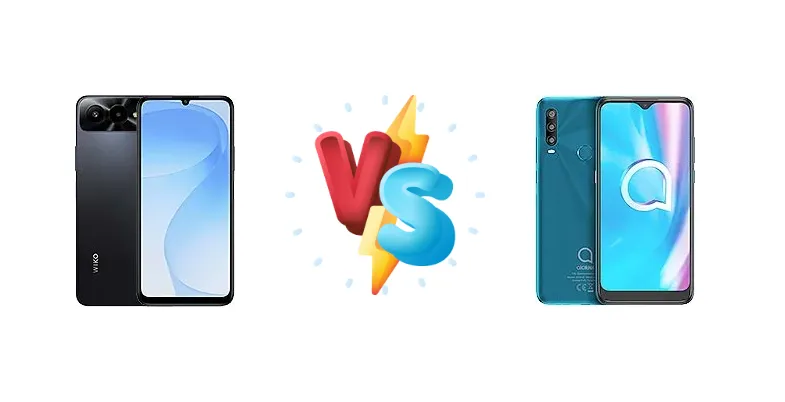
The Wiko T30 and Alcatel 1SE (2020) represent distinct approaches to the budget smartphone market. The Alcatel, released in 2020, offers a baseline experience at a very low price point. The Wiko T30, a more recent entrant, aims to deliver significantly improved performance with a modern chipset, but at a higher cost. This comparison dissects the key differences to determine which phone provides the best value for your money.
🏆 Quick Verdict
For most users, the Wiko T30 is the clear winner. Its Mediatek Dimensity 6300 chipset offers a substantial performance leap over the Alcatel 1SE’s Unisoc SC9863A, translating to smoother multitasking and a more responsive user experience. While the Alcatel 1SE remains a viable option for extremely budget-conscious buyers, the T30’s improved efficiency and capabilities justify the price premium.
| Network |
|---|
| 2G bands | GSM 850 / 900 / 1800 / 1900 | GSM 850 / 900 / 1800 / 1900 |
| 3G bands | HSDPA 850 / 900 / 1700(AWS) / 1900 / 2100 | HSDPA 850 / 900 / 1900 / 2100 |
| 4G bands | 1, 2, 3, 5, 7, 8, 20, 28, 38, 40, 41 | 1, 3, 7, 8, 20, 28 |
| 5G bands | 1, 3, 5, 7, 8, 20, 28, 38, 41, 77, 78 SA/NSA | - |
| Speed | HSPA, LTE, 5G | HSPA 21.1/5.76 Mbps, LTE Cat4 150/50 Mbps |
| Technology | GSM / CDMA / HSPA / LTE / 5G | GSM / HSPA / LTE |
| Launch |
|---|
| Announced | 2025, October 15 | 2020, October 28. Released 2020, October 28 |
| Status | Available. Released 2025, October | Discontinued |
| Body |
|---|
| Build | - | Glass front, plastic frame, plastic back |
| Dimensions | 168.8 x 78.1 x 8.5 mm (6.65 x 3.07 x 0.33 in) | 159.2 x 75.2 x 8.7 mm (6.27 x 2.96 x 0.34 in) |
| SIM | Nano-SIM + Nano-SIM | Nano-SIM + Nano-SIM |
| Weight | 199.6 g (7.05 oz) | 175 g (6.17 oz) |
| Display |
|---|
| Resolution | 720 x 1600 pixels, 20:9 ratio (~260 ppi density) | 720 x 1520 pixels, 19:9 ratio (~270 ppi density) |
| Size | 6.75 inches, 110.0 cm2 (~83.4% screen-to-body ratio) | 6.22 inches, 96.6 cm2 (~80.7% screen-to-body ratio) |
| Type | IPS LCD, 120Hz | IPS LCD |
| Platform |
|---|
| CPU | Octa-core (2x2.4 GHz Cortex-A76 & 6x2.0 GHz Cortex-A55) | Octa-core (4x1.6 GHz Cortex-A55 & 4x1.2 GHz Cortex-A55) |
| Chipset | Mediatek Dimensity 6300 (6 nm) | Unisoc SC9863A (28 nm) |
| GPU | Mali-G57 MC2 | IMG8322 |
| OS | Android 15 | Android 10 |
| Memory |
|---|
| Card slot | Unspecified | microSDXC (uses shared SIM slot) |
| Internal | 128GB 4GB RAM, 256GB 8GB RAM | 32GB 3GB RAM, 64GB 2GB RAM, 128GB 4GB RAM |
| | - | eMMC 5.1 |
| Main Camera |
|---|
| Features | LED flash | LED flash, HDR, panorama |
| Single | 50 MP | 8 MP, AF |
| Triple | - | 13 MP, f/2.2, (wide), 1/3.06", 1.12µm, AF
5 MP, f/2.2, (ultrawide), 1/5.0", 1.12µm
Auxiliary lens |
| Video | 1080p@30fps | 1080p@30fps |
| Selfie camera |
|---|
| Features | - | HDR |
| Single | 5 MP | 5 MP, f/2.2, (wide), 1/5.0", 1.12µm |
| Video | Yes | 1080p@30fps |
| Sound |
|---|
| 3.5mm jack | - | Yes |
| 35mm jack | Yes | Yes |
| Loudspeaker | Yes | Yes |
| Comms |
|---|
| Bluetooth | 5.2, A2DP, LE | 4.2, A2DP |
| NFC | No | No |
| Positioning | GPS, GLONASS, GALILEO | GPS |
| Radio | Unspecified | FM radio |
| USB | USB Type-C | microUSB 2.0 |
| WLAN | Wi-Fi 802.11 a/b/g/n/ac | Wi-Fi 802.11 b/g/n, Wi-Fi Direct |
| Features |
|---|
| Sensors | Fingerprint (side-mounted), accelerometer | Fingerprint (rear-mounted), accelerometer, proximity |
| Battery |
|---|
| Charging | 18W wired | - |
| Stand-by | - | Up to 161 h |
| Talk time | - | Up to 12 h 20 min (2G) / Up to 10 h (3G) |
| Type | 5000 mAh | Li-Po 4000 mAh |
| Misc |
|---|
| Colors | Black, White | Agate Greeen, Power Gray |
| Models | - | 5030F, 5030U, 5030D_EEA, 5030F_EEA, 5030D, 5030E, 5030A, 5030E_TCL, 5030I, 5030M |
| Price | - | About 150 EUR |
| SAR EU | - | 0.33 W/kg (head) 0.51 W/kg (body) |
Wiko T30
- Significantly faster processor for smoother performance
- More efficient chipset for better battery life
- Faster 18W charging for quicker top-ups
- Higher price point than the Alcatel 1SE
- Specific display specs are unknown
alcatel 1SE (2020)
- Extremely affordable price
- Functional for basic smartphone tasks
- Simple and straightforward user experience
- Outdated and slow processor
- Inefficient chipset leading to shorter battery life
- Likely lower-quality camera and display
Display Comparison
Neither device’s display specifications are provided, so a direct comparison is limited. However, given the Alcatel 1SE’s 2020 release date, it likely features an older LCD panel with lower brightness and color accuracy compared to what Wiko would typically implement in a newer device like the T30. The T30, benefiting from more recent display technology, likely offers a more vibrant and visually appealing experience, even if it doesn't boast high-end features like a high refresh rate.
Camera Comparison
Without detailed camera specifications, a precise comparison is difficult. However, the age of the Alcatel 1SE suggests it likely features older, lower-resolution sensors. The Wiko T30, being a newer device, likely benefits from improved image processing algorithms and potentially larger sensors, resulting in better image quality, especially in low-light conditions. It’s reasonable to assume the T30 will offer a more versatile and capable camera system, even if it doesn’t feature flagship-level specifications.
Performance
The performance gap between these two devices is substantial. The Wiko T30’s Mediatek Dimensity 6300, built on a 6nm process, is significantly more efficient and powerful than the Alcatel 1SE’s Unisoc SC9863A, fabricated on a dated 28nm node. The Dimensity 6300’s octa-core configuration (2x2.4 GHz Cortex-A76 & 6x2.0 GHz Cortex-A55) provides a much stronger CPU performance profile than the Alcatel’s (4x1.6 GHz Cortex-A55 & 4x1.2 GHz Cortex-A55). This translates to faster app loading times, smoother multitasking, and a more responsive overall experience on the Wiko T30. The 6nm process also means the Dimensity 6300 will generate less heat under load, reducing the likelihood of performance throttling.
Battery Life
Battery capacity isn’t specified for either device. However, the Wiko T30’s 18W wired charging is a significant advantage over what the Alcatel 1SE likely offers. The Dimensity 6300’s 6nm process also contributes to better power efficiency, meaning the T30 will likely achieve comparable or better battery life despite potentially having a similar capacity battery. The faster charging speed will also reduce downtime, allowing users to quickly top up their device when needed.
Buying Guide
Buy the Wiko T30 if you need a phone capable of handling modern apps, light gaming, and multitasking without significant lag. Its more powerful processor and efficient design will provide a noticeably better user experience. Buy the Alcatel 1SE (2020) if you prioritize absolute affordability and only require basic smartphone functionality – calls, texts, and very light web browsing. It’s a functional device for those on the tightest of budgets.
Frequently Asked Questions
❓ How much of a performance difference will I actually see between the Dimensity 6300 and the Unisoc SC9863A in everyday use?
The difference is substantial. The Dimensity 6300’s newer architecture and 6nm process will result in significantly faster app loading times, smoother scrolling, and a more responsive user interface. The Alcatel 1SE’s Unisoc chip will struggle with multitasking and demanding apps, leading to noticeable lag and slowdowns.
❓ Is the 18W charging on the Wiko T30 a significant improvement over what the Alcatel 1SE offers?
Yes, it is. The Alcatel 1SE likely supports a much slower charging speed (likely 5W or 10W). 18W charging will significantly reduce the time it takes to fully charge the Wiko T30, providing a more convenient user experience.
❓ If I only use my phone for calls, texts, and occasional web browsing, is the Wiko T30 worth the extra cost?
Probably not. If your usage is extremely limited, the Alcatel 1SE will suffice. However, even for basic tasks, the Wiko T30 will provide a smoother and more enjoyable experience, and its future-proofing is a benefit.