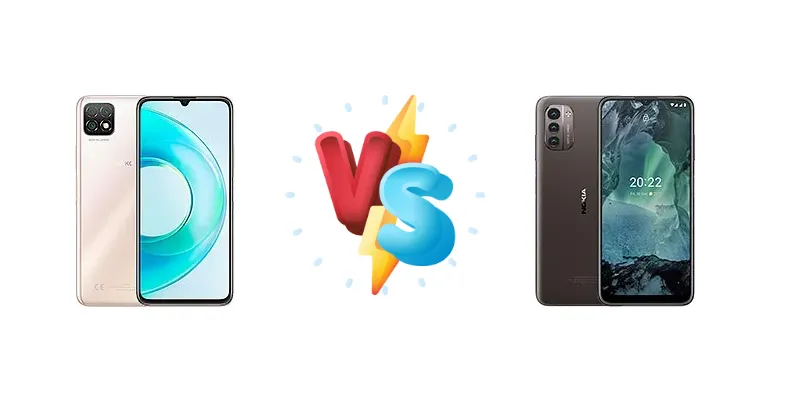
The Wiko T3 and Nokia G21 represent compelling options in the ultra-budget smartphone segment. Both aim to deliver essential functionality at a low price point, but they take different approaches to achieving this. The Wiko T3 relies on the older Mediatek Helio P35, while the Nokia G21 opts for the Unisoc T606. This comparison will dissect their key differences to determine which device offers the best value.
🏆 Quick Verdict
For most users, the Nokia G21 emerges as the better choice. While both phones target the budget market, the Unisoc T606 chipset provides a noticeable performance uplift over the Helio P35, and the inclusion of 18W PD3.0 charging is a significant advantage, despite the identical endurance rating.
| Network |
|---|
| 2G bands | GSM 850 / 900 / 1800 / 1900 | GSM 850 / 900 / 1800 / 1900 |
| 3G bands | HSDPA 850 / 900 / 1700(AWS) / 1900 / 2100 | HSDPA 850 / 900 / 2100 - International |
| 4G bands | 1, 2, 3, 4, 5, 7, 8, 20, 26, 28, 38, 40, 41, 66 | 1, 3, 5, 7, 8, 20, 28, 38, 40, 41 - International |
| Speed | HSPA, LTE | HSPA 42.2/5.76 Mbps, LTE Cat4 150/50 Mbps |
| Technology | GSM / HSPA / LTE | GSM / HSPA / LTE |
| | - | 1, 2, 3, 4, 5, 7, 8, 12, 17, 28, 40, 66 - LATAM |
| Launch |
|---|
| Announced | 2021, December | 2022, February 14 |
| Status | Available. Released 2021, December | Available. Released 2022, February 15 |
| Body |
|---|
| Build | - | Glass front, plastic frame, plastic back |
| Dimensions | 165.3 x 76 x 9.2 mm (6.51 x 2.99 x 0.36 in) | 164.6 x 75.9 x 8.5 mm (6.48 x 2.99 x 0.33 in) |
| SIM | · Nano-SIM· Nano-SIM + Nano-SIM | · Nano-SIM· Nano-SIM + Nano-SIM |
| Weight | 188 g (6.63 oz) | 190 g (6.70 oz) |
| Display |
|---|
| Resolution | 720 x 1600 pixels, 20:9 ratio (~266 ppi density) | 720 x 1600 pixels, 20:9 ratio (~270 ppi density) |
| Size | 6.6 inches, 105.2 cm2 (~83.7% screen-to-body ratio) | 6.5 inches, 102.0 cm2 (~81.6% screen-to-body ratio) |
| Type | IPS LCD | IPS LCD, 90Hz, 400 nits (typ) |
| Platform |
|---|
| CPU | Octa-core (4x2.3 GHz Cortex-A53 & 4x1.8 GHz Cortex-A53) | Octa-core (2x1.6 GHz Cortex-A75 & 6x1.6 GHz Cortex-A55) |
| Chipset | Mediatek MT6765 Helio P35 (12 nm) | Unisoc T606 (12 nm) |
| GPU | PowerVR GE8320 | Mali-G57 MP1 |
| OS | Android 11 | Android 11, upgradable to Android 13 |
| Memory |
|---|
| Card slot | microSDXC | microSDXC (dedicated slot) |
| Internal | 128GB 4GB RAM | 64GB 3GB RAM, 64GB 4GB RAM, 128GB 4GB RAM, 128GB 6GB RAM |
| | - | eMMC 5.1 |
| Main Camera |
|---|
| Features | LED flash, HDR, panorama | LED flash, HDR, panorama |
| Single | 8 MP | 8 MP, f/2.0, (wide) |
| Triple | 48 MP, AF
5 MP
2 MP | 50 MP, f/1.8, 28mm (wide), 1/2.76", 0.64µm, PDAF
2 MP (macro)
Auxiliary lens |
| Video | 1080p@30fps | 1080p@30fps |
| Selfie camera |
|---|
| Single | 8 MP | 8 MP, f/2.0, (wide) |
| Video | - | 1080p@30fps |
| Sound |
|---|
| 3.5mm jack | Yes | Yes |
| 35mm jack | Yes | Yes |
| Loudspeaker | Yes | Yes |
| Comms |
|---|
| Bluetooth | 5.0, A2DP, LE | 5.0, A2DP, LE |
| NFC | No | Yes (market/region dependent) |
| Positioning | GPS, GLONASS, GALILEO, BDS | GPS, GLONASS, GALILEO |
| Radio | FM radio | FM radio, RDS |
| USB | Yes | USB Type-C 2.0, OTG |
| WLAN | Wi-Fi 802.11 b/g/n | Wi-Fi 802.11 a/b/g/n/ac, dual-band, Wi-Fi Direct |
| Features |
|---|
| Sensors | Fingerprint (side-mounted), accelerometer, proximity | Fingerprint (side-mounted), accelerometer, proximity |
| Battery |
|---|
| Charging | - | 18W wired, PD3.0 |
| Type | Li-Ion 5000 mAh | Li-Po 5050 mAh |
| Misc |
|---|
| Colors | Black, Gold | Nordic Blue, Dusk |
| Models | - | TA-1418, TA-1477, TA-1415, TA-1405, TA-1404, TA-1412 |
| Price | - | About 90 EUR |
| SAR | - | 1.00 W/kg (head) 1.10 W/kg (body) |
| SAR EU | - | 0.34 W/kg (head) 1.05 W/kg (body) |
| Tests |
|---|
| Battery life | - |
Endurance rating 126h
|
| Camera | - |
Photo / Video |
| Display | - |
Contrast ratio: 1631:1 (nominal) |
| Loudspeaker | - |
-30.7 LUFS (Below average)
|
| Performance | - |
AnTuTu: 171299 (v9)
GeekBench: 1193 (v5.1)
GFXBench: 8.9fps (ES 3.1 onscreen) |
Wiko T3
- Potentially lower price point
- Simple and straightforward user experience
- Acceptable for basic tasks
- Outdated Mediatek Helio P35 chipset
- Likely slower charging speeds
- Inferior performance for multitasking
Nokia G21
- More powerful Unisoc T606 chipset
- Faster 18W PD3.0 charging
- Brighter display for outdoor use
- Slightly higher price
- Camera performance likely similar to Wiko T3
- May not be significantly better for extremely light usage
Display Comparison
Both the Wiko T3 and Nokia G21 feature displays with a 1631:1 contrast ratio, suggesting similar visual characteristics in terms of black levels and color depth. However, the Nokia G21 boasts a measured peak brightness of 500 nits, a crucial advantage for outdoor visibility. While the contrast ratio is nominally the same, real-world viewing experience will likely favor the Nokia G21 in brighter environments. Details regarding panel technology (IPS, TFT) and resolution are missing, but given the price point, both are likely utilizing standard IPS LCD panels.
Camera Comparison
Both devices are listed as having 'Photo / Video' capabilities, offering minimal insight. Without specific sensor details (megapixel count, sensor size, aperture), a direct comparison is difficult. It’s safe to assume both phones feature basic camera systems geared towards casual photography. The absence of any mention of Optical Image Stabilization (OIS) suggests neither phone will excel in low-light conditions. Focusing on the chipset, the Unisoc T606’s image signal processor (ISP) is likely more capable than the Helio P35’s, potentially leading to slightly better image processing and noise reduction.
Performance
The core difference lies in the chipsets. The Wiko T3’s Mediatek Helio P35 utilizes a big.LITTLE architecture with four Cortex-A53 cores clocked at 2.3 GHz and another four at 1.8 GHz. The Nokia G21’s Unisoc T606 employs a more modern configuration: two Cortex-A75 cores at 1.6 GHz and six Cortex-A55 cores, also at 1.6 GHz. The Cortex-A75 cores in the T606 represent a significant architectural improvement over the A53, offering better single-core performance and responsiveness. This translates to snappier app launches and smoother multitasking. While both are 12nm chips, the Unisoc T606’s architecture provides a clear performance edge.
Battery Life
Both the Wiko T3 and Nokia G21 achieve an endurance rating of 126 hours, indicating comparable battery life under similar usage conditions. However, the Nokia G21 includes 18W wired charging with PD3.0 support, a substantial advantage over the Wiko T3’s likely slower charging speed (specifications are missing). This means the Nokia G21 can replenish its battery significantly faster, reducing downtime. While the overall battery capacity isn’t specified, the faster charging capability makes the Nokia G21 more convenient for users who frequently need to top up their battery.
Buying Guide
Buy the Wiko T3 if your primary need is a basic, functional smartphone for essential tasks like calls, texts, and light social media use, and you prioritize minimizing upfront cost. Buy the Nokia G21 if you value a smoother user experience, slightly better performance for multitasking and light gaming, and the convenience of faster charging, even if it means a slightly higher initial investment.
Frequently Asked Questions
❓ Will the Unisoc T606 in the Nokia G21 handle popular games like PUBG Mobile?
The Unisoc T606 can run PUBG Mobile, but expect to play at lower graphics settings (balanced or low) to maintain a stable frame rate. It's not a gaming powerhouse, but it offers a playable experience for casual gamers, a significant improvement over the Helio P35.
❓ Is the lack of specific camera details a concern for either phone?
Yes, the absence of sensor size and aperture information suggests both phones have basic camera systems. Don't expect flagship-level image quality. They'll be adequate for casual snapshots in good lighting conditions, but struggle in low light.
❓ How long will it take to fully charge the Nokia G21 with the 18W charger?
While a precise time isn't available, with 18W PD3.0 charging, the Nokia G21 should fully charge in approximately 2-3 hours, depending on battery capacity. This is considerably faster than the Wiko T3, which likely charges at a slower rate.