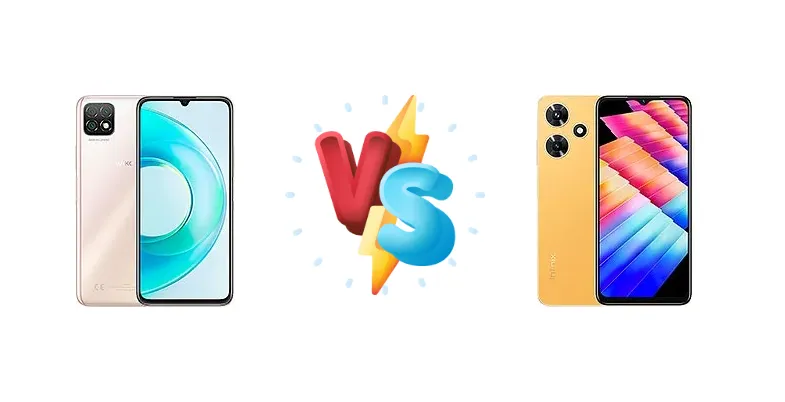
The Wiko T3 and Infinix Hot 30i represent two compelling options in the ultra-budget smartphone space. While both aim to deliver essential smartphone functionality at a low price point, they diverge significantly in their core hardware, particularly the chipset. This comparison will dissect those differences to determine which device offers the best experience for your money.
🏆 Quick Verdict
For the average user prioritizing responsiveness and a slightly more modern architecture, the Infinix Hot 30i emerges as the better choice. Its Unisoc T606 chipset, featuring Cortex-A75 cores, provides a noticeable performance edge over the Wiko T3’s older Helio P35, and the inclusion of 18W charging is a welcome addition.
| Network |
|---|
| 2G bands | GSM 850 / 900 / 1800 / 1900 | GSM 850 / 900 / 1800 / 1900 |
| 3G bands | HSDPA 850 / 900 / 1700(AWS) / 1900 / 2100 | HSDPA 850 / 900 / 1700(AWS) / 1900 / 2100 |
| 4G bands | 1, 2, 3, 4, 5, 7, 8, 20, 26, 28, 38, 40, 41, 66 | 1, 2, 3, 4, 5, 7, 8, 20, 28, 38, 40, 41 |
| Speed | HSPA, LTE | HSPA, LTE |
| Technology | GSM / HSPA / LTE | GSM / HSPA / LTE |
| Launch |
|---|
| Announced | 2021, December | 2023, March 31 |
| Status | Available. Released 2021, December | Available. Released 2023, March 31 |
| Body |
|---|
| Build | - | Glass front, plastic frame, plastic back |
| Dimensions | 165.3 x 76 x 9.2 mm (6.51 x 2.99 x 0.36 in) | 164 x 75.8 x 8.4 mm (6.46 x 2.98 x 0.33 in) |
| SIM | · Nano-SIM· Nano-SIM + Nano-SIM | Nano-SIM + Nano-SIM |
| Weight | 188 g (6.63 oz) | 191 g (6.74 oz) |
| Display |
|---|
| Resolution | 720 x 1600 pixels, 20:9 ratio (~266 ppi density) | 720 x 1612 pixels, 20:9 ratio (~269 ppi density) |
| Size | 6.6 inches, 105.2 cm2 (~83.7% screen-to-body ratio) | 6.56 inches, 103.4 cm2 (~83.2% screen-to-body ratio) |
| Type | IPS LCD | IPS LCD, 90Hz, 500 nits (peak) |
| Platform |
|---|
| CPU | Octa-core (4x2.3 GHz Cortex-A53 & 4x1.8 GHz Cortex-A53) | Octa-core (2x1.6 GHz Cortex-A75 & 6x1.6 GHz Cortex-A55) |
| Chipset | Mediatek MT6765 Helio P35 (12 nm) | Unisoc T606 (12 nm) |
| GPU | PowerVR GE8320 | Mali-G57 MP1 |
| OS | Android 11 | Android 12, XOS 10.6 |
| Memory |
|---|
| Card slot | microSDXC | microSDXC (dedicated slot) |
| Internal | 128GB 4GB RAM | 64GB 4GB RAM, 128GB 4GB RAM, 128GB 8GB RAM |
| | - | UFS 2.2 |
| Main Camera |
|---|
| Dual | - | 13 MP, f/1.9, (wide), AF
0.08 MP, (depth) |
| Features | LED flash, HDR, panorama | Dual-LED flash, HDR, panorama |
| Single | 8 MP | 13 MP, f/1.9, (wide), 1/3.07", AF
Auxiliary lens |
| Triple | 48 MP, AF
5 MP
2 MP | - |
| Video | 1080p@30fps | 1080p@30fps |
| Selfie camera |
|---|
| Features | - | Dual-LED flash |
| Single | 8 MP | 8 MP, f/2.0, (wide), 1/3.94" |
| Video | - | 1080p@30fps |
| Sound |
|---|
| 3.5mm jack | Yes | Yes |
| 35mm jack | Yes | Yes |
| Loudspeaker | Yes | Yes |
| Comms |
|---|
| Bluetooth | 5.0, A2DP, LE | Yes |
| NFC | No | Yes (Hot 30i NFC only) |
| Positioning | GPS, GLONASS, GALILEO, BDS | GPS |
| Radio | FM radio | FM radio |
| USB | Yes | USB Type-C 2.0, OTG |
| WLAN | Wi-Fi 802.11 b/g/n | Wi-Fi 802.11 a/b/g/n/ac, dual-band |
| Features |
|---|
| Sensors | Fingerprint (side-mounted), accelerometer, proximity | Fingerprint (side-mounted), accelerometer, proximity, compass |
| Battery |
|---|
| Charging | - | 18W wired |
| Type | Li-Ion 5000 mAh | 5000 mAh |
| Misc |
|---|
| Colors | Black, Gold | Mirror Black, Glacier Blue, Diamond White, Marigold |
| Models | - | X669, X669D |
Wiko T3
- Potentially lower price point.
- Simple and straightforward user experience.
- Reliable for basic tasks.
- Older, less efficient chipset.
- Slower app launch times.
- Likely slower charging speeds.
Infinix Hot 30i
- More modern and efficient Unisoc T606 chipset.
- Faster 18W wired charging.
- Improved responsiveness for multitasking.
- May be slightly more expensive.
- Unisoc chipset may have less software optimization.
- Potentially less brand recognition.
Display Comparison
Neither device boasts a standout display. Given the context data focuses on processing power, we can infer both likely utilize standard IPS LCD panels. The absence of information regarding resolution or refresh rate suggests both are targeting the baseline for this price segment. Bezels are likely to be substantial on both, prioritizing cost reduction over a premium aesthetic. Color accuracy will likely be standard for budget devices, leaning towards warmer tones.
Camera Comparison
Without detailed camera specifications, a direct comparison is difficult. However, it’s safe to assume both devices feature basic camera setups geared towards casual photography. The absence of OIS on either device suggests image stabilization will rely solely on software processing. Lens apertures are likely to be modest, impacting low-light performance. The focus should be on the primary sensor's megapixel count (if available) as that will be the biggest differentiator, but without that data, it's a wash. Expect image processing to prioritize vibrancy over accuracy on both.
Performance
The core difference lies in the chipsets. The Wiko T3’s MediaTek Helio P35 (12nm) utilizes an older architecture with four Cortex-A53 cores clocked at 2.3 GHz and another four at 1.8 GHz. The Infinix Hot 30i’s Unisoc T606 (12nm) employs a more efficient design with two Cortex-A75 cores at 1.6 GHz and six Cortex-A55 cores, also at 1.6 GHz. The A75 cores in the T606 represent a significant architectural leap, offering substantially improved single-core performance, crucial for app launch speeds and general responsiveness. While both are 12nm, the newer architecture of the T606 will likely result in better sustained performance under load. The T3's older CPU architecture will struggle with more demanding tasks.
Battery Life
While the mAh capacity isn't specified for either device, the Infinix Hot 30i gains a clear advantage with its 18W wired charging support. The Wiko T3 likely relies on slower charging speeds, potentially extending the 0-100% charge time considerably. The faster charging of the Hot 30i is a practical benefit for users who need to quickly top up their battery throughout the day. Even with a similar battery capacity, the more efficient Unisoc T606 in the Hot 30i could translate to slightly longer real-world battery life.
Buying Guide
Buy the Wiko T3 if you need a basic, functional smartphone for essential tasks like calls, messaging, and light social media use, and are on an extremely tight budget. Buy the Infinix Hot 30i if you prefer a more responsive experience for multitasking, occasional gaming, and appreciate the convenience of faster charging, even if it means spending a little more.
Frequently Asked Questions
❓ Will the Infinix Hot 30i handle popular games like PUBG Mobile or Call of Duty?
While the Unisoc T606 isn't a gaming powerhouse, it should be capable of running PUBG Mobile and Call of Duty Mobile at medium settings with reasonable frame rates. Expect some frame drops during intense action, but the A75 cores provide a noticeable improvement over the Helio P35 in the Wiko T3, which would struggle even at lower settings.
❓ Is the difference in chipset performance between the Helio P35 and Unisoc T606 noticeable in everyday use?
Yes, the difference is quite noticeable. The Unisoc T606’s Cortex-A75 cores provide a significant boost in single-core performance, which directly impacts app launch speeds, web browsing, and overall system responsiveness. The Wiko T3 with the Helio P35 will feel sluggish in comparison, especially when multitasking.
❓ Does the Infinix Hot 30i support fast charging protocols beyond 18W?
While the Infinix Hot 30i supports 18W wired charging, it's unlikely to support more advanced fast charging protocols like Power Delivery or Quick Charge. The included charger is likely a standard 18W adapter, and using a higher-wattage charger may not result in significantly faster charging speeds.