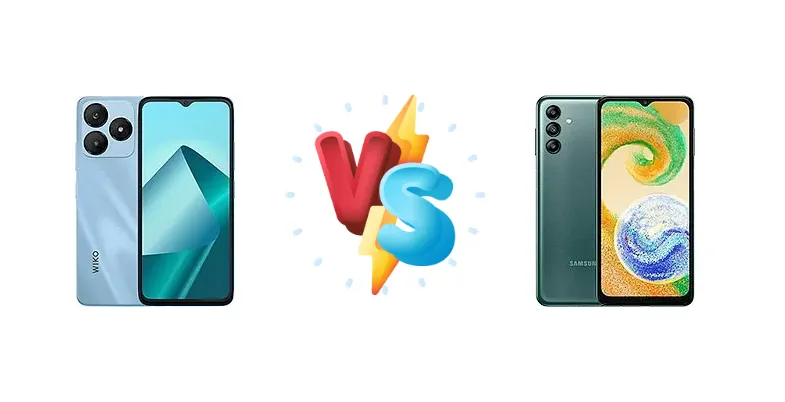
The sub-$150 smartphone market is fiercely competitive. Both the Samsung Galaxy A04s and the Wiko T20 aim to deliver essential smartphone functionality at an accessible price. However, they take different approaches to achieving this, with Samsung leveraging its brand recognition and the Exynos 850 chipset, while Wiko opts for a Unisoc processor and a focus on simplicity. This comparison dives deep into the specifications to determine which device offers the best value.
🏆 Quick Verdict
For most users, the Samsung Galaxy A04s is the better choice. Its Exynos 850 chipset provides a noticeable performance advantage over the Wiko T20’s Unisoc SC9863A1, and the 15W charging is a welcome improvement over the Wiko’s 10W. While both offer similar battery endurance, the A04s’ brighter display and established software support make it a more compelling overall package.
| Network |
|---|
| 2G bands | GSM 850 / 900 / 1800 / 1900 | GSM 850 / 900 / 1800 / 1900 |
| 3G bands | HSDPA 850 / 900 / 1900 / 2100 | HSDPA 850 / 900 / 2100 |
| 4G bands | 1, 3, 5, 7, 8, 20, 28, 38, 40, 41 | 1, 3, 5, 7, 8, 20, 28, 38, 40, 41 |
| Speed | HSPA, LTE | HSPA, LTE |
| Technology | GSM / HSPA / LTE | GSM / HSPA / LTE |
| Launch |
|---|
| Announced | 2024, May | 2022, August 31 |
| Status | Available. Released 2024, May | Available. Released 2022, September 22 |
| Body |
|---|
| Build | - | Glass front, plastic back, plastic frame |
| Dimensions | 164.5 x 75.9 x 8.9 mm (6.48 x 2.99 x 0.35 in) | 164.7 x 76.7 x 9.1 mm (6.48 x 3.02 x 0.36 in) |
| SIM | Nano-SIM + Nano-SIM | Nano-SIM + Nano-SIM |
| Weight | 186 g (6.56 oz) | 195 g (6.88 oz) |
| Display |
|---|
| Protection | Corning Gorilla Glass | - |
| Resolution | 720 x 1612 pixels, 20:9 ratio (~269 ppi density) | 720 x 1600 pixels, 20:9 ratio (~270 ppi density) |
| Size | 6.56 inches, 103.4 cm2 (~82.8% screen-to-body ratio) | 6.5 inches, 102.0 cm2 (~80.7% screen-to-body ratio) |
| Type | IPS LCD | PLS LCD, 90Hz, 400 nits (peak) |
| Platform |
|---|
| CPU | Octa-core (4x1.6 GHz Cortex-A55 & 4x1.2 GHz Cortex-A55) | Octa-core (4x2.0 GHz Cortex-A55 & 4x2.0 GHz Cortex-A55) |
| Chipset | Unisoc SC9863A1 (22 nm) | Exynos 850 (8 nm) |
| GPU | IMG8322 | Mali-G52 |
| OS | Android 13 | Android 12, upgradable to Android 14, One UI 6.1 |
| Memory |
|---|
| Card slot | microSDXC | microSDXC (dedicated slot) |
| Internal | 64GB 4GB RAM, 128GB 4GB RAM | 32GB 3GB RAM, 32GB 4GB RAM, 64GB 3GB RAM, 64GB 4GB RAM, 128GB 3GB RAM, 128GB 4GB RAM |
| | - | eMMC 5.1 |
| Main Camera |
|---|
| Features | LED flash | LED flash, panorama, HDR |
| Single | 8 MP, f/2.0, (wide), 1/4.0", 1.12µm, AF
Auxiliary lens | - |
| Triple | - | 50 MP, f/1.8, 26mm (wide), 1/2.76", 0.64µm, PDAF
2 MP (macro)
Auxiliary lens |
| Video | 1080p@30fps | 1080p@30fps |
| Selfie camera |
|---|
| Single | 5 MP, f/2.0, (wide), 1/5.0", 1.12µm | 5 MP, f/2.2, (wide) |
| Video | Yes | 720p@30fps |
| Sound |
|---|
| 3.5mm jack | - | Yes |
| 35mm jack | Yes | Yes |
| Loudspeaker | Yes | Yes |
| Comms |
|---|
| Bluetooth | 4.2, A2DP | 5.0, A2DP, LE |
| NFC | No | Yes (market/region dependent) |
| Positioning | GPS, GLONASS, GALILEO, BDS | GPS, GLONASS, BDS, GALILEO, QZSS |
| Radio | Unspecified | No |
| USB | USB Type-C, OTG | USB Type-C 2.0 |
| WLAN | Wi-Fi 802.11 b/g/n | Wi-Fi 802.11 a/b/g/n/ac, dual-band, Wi-Fi Direct |
| Features |
|---|
| Sensors | Fingerprint (side-mounted), accelerometer | Fingerprint (side-mounted), accelerometer |
| | - | Virtual Proximity Sensing |
| Battery |
|---|
| Charging | 10W wired | 15W wired |
| Type | Li-Po 5000 mAh | Li-Po 5000 mAh |
| Misc |
|---|
| Colors | Black, Green, Blue | Black, Green, White, Copper |
| Models | - | SM-A047F, SM-A047F/DS, SM-A047F/DSN, SM-A047M |
| Price | About 120 EUR | € 133.89 |
| SAR EU | - | 0.52 W/kg (head) 1.23 W/kg (body) |
| Tests |
|---|
| Battery life | - |
Endurance rating 114h
|
| Camera | - |
Photo / Video |
| Display | - |
Contrast ratio: 1614:1 |
| Loudspeaker | - |
-30.3 LUFS (Below average)
|
| Performance | - |
AnTuTu: 145123(v9)
GeekBench: 1100 (v5.1)
GFXBench: 11fps (ES 3.1 onscreen) |
Wiko T20
- Faster processor (Exynos 850)
- Brighter display (389 nits)
- Faster charging (15W)
- Established brand and software support
- Potentially higher price
- Plastic build quality
Samsung Galaxy A04s
- Lower price point
- Simple and uncluttered software
- Decent battery endurance
- Lightweight design
- Significantly slower processor (Unisoc SC9863A1)
- Slower charging (10W)
- Less refined camera experience
Display Comparison
The Samsung Galaxy A04s boasts a brighter display, measured at 389 nits, compared to the Wiko T20 (brightness unspecified). Both share a 1614:1 contrast ratio, suggesting similar color reproduction capabilities. However, the higher peak brightness of the A04s will translate to better visibility outdoors and a more engaging viewing experience. While neither phone is expected to feature high refresh rates or advanced panel technologies like LTPO, the A04s’ superior brightness is a clear advantage.
Camera Comparison
Both devices offer 'Photo / Video' capabilities, but detailed camera specifications are limited. Without sensor size or aperture information, it’s difficult to make a definitive judgment. However, Samsung’s image processing algorithms are generally more refined, potentially leading to better image quality in various lighting conditions. The presence of a dedicated night mode on the A04s (likely) would further enhance its low-light performance. The Wiko T20’s camera is likely to be more basic, suitable for casual snapshots.
Performance
The core difference lies in the chipsets. The Samsung Galaxy A04s utilizes the Exynos 850, fabricated on an 8nm process, while the Wiko T20 is powered by the Unisoc SC9863A1, built on a less efficient 22nm node. The Exynos 850’s octa-core configuration (4x2.0 GHz Cortex-A55 & 4x2.0 GHz Cortex-A55) significantly outperforms the Wiko’s (4x1.6 GHz Cortex-A55 & 4x1.2 GHz Cortex-A55). This translates to faster app loading times, smoother multitasking, and a more responsive user experience on the A04s. The 8nm process also contributes to better thermal management, reducing the likelihood of performance throttling under sustained load.
Battery Life
Both the Wiko T20 and Samsung Galaxy A04s achieve an endurance rating of 114 hours, indicating comparable battery life under typical usage. However, the A04s supports 15W wired charging, while the Wiko T20 is limited to 10W. This means the A04s will recharge significantly faster, reducing downtime. While battery capacity isn’t specified for either device, the faster charging speed of the A04s provides a practical advantage for users who frequently need to top up their battery.
Buying Guide
Buy the Wiko T20 if you prioritize extreme simplicity and a minimal software experience, and are comfortable with a significantly less powerful processor. It’s a viable option for basic communication and light tasks. Buy the Samsung Galaxy A04s if you need a phone capable of handling more demanding apps, enjoy a brighter and more vibrant display, and value the reliability and software updates associated with the Samsung brand.
Frequently Asked Questions
❓ Does the Exynos 850 in the Samsung A04s get hot during prolonged gaming sessions?
The Exynos 850 is an 8nm chip, which generally manages heat efficiently. While it won't deliver flagship-level gaming performance, it should handle moderate gaming sessions without significant overheating or throttling. Expect playable frame rates in popular titles like PUBG Mobile at medium settings.
❓ Is the 2MP macro camera on either phone actually useful for taking detailed close-up photos?
Generally, 2MP macro cameras on budget phones are limited in their usefulness. The low resolution results in images lacking detail and sharpness. They can be fun for experimentation, but don't expect professional-quality macro photography.
❓ How long does it realistically take to fully charge the Samsung Galaxy A04s from 0%?
With 15W charging, the Samsung Galaxy A04s should fully charge in approximately 2.5 to 3 hours, depending on usage during charging. This is significantly faster than the Wiko T20's 10W charging, which could take upwards of 4 hours.
❓ What kind of software updates can I expect on the Wiko T20?
Wiko typically provides limited software updates for its budget devices. Expect potentially one major Android version update, and infrequent security patches. Samsung, on the other hand, offers more consistent and long-term software support for the A04s.