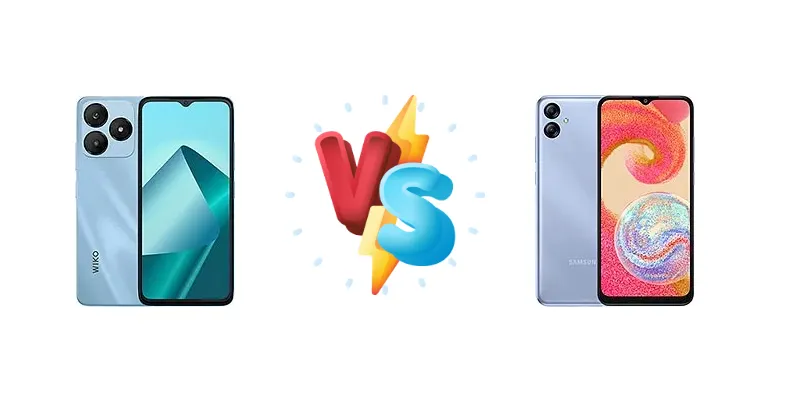
The Wiko T20 and Samsung Galaxy A04e represent the extreme end of the smartphone price spectrum. Both aim to deliver essential functionality at a minimal cost, but they achieve this through different hardware choices. This comparison dissects those choices, revealing which device offers the best experience for the money.
🏆 Quick Verdict
For the average user prioritizing efficiency and a slightly smoother experience, the Samsung Galaxy A04e is the better choice. Its 12nm Helio P35 chipset offers a performance-per-watt advantage over the Wiko T20’s 22nm Unisoc SC9863A1, translating to better sustained performance and potentially longer battery life.
| Network |
|---|
| 2G bands | GSM 850 / 900 / 1800 / 1900 | GSM 850 / 900 / 1800 / 1900 |
| 3G bands | HSDPA 850 / 900 / 1900 / 2100 | HSDPA 850 / 900 / 2100 |
| 4G bands | 1, 3, 5, 7, 8, 20, 28, 38, 40, 41 | 1, 3, 5, 7, 8, 20, 28, 38, 40, 41 |
| Speed | HSPA, LTE | HSPA, LTE |
| Technology | GSM / HSPA / LTE | GSM / HSPA / LTE |
| Launch |
|---|
| Announced | 2024, May | 2022, October 21 |
| Status | Available. Released 2024, May | Available. Released 2022, November 07 |
| Body |
|---|
| Build | - | Glass front, plastic back, plastic frame |
| Dimensions | 164.5 x 75.9 x 8.9 mm (6.48 x 2.99 x 0.35 in) | 164.2 x 75.9 x 9.1 mm (6.46 x 2.99 x 0.36 in) |
| SIM | Nano-SIM + Nano-SIM | · Nano-SIM· Nano-SIM + Nano-SIM |
| Weight | 186 g (6.56 oz) | 188 g (6.63 oz) |
| Display |
|---|
| Protection | Corning Gorilla Glass | - |
| Resolution | 720 x 1612 pixels, 20:9 ratio (~269 ppi density) | 720 x 1600 pixels, 20:9 ratio (~270 ppi density) |
| Size | 6.56 inches, 103.4 cm2 (~82.8% screen-to-body ratio) | 6.5 inches, 102.0 cm2 (~81.8% screen-to-body ratio) |
| Type | IPS LCD | PLS LCD |
| Platform |
|---|
| CPU | Octa-core (4x1.6 GHz Cortex-A55 & 4x1.2 GHz Cortex-A55) | Octa-core (4x2.3 GHz Cortex-A53 & 4x1.8 GHz Cortex-A53) |
| Chipset | Unisoc SC9863A1 (22 nm) | Mediatek MT6765 Helio P35 (12 nm) |
| GPU | IMG8322 | PowerVR GE8320 |
| OS | Android 13 | Android 12, One UI Core 4.1 |
| Memory |
|---|
| Card slot | microSDXC | microSDXC (dedicated slot) |
| Internal | 64GB 4GB RAM, 128GB 4GB RAM | 32GB 2GB RAM, 32GB 3GB RAM, 32GB 4GB RAM, 64GB 2GB RAM, 64GB 3GB RAM, 64GB 4GB RAM, 128GB 4GB RAM |
| Main Camera |
|---|
| Dual | - | 13 MP, f/2.2, (wide), AF
Auxiliary lens |
| Features | LED flash | LED flash |
| Single | 8 MP, f/2.0, (wide), 1/4.0", 1.12µm, AF
Auxiliary lens | 5 MP, f/2.2 |
| Video | 1080p@30fps | 1080p@30fps |
| Selfie camera |
|---|
| Single | 5 MP, f/2.0, (wide), 1/5.0", 1.12µm | 5 MP, f/2.2 |
| Video | Yes | Yes |
| Sound |
|---|
| 3.5mm jack | - | Yes |
| 35mm jack | Yes | Yes |
| Loudspeaker | Yes | Yes |
| Comms |
|---|
| Bluetooth | 4.2, A2DP | 5.0, A2DP, LE |
| NFC | No | No |
| Positioning | GPS, GLONASS, GALILEO, BDS | GPS, GLONASS, GALILEO, BDS |
| Radio | Unspecified | Unspecified |
| USB | USB Type-C, OTG | USB Type-C 2.0, OTG |
| WLAN | Wi-Fi 802.11 b/g/n | Wi-Fi 802.11 b/g/n, Wi-Fi Direct |
| Features |
|---|
| Sensors | Fingerprint (side-mounted), accelerometer | Accelerometer, proximity |
| Battery |
|---|
| Charging | 10W wired | - |
| Type | Li-Po 5000 mAh | Li-Po 5000 mAh |
| Misc |
|---|
| Colors | Black, Green, Blue | Black, Copper, Light Blue |
| Models | - | SM-A042F, SM-A042F/DS, SM-A042M, SM-A042M/DS |
| Price | About 120 EUR | ₹ 7,999 |
| SAR EU | - | 0.29 W/kg (head) 1.11 W/kg (body) |
Wiko T20
- Potentially larger display for media consumption
- Lower price point (potentially)
- Simple and straightforward Android experience
- Less efficient Unisoc chipset
- Likely more performance throttling
- Potentially shorter battery life
Samsung Galaxy A04e
- More efficient MediaTek Helio P35 chipset
- Faster app loading and multitasking
- Better sustained performance
- Samsung’s refined software experience
- Smaller display size
- Potentially higher price
- Basic camera system
Display Comparison
Neither device boasts a standout display. Both likely utilize LCD panels, a common cost-saving measure in this segment. While specific resolution and brightness data are unavailable, the Wiko T20’s larger size suggests a potentially more immersive viewing experience, but this comes at the cost of pixel density. The A04e’s smaller display will likely appear sharper, assuming similar resolutions. Color accuracy is expected to be basic on both, geared towards standard sRGB coverage rather than wider color gamuts.
Camera Comparison
Camera performance is likely to be similar, and largely unimpressive. Both devices likely feature a primary camera alongside basic auxiliary lenses. Without specific sensor size or aperture information, it’s difficult to make definitive claims. However, Samsung’s image processing algorithms are generally more refined, potentially resulting in slightly better image quality in good lighting conditions. The presence of a 2MP macro camera on either device is largely a marketing gimmick, offering limited practical benefit due to the low resolution and lack of optical image stabilization.
Performance
The core difference lies in the chipsets. The Samsung Galaxy A04e’s MediaTek Helio P35, fabricated on a 12nm process, is significantly more efficient than the Wiko T20’s Unisoc SC9863A1 (22nm). While the Wiko T20 has an octa-core CPU, the Cortex-A55 cores are less performant than the A04e’s Cortex-A53 cores, especially at the A04e’s higher clock speeds (2.3 GHz vs 1.6 GHz). This translates to faster app loading times and smoother multitasking on the A04e. The 22nm process of the Unisoc chip will likely result in more heat generation, potentially leading to performance throttling during extended use. Gaming, even on light titles, will be a more enjoyable experience on the A04e.
Battery Life
Battery life will depend heavily on usage patterns. While the exact battery capacities are unknown, the A04e’s more efficient Helio P35 chipset will likely deliver longer screen-on time compared to the Wiko T20. Both devices are limited to 10W wired charging, meaning a full charge will take a considerable amount of time – likely exceeding 3 hours. The efficiency gain of the A04e’s chipset will be more noticeable in real-world usage than any potential difference in battery capacity.
Buying Guide
Buy the Wiko T20 if you need a larger display and are primarily focused on basic tasks like calling, texting, and light social media use. Its larger screen real estate is beneficial for media consumption. Buy the Samsung Galaxy A04e if you prioritize a more responsive user experience, slightly better gaming performance, and a more efficient chipset that won't throttle as quickly under load. It's the better all-rounder for everyday tasks.
Frequently Asked Questions
❓ Will the Helio P35 in the Galaxy A04e struggle with demanding games like PUBG Mobile?
While the Helio P35 isn't a gaming powerhouse, it will handle PUBG Mobile at lower settings (balanced graphics, medium frame rate). Expect occasional frame drops during intense action. The Wiko T20’s Unisoc chip will likely struggle even more, resulting in a less playable experience.
❓ Is the 10W charging on either phone a significant drawback?
Yes, 10W charging is quite slow by modern standards. Expect a full charge to take over 3 hours. Neither phone prioritizes fast charging, focusing instead on keeping the cost down. Plan to charge overnight.
❓ How does the software experience differ between Wiko and Samsung?
Samsung’s One UI is a more polished and feature-rich software experience compared to Wiko’s typically more basic Android implementation. Samsung provides more software updates and security patches, offering a longer software support lifecycle.
❓ Does the Unisoc SC9863A1 chipset in the Wiko T20 overheat during prolonged use?
The 22nm fabrication process of the Unisoc SC9863A1 is less efficient, meaning it generates more heat. Prolonged use, especially with demanding apps, is likely to cause noticeable throttling, reducing performance to prevent overheating.