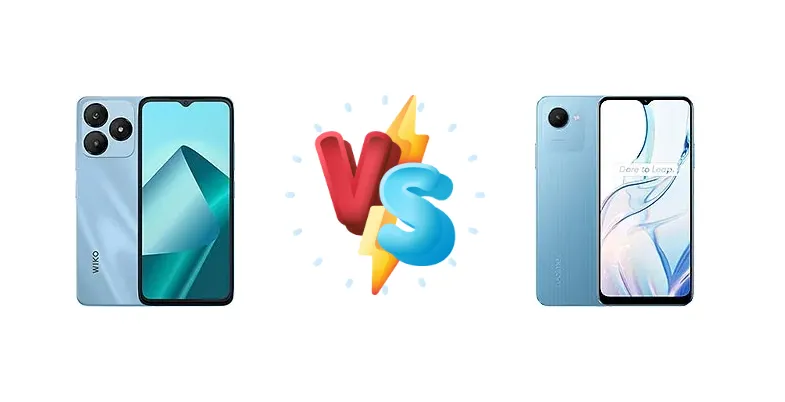
The Wiko T20 and Realme C30s represent the fiercely competitive sub-$150 smartphone market. Both aim to deliver essential smartphone functionality at an accessible price point, but they achieve this with slightly different approaches to chipset design. This comparison dissects their specifications to determine which device offers the best value for budget-conscious consumers.
🏆 Quick Verdict
For the average user prioritizing consistent performance, the Realme C30s edges out the Wiko T20. While both utilize an octa-core Cortex-A55 CPU clocked at 1.6GHz, the Realme’s streamlined chipset design likely results in slightly better efficiency and responsiveness in everyday tasks. However, the Wiko T20’s Unisoc chipset offers a broader range of core clock speeds, potentially benefiting specific workloads.
| Network |
|---|
| 2G bands | GSM 850 / 900 / 1800 / 1900 | GSM 850 / 900 / 1800 / 1900 |
| 3G bands | HSDPA 850 / 900 / 1900 / 2100 | HSDPA 850 / 900 / 2100 |
| 4G bands | 1, 3, 5, 7, 8, 20, 28, 38, 40, 41 | 1, 3, 5, 8, 38, 40, 41 |
| Speed | HSPA, LTE | HSPA, LTE |
| Technology | GSM / HSPA / LTE | GSM / HSPA / LTE |
| Launch |
|---|
| Announced | 2024, May | 2022, September 14 |
| Status | Available. Released 2024, May | Available. Released 2022, September 23 |
| Body |
|---|
| Build | - | Glass front, plastic frame, plastic back |
| Dimensions | 164.5 x 75.9 x 8.9 mm (6.48 x 2.99 x 0.35 in) | 164.2 x 75.7 x 8.5 mm (6.46 x 2.98 x 0.33 in) |
| SIM | Nano-SIM + Nano-SIM | Nano-SIM + Nano-SIM |
| Weight | 186 g (6.56 oz) | 186 g (6.56 oz) |
| Display |
|---|
| Protection | Corning Gorilla Glass | - |
| Resolution | 720 x 1612 pixels, 20:9 ratio (~269 ppi density) | 720 x 1600 pixels, 20:9 ratio (~270 ppi density) |
| Size | 6.56 inches, 103.4 cm2 (~82.8% screen-to-body ratio) | 6.5 inches, 102.0 cm2 (~82.1% screen-to-body ratio) |
| Type | IPS LCD | IPS LCD |
| Platform |
|---|
| CPU | Octa-core (4x1.6 GHz Cortex-A55 & 4x1.2 GHz Cortex-A55) | Octa-core 1.6 GHz Cortex-A55 |
| Chipset | Unisoc SC9863A1 (22 nm) | - |
| GPU | IMG8322 | IMG8322 |
| OS | Android 13 | Android 12, Realme UI Go |
| Memory |
|---|
| Card slot | microSDXC | microSDXC (dedicated slot) |
| Internal | 64GB 4GB RAM, 128GB 4GB RAM | 32GB 2GB RAM, 32GB 3GB RAM, 64GB 3GB RAM, 64GB 4GB RAM |
| Main Camera |
|---|
| Features | LED flash | LED flash, HDR, panorama |
| Single | 8 MP, f/2.0, (wide), 1/4.0", 1.12µm, AF
Auxiliary lens | 8 MP, (wide), 1/4.0", 1.12µm |
| Video | 1080p@30fps | 1080p@30fps |
| Selfie camera |
|---|
| Features | - | HDR |
| Single | 5 MP, f/2.0, (wide), 1/5.0", 1.12µm | 5 MP, (wide), 1/5.0", 1.12µm |
| Video | Yes | 720p@30fps |
| Sound |
|---|
| 3.5mm jack | - | Yes |
| 35mm jack | Yes | Yes |
| Loudspeaker | Yes | Yes |
| Comms |
|---|
| Bluetooth | 4.2, A2DP | 4.2, A2DP |
| NFC | No | No |
| Positioning | GPS, GLONASS, GALILEO, BDS | GPS, GLONASS |
| Radio | Unspecified | Unspecified |
| USB | USB Type-C, OTG | microUSB 2.0, OTG |
| WLAN | Wi-Fi 802.11 b/g/n | Wi-Fi 802.11 b/g/n |
| Features |
|---|
| Sensors | Fingerprint (side-mounted), accelerometer | Fingerprint (side-mounted), accelerometer, proximity |
| Battery |
|---|
| Charging | 10W wired | 10W wired |
| Type | Li-Po 5000 mAh | 5000 mAh |
| Misc |
|---|
| Colors | Black, Green, Blue | Stripe Blue, Stripe Black |
| Models | - | RMX3690 |
| Price | About 120 EUR | About 100 EUR |
Wiko T20
- Potentially wider performance scaling with dual-clock speed cores.
- Established brand presence in some markets.
- May offer slightly more customization options in software.
- Unisoc chipset may have less optimized software support.
- Potentially lower overall responsiveness compared to the Realme C30s.
- Limited information available on display quality.
Realme C30s
- Streamlined chipset design for potentially better efficiency.
- Likely more optimized software experience.
- Newer device, potentially benefiting from updated features.
- All cores clocked at the same speed, limiting performance scaling.
- May lack some customization options found on Wiko devices.
- Limited information available on display quality.
Display Comparison
Neither Wiko nor Realme provide display specifications beyond size. Given the price point, both likely utilize LCD panels with 720p+ resolution. Without knowing the panel technology or brightness levels, it’s difficult to assess display quality. However, the Realme C30s, being a newer device, *may* benefit from slightly improved color calibration, though this is speculative. Bezels are expected to be substantial on both devices, reflecting their budget nature.
Camera Comparison
Camera details are sparse for both devices. It’s safe to assume both feature a primary camera and potentially a secondary depth sensor. Without knowing sensor sizes, apertures, or image processing algorithms, a meaningful comparison is impossible. The inclusion of a 2MP macro camera on either device is largely a marketing tactic, offering minimal practical benefit due to the low resolution and lack of optical image stabilization. Image quality will likely be acceptable in good lighting conditions but suffer in low light.
Performance
The core of the performance difference lies in the chipsets. The Wiko T20’s Unisoc SC9863A1 features a heterogeneous octa-core CPU with a split configuration: four cores clocked at 1.6 GHz and four at 1.2 GHz. This aims to balance performance and power efficiency. The Realme C30s, however, utilizes an octa-core CPU with all cores clocked at a consistent 1.6 GHz. While the peak clock speed is the same, the Unisoc’s lower-clocked cores suggest it might prioritize battery life during less demanding tasks. Both rely on the Cortex-A55 architecture, which is known for its efficiency but limited raw power. Neither device is expected to excel in graphically intensive tasks. RAM specifications are not provided, but both likely feature 2-3GB, which will impact multitasking capabilities.
Battery Life
Both the Wiko T20 and Realme C30s support 10W wired charging. This is a standard, albeit slow, charging speed for budget smartphones. Actual charging times from 0-100% will likely be around 2.5-3.5 hours. Battery capacity is not specified for either device, but given the price point, both likely feature batteries in the 4000-5000 mAh range. The Realme C30s’ potentially more efficient chipset *could* translate to slightly longer battery life in real-world usage, offsetting any potential capacity differences.
Buying Guide
Buy the Wiko T20 if you need a device with a potentially wider range of performance scaling due to its dual-clock speed Cortex-A55 configuration, and are comfortable with potentially slightly lower overall responsiveness. Buy the Realme C30s if you prioritize a streamlined, efficient experience for everyday tasks like social media, messaging, and light web browsing, and want a phone that feels consistently snappy.
Frequently Asked Questions
❓ Will the Realme C30s struggle with popular apps like WhatsApp and Facebook?
The Realme C30s, with its 1.6GHz octa-core Cortex-A55 CPU, should handle basic apps like WhatsApp and Facebook without significant issues. However, running multiple apps simultaneously or using more demanding features within these apps may lead to some slowdown. Managing background app activity will be crucial for a smooth experience.
❓ Is the Unisoc SC9863A1 in the Wiko T20 known for overheating during prolonged use?
The Unisoc SC9863A1 is a relatively low-power chipset, and overheating is unlikely to be a major concern during typical usage scenarios. However, prolonged gaming or intensive multitasking could lead to some thermal throttling, reducing performance slightly. The device's thermal design will play a role in mitigating this.
❓ Can either of these phones handle basic mobile games like Candy Crush or Subway Surfers?
Yes, both the Wiko T20 and Realme C30s should be capable of running casual mobile games like Candy Crush or Subway Surfers without significant problems. However, don't expect high frame rates or detailed graphics settings. These phones are designed for basic gaming experiences.