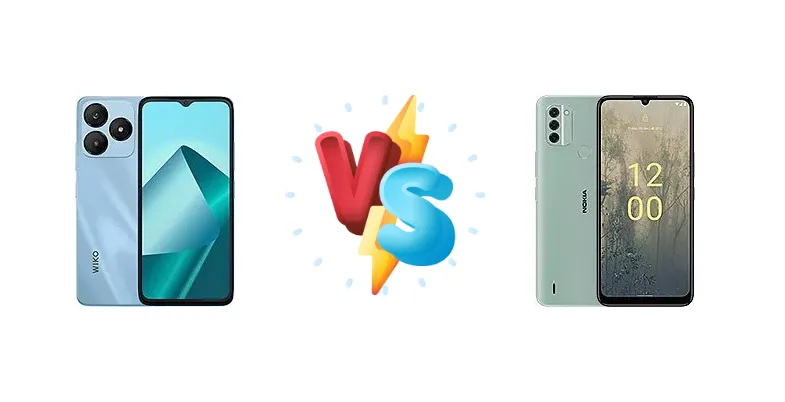
The Wiko T20 and Nokia C31 represent the ultra-budget end of the Android smartphone spectrum. Both aim to deliver essential smartphone functionality at the lowest possible price point. However, subtle differences in their underlying hardware, specifically the chipset fabrication process, can impact performance and efficiency. This comparison dissects these differences to determine which device offers the best value.
🏆 Quick Verdict
For the average user prioritizing efficiency and potentially smoother multitasking, the Wiko T20 is the better choice. Its Unisoc SC9863A1 chipset, built on a 22nm process, offers a slight advantage over the Nokia C31’s 28nm SC9863A, translating to potentially lower power consumption and marginally improved performance.
| Network |
|---|
| 2G bands | GSM 850 / 900 / 1800 / 1900 | GSM 850 / 900 / 1800 / 1900 |
| 3G bands | HSDPA 850 / 900 / 1900 / 2100 | HSDPA 850 / 900 / 2100 - International |
| 4G bands | 1, 3, 5, 7, 8, 20, 28, 38, 40, 41 | 1, 3, 5, 7, 8, 20, 28, 38, 40, 41 - International |
| Speed | HSPA, LTE | HSPA 42.2/5.76 Mbps, LTE Cat4 150/50 Mbps |
| Technology | GSM / HSPA / LTE | GSM / HSPA / LTE |
| | - | 1, 3, 5, 7, 8, 20, 28, 38, 40, 41 - South Africa, Egypt |
| Launch |
|---|
| Announced | 2024, May | 2022, September 01 |
| Status | Available. Released 2024, May | Available. Released 2022, September 01 |
| Body |
|---|
| Build | - | Glass front, plastic frame, plastic back |
| Dimensions | 164.5 x 75.9 x 8.9 mm (6.48 x 2.99 x 0.35 in) | 169.2 x 78 x 8.6 mm (6.66 x 3.07 x 0.34 in) |
| SIM | Nano-SIM + Nano-SIM | Nano-SIM + Nano-SIM |
| Weight | 186 g (6.56 oz) | 200 g (7.05 oz) |
| | - | Splash resistant |
| Display |
|---|
| Protection | Corning Gorilla Glass | - |
| Resolution | 720 x 1612 pixels, 20:9 ratio (~269 ppi density) | 720 x 1600 pixels, 20:9 ratio (~260 ppi density) |
| Size | 6.56 inches, 103.4 cm2 (~82.8% screen-to-body ratio) | 6.75 inches, 110.0 cm2 (~83.4% screen-to-body ratio) |
| Type | IPS LCD | IPS LCD |
| Platform |
|---|
| CPU | Octa-core (4x1.6 GHz Cortex-A55 & 4x1.2 GHz Cortex-A55) | Octa-core (4x1.6 GHz Cortex-A55 & 4x1.2 GHz Cortex-A55) |
| Chipset | Unisoc SC9863A1 (22 nm) | Unisoc SC9863A (28 nm) |
| GPU | IMG8322 | IMG8322 |
| OS | Android 13 | Android 12 |
| Memory |
|---|
| Card slot | microSDXC | microSDXC (dedicated slot) |
| Internal | 64GB 4GB RAM, 128GB 4GB RAM | 32GB 3GB RAM, 64GB 4GB RAM, 128GB 4GB RAM |
| | - | eMMC 5.1 |
| Main Camera |
|---|
| Features | LED flash | LED flash, HDR |
| Single | 8 MP, f/2.0, (wide), 1/4.0", 1.12µm, AF
Auxiliary lens | 5 MP |
| Triple | - | 13 MP, (wide), AF
2 MP (macro)
Auxiliary lens |
| Video | 1080p@30fps | 1080p@30fps |
| Selfie camera |
|---|
| Single | 5 MP, f/2.0, (wide), 1/5.0", 1.12µm | 5 MP |
| Video | Yes | Yes |
| Sound |
|---|
| 3.5mm jack | - | Yes |
| 35mm jack | Yes | Yes |
| Loudspeaker | Yes | Yes |
| Comms |
|---|
| Bluetooth | 4.2, A2DP | 4.2, A2DP |
| NFC | No | No |
| Positioning | GPS, GLONASS, GALILEO, BDS | GPS |
| Radio | Unspecified | Wireless FM radio |
| USB | USB Type-C, OTG | microUSB 2.0, OTG |
| WLAN | Wi-Fi 802.11 b/g/n | Wi-Fi 802.11 b/g/n |
| Features |
|---|
| Sensors | Fingerprint (side-mounted), accelerometer | Fingerprint (rear-mounted), accelerometer, proximity |
| Battery |
|---|
| Charging | 10W wired | 10W wired |
| Type | Li-Po 5000 mAh | Li-Po 5050 mAh |
| Misc |
|---|
| Colors | Black, Green, Blue | Charcoal, Mint, Cyan |
| Models | - | TA-1499, TA-1497, TA-1493 |
| Price | About 120 EUR | About 130 EUR |
| SAR EU | - | 0.35 W/kg (head) 1.39 W/kg (body) |
Wiko T20
- More efficient chipset (22nm)
- Potentially longer battery life
- Slightly better performance due to fabrication process
- Brand recognition is lower than Nokia
- Software update support may be limited
Nokia C31
- Strong brand reputation for reliability
- Potentially better software support
- Wider availability of replacement parts
- Less efficient chipset (28nm)
- Potentially shorter battery life
- Slightly lower performance
Display Comparison
Neither Wiko nor Nokia provide detailed display specifications beyond the basic panel size. Given the price point, both likely utilize IPS LCD panels with modest brightness levels. The absence of data prevents a meaningful comparison of color accuracy or viewing angles. Bezels are expected to be substantial on both devices, maximizing screen real estate within a budget-friendly form factor. The lack of high refresh rates or advanced features like LTPO is standard for this segment.
Camera Comparison
Both devices are expected to feature basic camera setups geared towards casual photography. Detailed camera specifications are scarce, but it’s safe to assume both will include a primary sensor and potentially a secondary depth or macro sensor. Given the target market, image processing will likely prioritize speed over detail. The absence of Optical Image Stabilization (OIS) is almost certain. Without specific sensor size or aperture information, a direct comparison is impossible, but the camera experience on both will be similar – adequate for basic snapshots in good lighting conditions.
Performance
The core of the performance difference lies in the chipset fabrication process. The Wiko T20’s Unisoc SC9863A1 is manufactured on a 22nm process, while the Nokia C31 uses the SC9863A on a 28nm process. A smaller fabrication node generally translates to lower power consumption and higher transistor density, potentially leading to improved performance. Both chipsets feature the same octa-core CPU configuration – 4x1.6 GHz Cortex-A55 and 4x1.2 GHz Cortex-A55 – meaning raw clock speed isn’t a differentiator. The 22nm process of the T20’s chip *should* result in better thermal management, reducing the likelihood of throttling during sustained tasks. However, the real-world impact will be minimal for typical usage.
Battery Life
Both the Wiko T20 and Nokia C31 feature 10W wired charging, indicating a similar charging experience – expect approximately 2-3 hours for a full charge. While battery capacity isn’t specified, the more efficient Unisoc SC9863A1 in the Wiko T20 *should* translate to slightly longer battery life in real-world usage. The 28nm process of the Nokia C31’s chipset will consume more power for the same tasks, potentially requiring more frequent charging.
Buying Guide
Buy the Wiko T20 if you need a device for basic tasks like calling, messaging, and light social media use, and you value potentially longer battery life due to the more efficient chipset. Buy the Nokia C31 if you prioritize the Nokia brand’s reputation for software support and a potentially wider availability of replacement parts, and are willing to accept a slightly less efficient processor.
Frequently Asked Questions
❓ Will the Nokia C31 receive regular Android updates?
Nokia generally provides a guaranteed number of years of security updates for its devices, even at the budget level. While major Android version updates are less frequent on devices like the C31, you can expect a reasonable level of security patching, which is crucial for protecting your data. Check Nokia's official website for the specific update commitment for the C31 in your region.
❓ Is the Unisoc SC9863A chipset capable of running popular apps like WhatsApp and Facebook smoothly?
Yes, the Unisoc SC9863A and SC9863A1 are designed to handle basic smartphone tasks like running WhatsApp, Facebook, and web browsing. However, don't expect a fluid experience with graphically intensive apps or multitasking with numerous applications open simultaneously. These chipsets are optimized for efficiency rather than raw performance.
❓ How long will it take to fully charge both phones from 0%?
With both phones utilizing 10W charging, a full charge from 0% is estimated to take approximately 2.5 to 3.5 hours. The charging speed is relatively slow compared to modern smartphones, but it's typical for devices in this price range. Overnight charging is recommended.