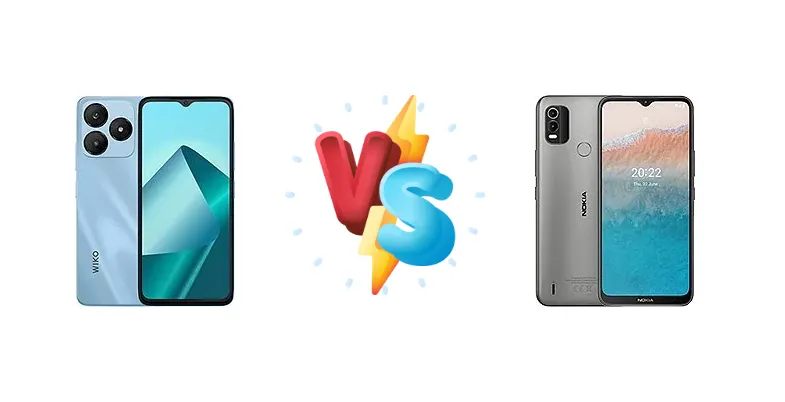
The Wiko T20 and Nokia C21 Plus represent the ultra-budget end of the Android smartphone market, targeting first-time smartphone buyers or those needing a reliable secondary device. Both rely on Unisoc chipsets, but subtle differences in fabrication and design impact real-world performance and efficiency. This comparison dissects those nuances to determine which device offers the best value.
🏆 Quick Verdict
For the average user prioritizing efficiency and slightly better performance, the Wiko T20 is the superior choice. Its Unisoc SC9863A1, built on a 22nm process, offers a marginal advantage over the Nokia C21 Plus’s 28nm SC9863A, translating to potentially better thermal management and slightly improved responsiveness during everyday tasks.
| Network |
|---|
| 2G bands | GSM 850 / 900 / 1800 / 1900 | GSM 850 / 900 / 1800 / 1900 |
| 3G bands | HSDPA 850 / 900 / 1900 / 2100 | HSDPA 850 / 900 / 2100 |
| 4G bands | 1, 3, 5, 7, 8, 20, 28, 38, 40, 41 | LTE |
| Speed | HSPA, LTE | HSPA 42.2/5.76 Mbps, LTE Cat4 150/50 Mbps |
| Technology | GSM / HSPA / LTE | GSM / HSPA / LTE |
| | - | HSDPA 850 / 900 / 1700(AWS) / 1900 / 2100 |
| Launch |
|---|
| Announced | 2024, May | 2022, February 28 |
| Status | Available. Released 2024, May | Available. Released 2022, April 29 |
| Body |
|---|
| Build | - | Glass front, aluminum frame, plastic back |
| Dimensions | 164.5 x 75.9 x 8.9 mm (6.48 x 2.99 x 0.35 in) | 164.8 x 75.9 x 8.6 mm (6.49 x 2.99 x 0.34 in) |
| SIM | Nano-SIM + Nano-SIM | · Nano-SIM· Nano-SIM + Nano-SIM |
| Weight | 186 g (6.56 oz) | 178 g or 191 g (6.28 oz) |
| | - | Splash protection |
| Display |
|---|
| Protection | Corning Gorilla Glass | Scratch-resistant glass |
| Resolution | 720 x 1612 pixels, 20:9 ratio (~269 ppi density) | 720 x 1600 pixels, 20:9 ratio (~269 ppi density) |
| Size | 6.56 inches, 103.4 cm2 (~82.8% screen-to-body ratio) | 6.52 inches, 102.6 cm2 (~82.1% screen-to-body ratio) |
| Type | IPS LCD | IPS LCD |
| Platform |
|---|
| CPU | Octa-core (4x1.6 GHz Cortex-A55 & 4x1.2 GHz Cortex-A55) | Octa-core (4x1.6 GHz Cortex-A55 & 4x1.2 GHz Cortex-A55) |
| Chipset | Unisoc SC9863A1 (22 nm) | Unisoc SC9863A (28 nm) |
| GPU | IMG8322 | IMG8322 |
| OS | Android 13 | Android 11 (Go edition) |
| Memory |
|---|
| Card slot | microSDXC | microSDXC (dedicated slot) |
| Internal | 64GB 4GB RAM, 128GB 4GB RAM | 32GB 2GB RAM, 32GB 3GB RAM, 64GB 2GB RAM, 64GB 3GB RAM, 64GB 4GB RAM |
| | - | eMMC 5.1 |
| Main Camera |
|---|
| Dual | - | 13 MP, (wide), AF
Auxiliary lens |
| Features | LED flash | LED flash, HDR, panorama |
| Single | 8 MP, f/2.0, (wide), 1/4.0", 1.12µm, AF
Auxiliary lens | 5 MP |
| Video | 1080p@30fps | 1080p@30fps |
| Selfie camera |
|---|
| Features | - | LED flash |
| Single | 5 MP, f/2.0, (wide), 1/5.0", 1.12µm | 5 MP |
| Video | Yes | 720p |
| Sound |
|---|
| 3.5mm jack | - | Yes |
| 35mm jack | Yes | Yes |
| Loudspeaker | Yes | Yes |
| Comms |
|---|
| Bluetooth | 4.2, A2DP | 4.2, A2DP |
| NFC | No | No |
| Positioning | GPS, GLONASS, GALILEO, BDS | GPS |
| Radio | Unspecified | FM radio |
| USB | USB Type-C, OTG | microUSB 2.0 |
| WLAN | Wi-Fi 802.11 b/g/n | Wi-Fi 802.11 b/g/n |
| Features |
|---|
| Sensors | Fingerprint (side-mounted), accelerometer | Fingerprint (rear-mounted), accelerometer, proximity |
| Battery |
|---|
| Charging | 10W wired | 10W wired |
| Type | Li-Po 5000 mAh | Li-Ion 4000/5050 mAh |
| Misc |
|---|
| Colors | Black, Green, Blue | Dark Cyan, Warm Gray |
| Models | - | TA-1433, TA-1431, TA-1426, TA-1424 |
| Price | About 120 EUR | About 120 EUR |
| SAR | - | 0.57 W/kg (head) 0.65 W/kg (body) |
| SAR EU | - | 0.40 W/kg (head) 0.99 W/kg (body) |
Wiko T20
- More efficient chipset (22nm)
- Potentially better thermal management
- Slightly improved performance in sustained tasks
- Brand recognition is lower than Nokia
- Limited software update support likely
Nokia C21 Plus
- Strong brand reputation for reliability
- Potential for longer software support
- Widely available service network
- Less efficient chipset (28nm)
- Potential for more thermal throttling
- Slightly lower performance in sustained tasks
Display Comparison
Neither Wiko nor Nokia provide detailed display specifications beyond resolution. However, given the price point, both likely utilize IPS LCD panels. The absence of information regarding peak brightness or color gamut suggests neither device will excel in outdoor visibility or color accuracy. Bezels are expected to be substantial on both, maximizing screen real estate within a compact form factor. The focus here is clearly on affordability, not display quality.
Camera Comparison
Camera details are sparse for both devices. It’s safe to assume both feature basic camera setups geared towards casual photography. Without sensor size or aperture information, a direct comparison is difficult. The inclusion of a 2MP macro camera on either device is largely a marketing tactic, offering limited practical benefit due to the small sensor size and lack of optical image stabilization. Image processing will likely be basic, relying heavily on software algorithms to enhance image quality. Expect acceptable results in well-lit conditions, but poor performance in low light.
Performance
The core of the performance difference lies in the chipset fabrication process. The Wiko T20’s Unisoc SC9863A1 is manufactured on a 22nm process, while the Nokia C21 Plus uses the SC9863A on a 28nm process. A smaller fabrication node generally translates to lower power consumption and higher transistor density, potentially leading to improved performance and thermal efficiency. Both CPUs feature the same octa-core configuration (4x1.6 GHz Cortex-A55 & 4x1.2 GHz Cortex-A55), meaning raw clock speed isn’t a differentiator. The 22nm node of the Wiko T20 should result in less heat generation during prolonged use, reducing the likelihood of performance throttling. RAM configurations are not specified, but are likely limited, impacting multitasking capabilities on both devices.
Battery Life
Both the Wiko T20 and Nokia C21 Plus feature 10W wired charging, indicating a similar charging experience – slow by modern standards. Battery capacity is not specified, but given the target market, both likely house batteries in the 3000-4000 mAh range. The Wiko T20’s more efficient chipset (22nm) could translate to slightly longer battery life between charges, even with a similar capacity battery. Expect a full charge to take well over two hours with the included charger.
Buying Guide
Buy the Wiko T20 if you need a phone for basic tasks like calling, messaging, and light social media use, and value a slightly more efficient processor for potentially longer battery life. Buy the Nokia C21 Plus if you prioritize the Nokia brand’s reputation for software support and durability, and are comfortable with a chipset that may exhibit slightly more thermal throttling under sustained load. Both are excellent choices for users on a very tight budget.
Frequently Asked Questions
❓ Will the Unisoc SC9863A chipset struggle with popular apps like WhatsApp and Facebook?
While not a powerhouse, the Unisoc SC9863A and SC9863A1 are capable of running basic apps like WhatsApp and Facebook without significant issues. However, expect some lag when switching between multiple apps or using more demanding features within those apps. Both phones are best suited for light usage.
❓ How long will it take to fully charge the Wiko T20 or Nokia C21 Plus with the included 10W charger?
With the included 10W charger, expect a full charge to take approximately 3-4 hours, potentially longer if the phone is being used during charging. These devices do not support fast charging technologies.
❓ Are either of these phones suitable for playing mobile games?
Neither the Wiko T20 nor the Nokia C21 Plus are ideal for gaming. While simple 2D games may be playable at low settings, more demanding 3D games will likely experience significant lag and frame rate drops. The chipsets are simply not powerful enough for a smooth gaming experience.
❓ What version of Android do these phones run, and will they receive updates?
Both devices likely ship with Android Go Edition, a lightweight version of Android designed for low-end hardware. Software update support is limited on both devices, but Nokia generally provides slightly longer support windows than Wiko. Expect at most one major Android version update, if any.