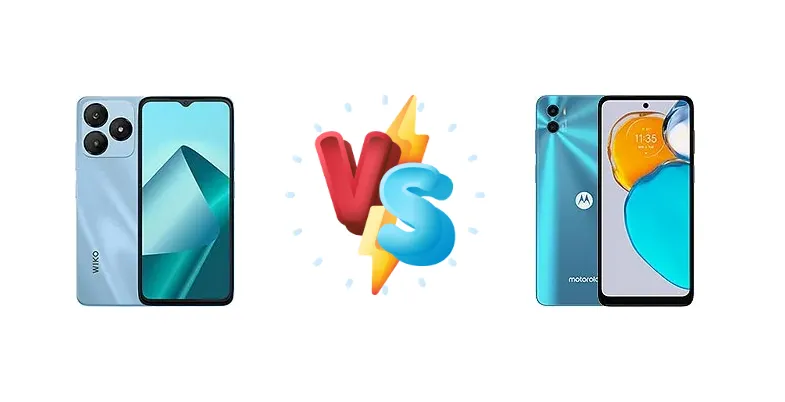
The Wiko T20 and Motorola Moto E22s represent the fiercely competitive sub-$150 smartphone market. Both aim to deliver essential functionality at an accessible price point, but they take different approaches to achieving this. The key differentiator lies in their chipsets – the Wiko T20 utilizes a Unisoc SC9863A1, while the Moto E22s features a MediaTek Helio G37. This comparison will dissect these differences and determine which device offers the best value for budget-conscious consumers.
🏆 Quick Verdict
For the average user, the Motorola Moto E22s is the better choice. While both phones offer similar basic functionality, the Helio G37’s 12nm process provides a noticeable efficiency advantage over the Wiko T20’s 22nm Unisoc chip, translating to potentially better sustained performance and slightly improved battery life. Both charge at the same slow 10W rate.
| Network |
|---|
| 2G bands | GSM 850 / 900 / 1800 / 1900 | GSM 850 / 900 / 1800 / 1900 |
| 3G bands | HSDPA 850 / 900 / 1900 / 2100 | HSDPA 850 / 900 / 2100 |
| 4G bands | 1, 3, 5, 7, 8, 20, 28, 38, 40, 41 | 1, 3, 5, 7, 8, 20, 38, 40, 41 |
| Speed | HSPA, LTE | HSPA 42.2/5.76 Mbps, LTE Cat4 150/50 Mbps |
| Technology | GSM / HSPA / LTE | GSM / HSPA / LTE |
| Launch |
|---|
| Announced | 2024, May | 2022, August 24 |
| Status | Available. Released 2024, May | Available. Released 2022, October 22 |
| Body |
|---|
| Build | - | Glass front, plastic frame, plastic back |
| Dimensions | 164.5 x 75.9 x 8.9 mm (6.48 x 2.99 x 0.35 in) | 164 x 75 x 8.5 mm (6.46 x 2.95 x 0.33 in) |
| SIM | Nano-SIM + Nano-SIM | Nano-SIM + Nano-SIM |
| Weight | 186 g (6.56 oz) | 185 g (6.53 oz) |
| | - | Water-repellent coating |
| Display |
|---|
| Protection | Corning Gorilla Glass | - |
| Resolution | 720 x 1612 pixels, 20:9 ratio (~269 ppi density) | 720 x 1600 pixels, 20:9 ratio (~270 ppi density) |
| Size | 6.56 inches, 103.4 cm2 (~82.8% screen-to-body ratio) | 6.5 inches, 102.0 cm2 (~82.9% screen-to-body ratio) |
| Type | IPS LCD | IPS LCD, 90Hz |
| Platform |
|---|
| CPU | Octa-core (4x1.6 GHz Cortex-A55 & 4x1.2 GHz Cortex-A55) | Octa-core (4x2.3 GHz Cortex-A53 & 4x1.8 GHz Cortex-A53) |
| Chipset | Unisoc SC9863A1 (22 nm) | Mediatek MT6765V/CB Helio G37 (12 nm) |
| GPU | IMG8322 | PowerVR GE8320 |
| OS | Android 13 | Android 12 |
| Memory |
|---|
| Card slot | microSDXC | microSDXC (dedicated slot) |
| Internal | 64GB 4GB RAM, 128GB 4GB RAM | 64GB 4GB RAM |
| | - | eMMC 5.1 |
| Main Camera |
|---|
| Dual | - | 16 MP, f/2.2, (wide), 1.0µm, PDAF
Auxiliary lens |
| Features | LED flash | LED flash, HDR, panorama |
| Single | 8 MP, f/2.0, (wide), 1/4.0", 1.12µm, AF
Auxiliary lens | - |
| Video | 1080p@30fps | 1080p@30fps |
| Selfie camera |
|---|
| Features | - | HDR |
| Single | 5 MP, f/2.0, (wide), 1/5.0", 1.12µm | 8 MP, f/2.2, (wide), 1/4.0, 1.12µm |
| Video | Yes | 1080p@30fps |
| Sound |
|---|
| 3.5mm jack | - | Yes |
| 35mm jack | Yes | Yes |
| Loudspeaker | Yes | Yes |
| Comms |
|---|
| Bluetooth | 4.2, A2DP | 5.0, A2DP, LE |
| NFC | No | No |
| Positioning | GPS, GLONASS, GALILEO, BDS | GPS, GLONASS, GALILEO |
| Radio | Unspecified | Unspecified |
| USB | USB Type-C, OTG | USB Type-C 2.0 |
| WLAN | Wi-Fi 802.11 b/g/n | Wi-Fi 802.11 a/b/g/n/ac, dual-band |
| Features |
|---|
| Sensors | Fingerprint (side-mounted), accelerometer | Fingerprint (side-mounted), accelerometer, compass |
| Battery |
|---|
| Charging | 10W wired | 10W wired |
| Type | Li-Po 5000 mAh | Li-Po 5000 mAh |
| Misc |
|---|
| Colors | Black, Green, Blue | Iceberg Blue, Cosmic Black |
| Price | About 120 EUR | About 110 EUR |
Wiko T20
- Potentially lower purchase price
- Acceptable for basic tasks
- Octa-core processor
- Less efficient Unisoc chipset
- Likely more thermal throttling
- Older processor architecture
Motorola Moto E22s
- More efficient MediaTek Helio G37
- Modern Cortex-A53 cores
- Potentially better sustained performance
- Slightly higher price point
- Slow 10W charging
- Basic camera system
Display Comparison
Neither device boasts a standout display. Details regarding panel type, resolution, and brightness are absent from the provided data, suggesting both utilize basic LCD panels common in this price bracket. Bezels are likely to be substantial on both, and color accuracy will likely be standard for the segment. The lack of information prevents a meaningful comparison beyond assuming similar visual experiences.
Camera Comparison
Without sensor size or aperture information, a detailed camera comparison is impossible. However, it’s safe to assume both phones feature basic camera setups geared towards casual photography. The prevalence of 2MP macro lenses in this segment suggests both may include one, but their utility is limited. Image processing will likely be basic on both, relying heavily on software enhancements to improve image quality. The Helio G37’s ISP (Image Signal Processor) *may* offer slightly better processing capabilities, but this is speculative without further data.
Performance
The core difference lies in the chipsets. The Motorola Moto E22s’ MediaTek Helio G37, built on a 12nm process, is significantly more efficient than the Wiko T20’s Unisoc SC9863A1 (22nm). While both are octa-core CPUs, the Helio G37 utilizes Cortex-A53 cores clocked at 2.3 GHz, while the Wiko T20 uses a mix of Cortex-A55 cores clocked at 1.6 GHz and 1.2 GHz. The A53 architecture is older, but the higher clock speeds and more efficient node give the Helio G37 an edge in both single-core and multi-core performance. This translates to snappier app loading and smoother multitasking on the Moto E22s. The larger process node of the Unisoc chip in the Wiko T20 will likely result in more heat generation under load, potentially leading to thermal throttling.
Battery Life
Both the Wiko T20 and Motorola Moto E22s are equipped with 10W wired charging, indicating a slow charging experience. While battery capacity isn’t specified, the more efficient Helio G37 in the Moto E22s will likely translate to better real-world battery life, even if the Wiko T20 has a slightly larger capacity. Expect both phones to take several hours to fully charge from 0-100%.
Buying Guide
Buy the Wiko T20 if you prioritize a potentially lower initial purchase price and are primarily focused on very basic tasks like calls, texts, and light social media browsing. Buy the Motorola Moto E22s if you value slightly better performance for everyday tasks, a more modern chipset architecture, and potentially longer battery life, even if it means spending a little more upfront.
Frequently Asked Questions
❓ Will the Unisoc SC9863A1 in the Wiko T20 struggle with modern mobile games?
Yes, the Unisoc SC9863A1 is a low-end chipset and will likely struggle with graphically demanding games. Expect low frame rates and significant lag, even on low settings. The Moto E22s’ Helio G37 will offer a slightly better gaming experience, but it’s still not ideal for serious gamers.
❓ How long will it take to fully charge both phones from 0%?
Given the 10W charging on both devices, expect a full charge to take approximately 3-4 hours. Neither phone supports fast charging, so patience is required.
❓ Is the Motorola Moto E22s a good option for someone upgrading from a very old smartphone?
Absolutely. The Moto E22s represents a significant upgrade in performance and features compared to older smartphones, even those that were mid-range at their time of release. The Helio G37 provides a noticeable improvement in responsiveness and multitasking capabilities.