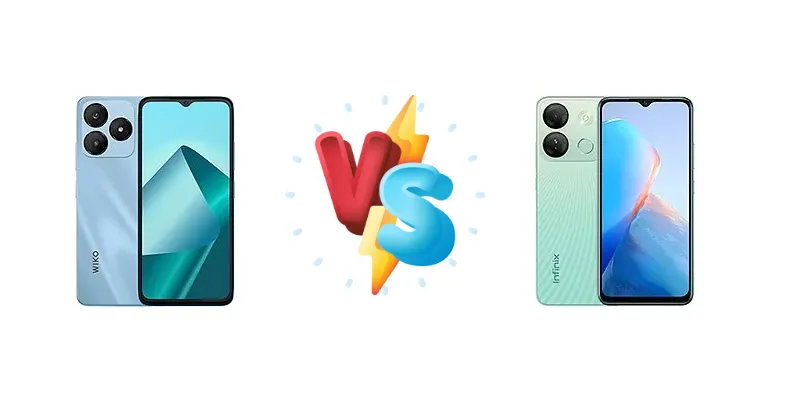
The Wiko T20 and Infinix Smart 7 HD represent the fiercely competitive sub-$150 smartphone market. Both aim to deliver essential smartphone functionality at an accessible price point, but they take slightly different approaches to achieving this. This comparison dissects their core specifications to determine which device offers the best balance of performance and value for budget-conscious consumers.
🏆 Quick Verdict
For the average user prioritizing consistent, if modest, performance, the Wiko T20 edges out the Infinix Smart 7 HD. The Unisoc SC9863A1 chipset, while not a powerhouse, offers a more clearly defined CPU architecture with a split core configuration, potentially leading to smoother multitasking than the generically specified octa-core processor in the Infinix.
| Network |
|---|
| 2G bands | GSM 850 / 900 / 1800 / 1900 | GSM 850 / 900 / 1800 / 1900 |
| 3G bands | HSDPA 850 / 900 / 1900 / 2100 | HSDPA 850 / 900 / 2100 |
| 4G bands | 1, 3, 5, 7, 8, 20, 28, 38, 40, 41 | 1, 3, 5, 8, 38, 40, 41 |
| Speed | HSPA, LTE | HSPA, LTE |
| Technology | GSM / HSPA / LTE | GSM / HSPA / LTE |
| | - | 1, 2, 3, 4, 5, 7, 8, 20, 28, 38, 40, 41 |
| Launch |
|---|
| Announced | 2024, May | 2023, April 14 |
| Status | Available. Released 2024, May | Available. Released 2023, April 14 |
| Body |
|---|
| Build | - | Glass front, plastic back, plastic frame |
| Dimensions | 164.5 x 75.9 x 8.9 mm (6.48 x 2.99 x 0.35 in) | 163.9 x 75.5 x 8.7 mm (6.45 x 2.97 x 0.34 in) |
| SIM | Nano-SIM + Nano-SIM | Nano-SIM + Nano-SIM |
| Weight | 186 g (6.56 oz) | 196.5 g (6.95 oz) |
| Display |
|---|
| Protection | Corning Gorilla Glass | - |
| Resolution | 720 x 1612 pixels, 20:9 ratio (~269 ppi density) | 720 x 1612 pixels, 20:9 ratio (~267 ppi density) |
| Size | 6.56 inches, 103.4 cm2 (~82.8% screen-to-body ratio) | 6.6 inches, 104.6 cm2 (~84.6% screen-to-body ratio) |
| Type | IPS LCD | IPS LCD, 500 nits |
| Platform |
|---|
| CPU | Octa-core (4x1.6 GHz Cortex-A55 & 4x1.2 GHz Cortex-A55) | Octa-core 1.6 GHz |
| Chipset | Unisoc SC9863A1 (22 nm) | - |
| GPU | IMG8322 | - |
| OS | Android 13 | Android 12 (Go edition) |
| Memory |
|---|
| Card slot | microSDXC | microSDXC (dedicated slot) |
| Internal | 64GB 4GB RAM, 128GB 4GB RAM | 64GB 2GB RAM |
| | - | UFS 2.1 |
| Main Camera |
|---|
| Dual | - | 8 MP, f/2.0
0.08 MP, (depth) |
| Features | LED flash | Dual-LED flash, HDR, panorama |
| Single | 8 MP, f/2.0, (wide), 1/4.0", 1.12µm, AF
Auxiliary lens | 8 MP, f/2.0
Auxiliary lens |
| Video | 1080p@30fps | 1080p@30fps |
| Selfie camera |
|---|
| Features | - | LED flash |
| Single | 5 MP, f/2.0, (wide), 1/5.0", 1.12µm | 5 MP, f/2.0 |
| Video | Yes | 720p@30fps |
| Sound |
|---|
| 3.5mm jack | - | Yes |
| 35mm jack | Yes | Yes |
| Loudspeaker | Yes | Yes |
| Comms |
|---|
| Bluetooth | 4.2, A2DP | 5.0, A2DP, LE |
| NFC | No | No |
| Positioning | GPS, GLONASS, GALILEO, BDS | GPS |
| Radio | Unspecified | FM radio |
| USB | USB Type-C, OTG | microUSB 2.0, OTG |
| WLAN | Wi-Fi 802.11 b/g/n | Wi-Fi 802.11 b/g/n |
| Features |
|---|
| Sensors | Fingerprint (side-mounted), accelerometer | Fingerprint (rear-mounted), accelerometer, proximity |
| Battery |
|---|
| Charging | 10W wired | 10W wired |
| Type | Li-Po 5000 mAh | 5000 mAh |
| Misc |
|---|
| Colors | Black, Green, Blue | Ink Black, Silk Blue, Jade White, Green Apple |
| Models | - | X6516 |
| Price | About 120 EUR | About 110 EUR |
Wiko T20
- More defined chipset architecture (Unisoc SC9863A1)
- Potentially better multitasking due to core configuration
- Known 22nm process node for thermal predictability
- Slow 10W charging
- Limited RAM likely impacts performance
Infinix Smart 7 HD
- Potentially lower price point
- Simple and straightforward operation
- Likely decent battery life (assuming 4000-5000 mAh)
- Ambiguous CPU specification
- Uncertain performance characteristics
- Slow 10W charging
Display Comparison
Neither device provides display specifications beyond basic functionality. Given the price point, both likely utilize LCD panels with 720p+ resolutions. Without data on brightness (nits), color gamut coverage, or refresh rates, it's impossible to definitively declare a winner. However, the absence of any mention of advanced features like LTPO or high PWM dimming suggests both will offer a standard viewing experience, potentially straining eyes during prolonged use in low light.
Camera Comparison
Both devices are likely to feature basic camera setups geared towards casual photography. Without sensor size or aperture information, a detailed comparison is impossible. It’s safe to assume both will include a primary camera and potentially a depth or macro sensor, but image quality will be heavily reliant on software processing. The lack of OIS (Optical Image Stabilization) on either device suggests low-light performance will be limited. Focusing on megapixel counts alone would be misleading; sensor size and lens quality are far more critical at this price point.
Performance
The Wiko T20’s Unisoc SC9863A1 chipset is the key differentiator. Its octa-core configuration is split into two clusters: four Cortex-A55 cores clocked at 1.6 GHz and four at 1.2 GHz. This big.LITTLE architecture allows for efficient task allocation – the faster cores handling demanding tasks while the slower cores conserve power during idle or light usage. The Infinix Smart 7 HD only specifies an octa-core 1.6 GHz CPU, lacking the architectural detail. This ambiguity makes it difficult to assess its performance potential; it could be eight slower cores, or a less efficient configuration. The Wiko T20’s 22nm process node, while not cutting-edge, is a known quantity, offering a degree of predictability in thermal management. Both devices likely feature limited RAM, impacting multitasking capabilities, but the Wiko’s chipset architecture may mitigate this slightly.
Battery Life
Both the Wiko T20 and Infinix Smart 7 HD feature 10W wired charging. This slow charging speed means a full charge will take a significant amount of time – likely exceeding 3 hours. Battery capacity is not specified for either device, but given the target market, both likely house batteries in the 4000-5000 mAh range. The actual battery life will depend heavily on usage patterns and software optimization. The slow charging speed is a significant drawback for both, making overnight charging a necessity.
Buying Guide
Buy the Wiko T20 if you need a device with a slightly more predictable performance profile for basic tasks and light multitasking. Its chipset architecture provides a clearer understanding of its capabilities. Buy the Infinix Smart 7 HD if you prioritize simplicity and are looking for the absolute lowest price point, accepting that performance details are less transparent and may vary based on software optimization.
Frequently Asked Questions
❓ Will the Wiko T20 struggle with popular social media apps like Facebook and Instagram?
The Wiko T20’s Unisoc SC9863A1 chipset should be capable of running these apps, but expect some lag when switching between them or loading media-heavy content. The limited RAM will be a bottleneck, so closing unused apps is crucial for maintaining smooth performance.
❓ Is the Infinix Smart 7 HD a good choice for someone who primarily uses their phone for calls and texts?
Yes, the Infinix Smart 7 HD is well-suited for basic communication tasks like calls and texts. Its unspecified octa-core processor should be sufficient for these functions, and the battery life will likely be adequate for all-day use with minimal strain.
❓ Can either of these phones play PUBG Mobile?
While technically possible to *launch* PUBG Mobile on either device, the experience will be far from ideal. The chipsets lack the graphical power to run the game smoothly, even at the lowest settings. Expect significant frame rate drops and lag, making it unplayable for serious gamers.
❓ What kind of storage options are available on these phones?
Storage details are not provided in the specifications. However, given the price point, both devices likely offer limited internal storage (32GB or 64GB) and support for microSD card expansion. This is essential for storing photos, videos, and apps.