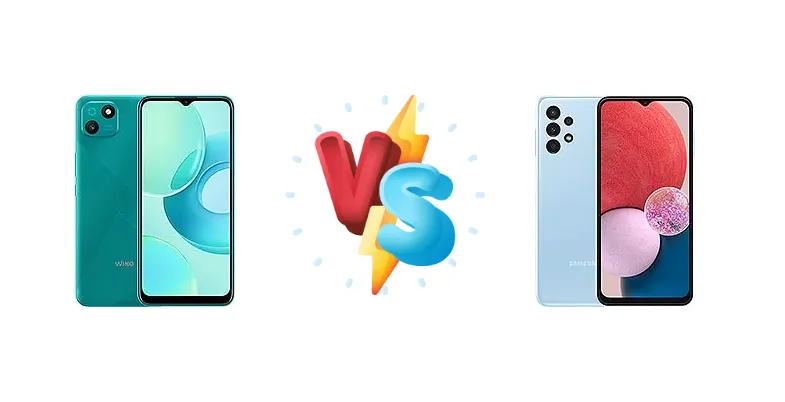
The Wiko T10 and Samsung Galaxy A13 (SM-A137) represent the lower end of the smartphone market, targeting users prioritizing affordability. However, a significant gap exists in their internal hardware, impacting real-world performance. This comparison dissects those differences to determine which device delivers the best value for your money.
🏆 Quick Verdict
For most users, the Samsung Galaxy A13 is the superior choice. Its Mediatek Helio G80 chipset, featuring a more modern CPU architecture, provides a noticeably smoother experience for everyday tasks and even light gaming. While the Wiko T10 is cheaper, the performance trade-off is substantial.
| Network |
|---|
| 2G bands | GSM 850 / 900 / 1800 / 1900 | GSM 850 / 900 / 1800 / 1900 |
| 3G bands | HSDPA 850 / 900 / 1700(AWS) / 1900 / 2100 - W-V673-01 | HSDPA 850 / 900 / 2100 |
| 4G bands | 1, 2, 3, 4, 5, 7, 8, 13, 26, 28, 38, 66 - W-V673-01 | 1, 3, 5, 7, 8, 20, 28, 38, 40, 41 |
| Speed | HSPA, LTE | HSPA, LTE |
| Technology | GSM / HSPA / LTE | GSM / HSPA / LTE |
| | 1, 3, 5, 7, 8, 20, 28, 38, 40, 41 - W-V673-02 | - |
| Launch |
|---|
| Announced | 2022, May 26 | 2022, June |
| Status | Available. Released 2022, May 26 | Available. Released 2022, July |
| Body |
|---|
| Build | - | Glass front (Gorilla Glass 5), plastic frame, plastic back |
| Dimensions | 163.9 x 75.8 x 9 mm (6.45 x 2.98 x 0.35 in) | 165.1 x 76.4 x 8.8 mm (6.5 x 3.01 x 0.35 in) |
| SIM | Nano-SIM + Nano-SIM | · Nano-SIM· Nano-SIM + Nano-SIM |
| Weight | 192 g (6.77 oz) | 195 g (6.88 oz) |
| Display |
|---|
| Protection | - | Corning Gorilla Glass 5 |
| Resolution | 720 x 1600 pixels, 20:9 ratio (~270 ppi density) | 1080 x 2408 pixels, 20:9 ratio (~400 ppi density) |
| Size | 6.5 inches, 102.0 cm2 (~82.1% screen-to-body ratio) | 6.6 inches, 104.9 cm2 (~83.2% screen-to-body ratio) |
| Type | IPS LCD | PLS LCD |
| Platform |
|---|
| CPU | Quad-core 2.0 GHz Cortex-A53 | Octa-core (2x2.0 GHz Cortex-A75 & 6x1.8 GHz Cortex-A55) |
| Chipset | Mediatek MT6761 Helio A22 (12 nm) | Mediatek MT6769V/CU Helio G80 (12 nm) |
| GPU | PowerVR GE8300 | Mali-G52 MC2 |
| OS | Android 11 (Go edition) | Android 12, upgradable to Android 14, One UI 6.1 |
| Memory |
|---|
| Card slot | microSDXC | microSDXC (dedicated slot) |
| Internal | 64GB 2GB RAM | 32GB 3GB RAM, 32GB 4GB RAM, 64GB 4GB RAM, 128GB 4GB RAM |
| | - | eMMC 5.1 |
| Main Camera |
|---|
| Features | LED flash, panorama | LED flash, panorama, HDR |
| Quad | - | 50 MP, f/1.8, (wide), PDAF
5 MP, f/2.2, 123˚ (ultrawide), 1/5.0", 1.12µm
2 MP (macro)
Auxiliary lens |
| Single | 13 MP, AF | 8 MP, f/2.2, (wide) |
| Video | 1080p@30fps | 1080p@30fps |
| Selfie camera |
|---|
| Single | 5 MP | 8 MP, f/2.2, (wide) |
| Video | - | 1080p@30fps |
| Sound |
|---|
| 3.5mm jack | Yes | Yes |
| 35mm jack | Yes | Yes |
| Loudspeaker | Yes | Yes |
| Comms |
|---|
| Bluetooth | 5.0, A2DP, LE | 5.2, A2DP, LE |
| NFC | No | Yes |
| Positioning | GPS, GLONASS, GALILEO, BDS | GPS, GLONASS, GALILEO, BDS |
| Radio | FM radio | No |
| USB | Yes | USB Type-C 2.0, OTG |
| WLAN | Wi-Fi 802.11 b/g/n | Wi-Fi 802.11 a/b/g/n/ac, dual-band, Wi-Fi Direct |
| Features |
|---|
| Sensors | Accelerometer, proximity | Fingerprint (side-mounted), accelerometer, compass |
| | - | Virtual proximity sensing |
| Battery |
|---|
| Charging | - | 15W wired |
| Type | Li-Ion 5000 mAh | Li-Po 5000 mAh |
| Misc |
|---|
| Colors | Black, Green | Black, White, Blue |
| Models | W-V673-01, W-V673-02 | SM-A137F, SM-A137F/DSN, SM-A137F/DS |
| Price | - | About 180 EUR |
| SAR EU | - | 0.35 W/kg (head) 1.22 W/kg (body) |
Wiko T10
- Lowest possible price point
- Simple and straightforward user experience
- Potentially longer standby time due to less demanding processor
- Significantly slower performance
- Struggles with multitasking
- Limited gaming capabilities
Samsung Galaxy A13 (SM-A137)
- Much faster and more responsive performance
- Better for multitasking and gaming
- 15W fast charging
- Slightly higher price
- May not offer significantly better camera quality
- Still an entry-level device with limitations
Display Comparison
Neither device boasts a standout display. Both utilize 12nm chipsets, suggesting similar power constraints impacting display capabilities. While specific display specs for the Wiko T10 are unavailable, the Galaxy A13's display is likely a standard LCD panel. The focus here isn't on visual fidelity, but rather basic usability. Expect similar color accuracy and brightness levels, adequate for indoor use but potentially washed out in direct sunlight.
Camera Comparison
Camera performance is likely to be similar in real-world scenarios, given both phones target the budget segment. The Galaxy A13 likely benefits from Samsung’s image processing algorithms, potentially delivering more pleasing results. However, without detailed sensor information for the Wiko T10, it’s difficult to make a definitive statement. The presence of a 2MP macro camera on the A13 is largely a marketing gimmick; its limited resolution offers minimal practical benefit. Focus should be on the main sensor performance, where the A13 likely has a slight edge due to its more powerful ISP (Image Signal Processor) integrated within the Helio G80.
Performance
The performance disparity is the most significant difference. The Wiko T10’s Mediatek MT6761 Helio A22, with its quad-core 2.0 GHz Cortex-A53 CPU, is a generation behind the Galaxy A13’s Helio G80. The G80’s octa-core configuration (2x2.0 GHz Cortex-A75 & 6x1.8 GHz Cortex-A55) provides a substantial advantage in multi-tasking and demanding applications. The Cortex-A75 cores in the A13 offer significantly higher single-core performance, crucial for app launch speeds and responsiveness. This translates to a smoother experience when switching between apps, browsing the web, and playing games. The A13 is the clear winner for users who don't want to fight lag.
Battery Life
Battery life will depend heavily on usage patterns. While specific battery capacities are not provided, the 15W wired charging on the Galaxy A13 suggests a slightly faster charging experience. The more efficient Helio G80 chipset in the A13 may also contribute to longer battery life under moderate load, despite potentially having a similar capacity to the Wiko T10. The A13’s ability to handle more demanding tasks without excessive power draw will be a key factor for users who frequently stream video or play games.
Buying Guide
Buy the Wiko T10 if you absolutely need the lowest possible price and your smartphone usage is limited to basic communication – calls, texts, and very light web browsing. Buy the Samsung Galaxy A13 (SM-A137) if you want a phone that can handle social media, streaming video, and occasional gaming without frustrating lag, and if you value a more responsive user experience.
Frequently Asked Questions
❓ Will the Samsung Galaxy A13 struggle with popular games like PUBG Mobile?
While the Helio G80 isn't a gaming powerhouse, the Galaxy A13 can handle PUBG Mobile at medium settings with reasonable frame rates. Expect some occasional stuttering, but it's a playable experience, unlike the Wiko T10 which would likely struggle significantly.
❓ Is the Wiko T10 a good choice for elderly users who primarily make calls and send texts?
Yes, the Wiko T10 is a suitable option for basic communication. Its simplicity and low price make it ideal for users who don't require advanced features or demanding performance. However, the slower processor might make even simple tasks feel sluggish compared to more modern phones.
❓ Does the Samsung Galaxy A13 support software updates for security patches?
Samsung generally provides several years of security updates for its Galaxy A-series devices. While the exact duration for the A13 isn't guaranteed, it's likely to receive updates for at least two years, offering better long-term security than the Wiko T10, which typically receives limited software support.