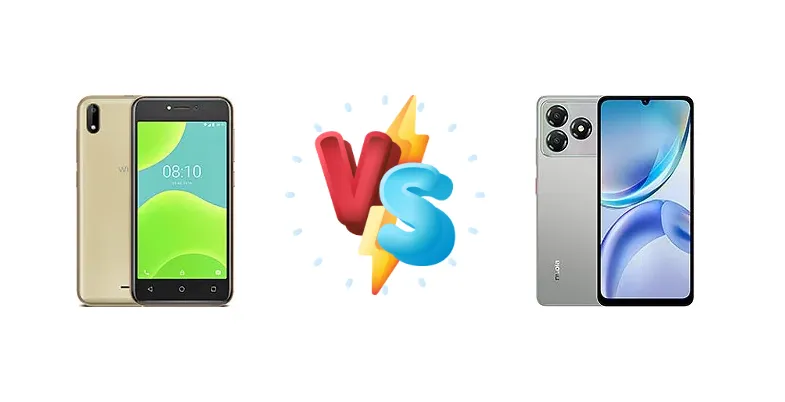
The Wiko Sunny4 and ZTE Blade A36 represent the ultra-budget end of the smartphone spectrum. While both aim to deliver essential functionality at a low price, they take drastically different approaches to achieving this. The Sunny4 prioritizes simplicity, while the Blade A36 attempts to offer a more modern chipset and extended battery endurance.
🏆 Quick Verdict
For the average user, the ZTE Blade A36 is the clear winner. Its Unisoc T7200 chipset, featuring Cortex-A75 cores, provides a significantly faster and more responsive experience than the Wiko Sunny4’s aging Cortex-A7 processor. The Blade A36’s impressive battery endurance further solidifies its position as the better overall value.
| Network |
|---|
| 2G bands | GSM 850 / 900 / 1800 / 1900 | GSM 850 / 900 / 1800 / 1900 |
| 3G bands | HSDPA 850 / 900 / 1900 / 2100 | HSDPA 850 / 900 / 1900 / 2100 |
| 4G bands | - | 1, 3, 5, 7, 8, 20, 28, 38, 40, 41 |
| Speed | HSPA 21.1/5.76 Mbps | HSPA, LTE |
| Technology | GSM / HSPA | GSM / HSPA / LTE |
| Launch |
|---|
| Announced | 2020. Released 2020 | 2025, June 18 |
| Status | Discontinued | Available. Released 2025, June |
| Body |
|---|
| Build | - | Glass front, plastic frame, plastic back |
| Dimensions | 146 x 73.5 x 8.7 mm (5.75 x 2.89 x 0.34 in) | 167.6 x 77.4 x 8.3 mm (6.60 x 3.05 x 0.33 in) |
| SIM | Nano-SIM + Micro-SIM | Nano-SIM + Nano-SIM |
| Weight | 160 g (5.64 oz) | - |
| Display |
|---|
| Protection | - | Mohs level 4 |
| Resolution | 480 x 854 pixels, 16:9 ratio (~196 ppi density) | 720 x 1600 pixels, 20:9 ratio (~260 ppi density) |
| Size | 5.0 inches, 68.9 cm2 (~64.2% screen-to-body ratio) | 6.75 inches, 110.0 cm2 (~84.8% screen-to-body ratio) |
| Type | TN TFT LCD | IPS LCD, 90Hz |
| Platform |
|---|
| CPU | Quad-core 1.3 GHz Cortex-A7 | Octa-core (2x1.6 GHz Cortex-A75 & 6x1.6 GHz Cortex-A55) |
| Chipset | - | Unisoc T7200 (12 nm) |
| GPU | - | Mali-G57 MP1 |
| OS | Android 8.1 (Oreo) | Android 15 |
| Memory |
|---|
| Card slot | microSDXC | microSDXC (dedicated slot) |
| Internal | 16GB 1GB RAM | 64GB 4GB RAM |
| | eMMC 5.1 | - |
| Main Camera |
|---|
| Features | LED flash, HDR, panorama | LED flash |
| Single | 5 MP | 13 MP, AF
Auxiliary lens |
| Video | 720p@30fps | 1080p@30fps |
| Selfie camera |
|---|
| Features | LED flash | - |
| Single | 5 MP | 5 MP |
| Video | - | Yes |
| Sound |
|---|
| 3.5mm jack | Yes | - |
| 35mm jack | Yes | Yes |
| Loudspeaker | Yes | Yes |
| Comms |
|---|
| Bluetooth | 4.2, A2DP, LE | 5.2, A2DP, LE |
| NFC | No | No |
| Positioning | GPS | GPS, GALILEO, GLONASS |
| Radio | FM radio | FM radio |
| USB | microUSB 2.0 | USB Type-C 2.0 |
| WLAN | Wi-Fi 802.11 b/g/n | Wi-Fi 802.11 a/b/g/n/ac |
| Features |
|---|
| Sensors | Accelerometer | Accelerometer, proximity, compass |
| Battery |
|---|
| Charging | - | 10W wired |
| Type | Li-Ion 2200 mAh | 5000 mAh |
| Misc |
|---|
| Colors | Dark Grey, Blue, Gold | Black, Green, Silver |
| Models | - | Z2472 |
| Price | About 50 EUR | About 60 EUR |
| EU LABEL |
|---|
| Battery | - | 54:13h endurance, 800 cycles |
| Energy | - | Class A |
| Free fall | - | Class D (80 falls) |
| Repairability | - | Class B |
Wiko Sunny4
- Potentially simpler user interface
- May be more affordable (depending on region)
- Lightweight and compact design (likely)
- Significantly slower processor
- Limited multitasking capabilities
- Inferior gaming performance
- Unknown battery life
ZTE Blade A36
- Faster and more responsive processor
- Excellent battery endurance (54:13h)
- 800 charge cycles for long-term reliability
- More capable for everyday tasks
- 10W charging is relatively slow
- May be slightly more expensive
- Potentially larger size/weight
Display Comparison
Neither device’s display specifications are provided, so we must infer. Given the price point, both likely feature LCD panels with 720p+ resolution. The Wiko Sunny4, given its simpler design, may have slightly larger bezels. Color accuracy is likely to be standard for this segment, with neither phone offering exceptional viewing angles or brightness. The absence of any mention of refresh rates suggests both are limited to the standard 60Hz.
Camera Comparison
Without detailed camera specifications, a direct comparison is difficult. However, it’s safe to assume both phones feature basic camera setups. The ZTE Blade A36 likely benefits from the increased processing power of the Unisoc T7200, allowing for faster image processing and potentially better low-light performance. The Wiko Sunny4’s limited processing capabilities will likely result in slower image capture and less effective noise reduction. The presence of a 2MP macro lens on either device is largely a marketing gimmick and should not be a deciding factor.
Performance
The performance gap is the most significant differentiator. The ZTE Blade A36’s Unisoc T7200, with its octa-core configuration (2x1.6 GHz Cortex-A75 & 6x1.6 GHz Cortex-A55) built on a 12nm process, represents a substantial leap over the Wiko Sunny4’s quad-core 1.3 GHz Cortex-A7. The Cortex-A75 cores in the Blade A36 offer significantly improved single-core performance, crucial for app launch speeds and general responsiveness. The 12nm process also contributes to better power efficiency. The Sunny4’s Cortex-A7 is an older architecture, resulting in noticeable lag when handling multiple apps or demanding tasks.
Battery Life
The ZTE Blade A36 excels in battery life, boasting a 54:13h endurance rating and 800 charge cycles. This indicates significantly longer usage between charges compared to the Wiko Sunny4, which lacks any specified battery endurance data. The Blade A36’s 10W wired charging is standard for this price range, but the long endurance minimizes the need for frequent top-ups. The Sunny4’s battery capacity is unknown, but given its simpler chipset, it likely requires less power, though it won’t match the Blade A36’s longevity.
Buying Guide
Buy the Wiko Sunny4 if you need a truly basic smartphone for calls, texts, and very light app usage, and prioritize extreme simplicity. It's a good option for first-time smartphone users or those needing a secondary device. Buy the ZTE Blade A36 if you prefer a phone that can handle multitasking, streaming, and occasional gaming without significant lag, and if long battery life is a priority. It’s the better choice for anyone wanting a more capable everyday smartphone.
Frequently Asked Questions
❓ Is the Unisoc T7200 in the ZTE Blade A36 powerful enough for casual gaming?
Yes, the Unisoc T7200 is capable of handling casual games and less demanding titles. While it won't deliver a high-end gaming experience, it provides a significantly smoother experience than the Wiko Sunny4’s processor for games like Candy Crush or Subway Surfers. Expect to adjust graphics settings for more demanding games.
❓ How does the 800 charge cycle rating of the ZTE Blade A36 impact its long-term usability?
The 800 charge cycle rating indicates that the Blade A36’s battery is designed to retain a significant portion of its capacity even after being charged and discharged 800 times. This translates to several years of reliable use before noticeable battery degradation, offering peace of mind and potentially extending the phone’s lifespan.
❓ Will the Wiko Sunny4 struggle with popular social media apps like Facebook and Instagram?
Yes, the Wiko Sunny4’s older Cortex-A7 processor and limited RAM will likely result in noticeable lag and slow loading times when using social media apps like Facebook and Instagram. The experience won’t be fluid, and multitasking between apps will be problematic.