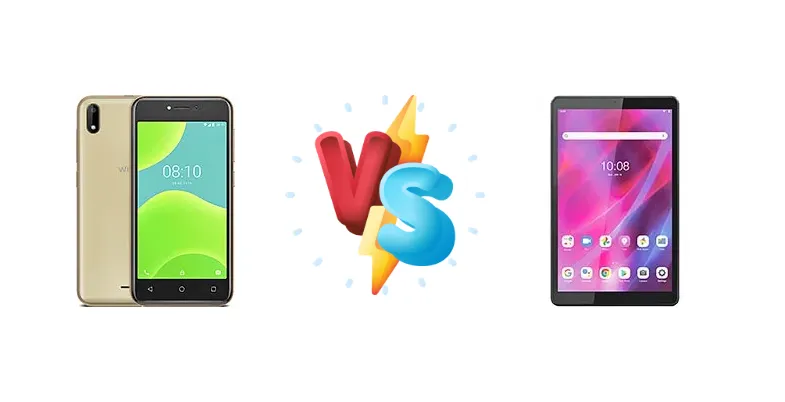
The budget tablet market is fiercely competitive, and the Wiko Sunny4 and Lenovo Tab M8 (3rd Gen) represent two compelling options for users seeking affordable Android experiences. While both aim to deliver functionality without breaking the bank, they take drastically different approaches to processing power, impacting everything from app responsiveness to multitasking capabilities. This comparison will dissect their key specifications to determine which tablet offers the best value.
🏆 Quick Verdict
For the average user prioritizing smooth multitasking and a responsive experience, the Lenovo Tab M8 (3rd Gen) is the clear winner. Its Mediatek MT8768T Helio P22T chipset, with its octa-core configuration, provides a significant performance advantage over the Wiko Sunny4’s quad-core Cortex-A7, making it better suited for everyday tasks and light gaming.
| Network |
|---|
| 2G bands | GSM 850 / 900 / 1800 / 1900 | GSM 850 / 900 / 1800 / 1900 |
| 3G bands | HSDPA 850 / 900 / 1900 / 2100 | HSDPA 850 / 900 / 1700(AWS) / 1900 / 2100 - International |
| 4G bands | - | 1, 2, 3, 4, 5, 19, 7, 8, 20, 26, 28, 38, 40, 41 - International |
| Speed | HSPA 21.1/5.76 Mbps | HSPA, LTE - cellular model only |
| Technology | GSM / HSPA | GSM / CDMA / HSPA / LTE |
| | - | 1, 3, 5, 7, 8, 34, 38, 39, 40, 41 - China |
| Launch |
|---|
| Announced | 2020. Released 2020 | 2021, June 28 |
| Status | Discontinued | Available. Released 2022, February |
| Body |
|---|
| Build | - | Glass front, aluminum back, aluminum frame |
| Dimensions | 146 x 73.5 x 8.7 mm (5.75 x 2.89 x 0.34 in) | 199.1 x 121.8 x 8.2 mm (7.84 x 4.80 x 0.32 in) |
| SIM | Nano-SIM + Micro-SIM | Nano-SIM (cellular model only) |
| Weight | 160 g (5.64 oz) | 305 g (10.76 oz) |
| Display |
|---|
| Resolution | 480 x 854 pixels, 16:9 ratio (~196 ppi density) | 800 x 1280 pixels, 16:10 ratio (~189 ppi density) |
| Size | 5.0 inches, 68.9 cm2 (~64.2% screen-to-body ratio) | 8.0 inches, 185.6 cm2 (~76.5% screen-to-body ratio) |
| Type | TN TFT LCD | TDDI IPS LCD, 350 nits (typ) |
| Platform |
|---|
| CPU | Quad-core 1.3 GHz Cortex-A7 | Octa-core (4x2.3 GHz Cortex-A53 & 4x1.8 GHz Cortex-A53) |
| Chipset | - | Mediatek MT8768T Helio P22T (12 nm) |
| GPU | - | PowerVR GE8320 |
| OS | Android 8.1 (Oreo) | Android 11 (Go edition) - 2 GB RAM versionAndroid 11 - 3 GB RAM version |
| Memory |
|---|
| Card slot | microSDXC | microSDXC (dedicated slot) |
| Internal | 16GB 1GB RAM | 32GB 2GB RAM, 32GB 3GB RAM |
| | eMMC 5.1 | eMMC 5.1 |
| Main Camera |
|---|
| Features | LED flash, HDR, panorama | - |
| Single | 5 MP | 5 MP, AF |
| Video | 720p@30fps | 1080p |
| Selfie camera |
|---|
| Features | LED flash | - |
| Single | 5 MP | 2 MP |
| Video | - | 720p |
| Sound |
|---|
| 3.5mm jack | Yes | Yes |
| 35mm jack | Yes | Yes |
| Loudspeaker | Yes | Yes |
| Comms |
|---|
| Bluetooth | 4.2, A2DP, LE | 5.0, A2DP, LE |
| NFC | No | No |
| Positioning | GPS | GPS, GLONASS, BDS - cellular model only |
| Radio | FM radio | FM radio |
| USB | microUSB 2.0 | USB Type-C 2.0, OTG |
| WLAN | Wi-Fi 802.11 b/g/n | Wi-Fi 802.11 a/b/g/n, dual-band, Wi-Fi Direct |
| Features |
|---|
| Sensors | Accelerometer | Accelerometer, proximity |
| Battery |
|---|
| Type | Li-Ion 2200 mAh | Li-Po 5100 mAh |
| Misc |
|---|
| Colors | Dark Grey, Blue, Gold | Iron Grey, Platinum Grey |
| Price | About 50 EUR | - |
Wiko Sunny4
- Potentially lower price point
- Functional for very basic tasks
- Lightweight and portable
- Significantly slower performance
- Outdated processor architecture
- Likely limited software support
Lenovo Tab M8 (3rd Gen)
- Faster and more responsive performance
- Octa-core processor for better multitasking
- More efficient chipset for longer battery life
- Slightly higher price
- Still a budget device with limitations
- May not support the latest Android versions for long
Display Comparison
Neither device boasts a particularly impressive display. Given the context data, we can assume both utilize LCD panels, common in this price bracket. However, the lack of specific display specs for the Wiko Sunny4 makes a direct comparison difficult. The Lenovo Tab M8’s 8-inch display benefits from the more powerful chipset driving its UI, resulting in smoother scrolling. While neither is likely to offer wide color gamut coverage, the Lenovo’s processor will likely handle video decoding more efficiently, leading to a better viewing experience. Bezels are expected to be substantial on both devices, reflecting their budget positioning.
Camera Comparison
Camera quality is unlikely to be a deciding factor for buyers in this segment. Both tablets likely feature basic camera sensors. Without specific details on the Wiko Sunny4’s camera, it’s safe to assume it’s comparable to, or slightly below, the Lenovo Tab M8’s. Focusing on the Lenovo, the Helio P22T’s ISP (Image Signal Processor) will offer some level of image processing, but don’t expect flagship-level results. These cameras are best suited for casual snapshots in good lighting conditions. Any claims of advanced features like HDR or night mode should be viewed with skepticism.
Performance
The performance disparity is the most significant difference between these tablets. The Wiko Sunny4’s quad-core 1.3 GHz Cortex-A7 processor is an older architecture, designed for basic smartphone functionality. In contrast, the Lenovo Tab M8 (3rd Gen) features the Mediatek MT8768T Helio P22T, an octa-core chip built on a more efficient 12nm process. The P22T’s configuration – four Cortex-A53 cores clocked at 2.3 GHz and four at 1.8 GHz – allows for better multitasking and handling of more demanding applications. This translates to faster app launch times, smoother web browsing, and a more responsive user interface on the Lenovo. The architectural difference alone – newer generation cores and more of them – provides a substantial advantage.
Battery Life
Battery life will depend heavily on usage patterns. Without knowing the battery capacity of the Wiko Sunny4, it’s difficult to make a direct comparison. However, the Lenovo Tab M8’s more efficient chipset and 12nm manufacturing process will likely result in better battery life under similar workloads. While the Lenovo’s charging wattage is not specified, it’s unlikely to support fast charging. Both tablets will likely require several hours to fully charge from 0-100%.
Buying Guide
Buy the Wiko Sunny4 if you need a tablet solely for extremely basic tasks like reading ebooks, simple web browsing, and occasional video playback, and your budget is exceptionally tight. It's a functional device for minimal usage. Buy the Lenovo Tab M8 (3rd Gen) if you prefer a more responsive and versatile tablet capable of handling multiple apps, streaming video comfortably, and offering a better overall user experience, even if it comes at a slightly higher price point.
Frequently Asked Questions
❓ Will the Lenovo Tab M8 (3rd Gen) be able to handle streaming services like Netflix and YouTube smoothly?
Yes, the Mediatek MT8768T Helio P22T chipset is capable of decoding 1080p video content without significant issues, making it suitable for streaming services like Netflix and YouTube. While it won't support the highest resolutions or frame rates, the experience should be smooth and enjoyable for most users.
❓ Is the Wiko Sunny4 suitable for playing games?
The Wiko Sunny4’s quad-core Cortex-A7 processor is not well-suited for gaming. While it might handle very simple 2D games, it will struggle with most modern 3D titles. Expect low frame rates, lag, and potential crashes. The Lenovo Tab M8 (3rd Gen) offers a slightly better gaming experience, but it’s still limited to less demanding games.
❓ How much storage does each tablet offer, and can it be expanded?
While the base storage configurations aren't specified, budget tablets typically offer 16GB or 32GB of internal storage. Both the Wiko Sunny4 and Lenovo Tab M8 (3rd Gen) likely feature a microSD card slot for storage expansion, allowing you to add more space for apps, photos, and videos. Check the specific model's specifications for maximum supported microSD card capacity.