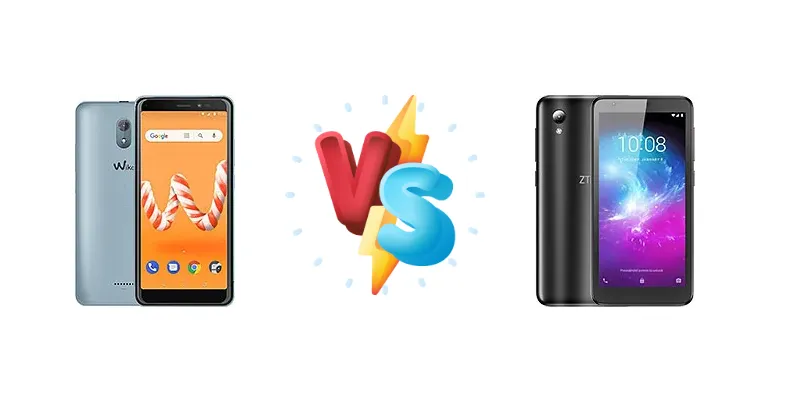
The Wiko Sunny3 Plus and ZTE Blade L8 represent the extreme end of the smartphone price spectrum. Both aim to deliver essential smartphone functionality at a minimal cost, but they achieve this with different hardware approaches. This comparison dissects their specifications to determine which offers the best value for users prioritizing affordability.
🏆 Quick Verdict
For the average user needing a basic, reliable smartphone for calls, texts, and light app usage, the ZTE Blade L8 edges out the Wiko Sunny3 Plus. The Unisoc SC7731E chipset, while not a powerhouse, offers a more modern architecture and potentially better efficiency than the aging Cortex-A7 in the Wiko.
| Network |
|---|
| 2G bands | GSM 850 / 900 / 1800 / 1900 | GSM 850 / 900 / 1800 / 1900 |
| 3G bands | HSDPA 850 / 900 / 2100 | HSDPA 900 / 2100 |
| Speed | HSPA 21.1/5.76 Mbps | HSPA 42.2/5.76 Mbps |
| Technology | GSM / HSPA | GSM / HSPA |
| Launch |
|---|
| Announced | 2019. Released 2019 | 2019, April. Released 2019, April |
| Status | Discontinued | Discontinued |
| Body |
|---|
| Dimensions | 148 x 72 x 9.3 mm (5.83 x 2.83 x 0.37 in) | 137.4 x 67.5 x 10.5 mm (5.41 x 2.66 x 0.41 in) |
| SIM | Dual SIM (Micro-SIM, dual stand-by) | Nano-SIM + Nano-SIM |
| Weight | 175 g (6.17 oz) | 144 g (5.08 oz) |
| Display |
|---|
| Resolution | 480 x 960 pixels, 18:9 ratio (~197 ppi density) | 480 x 960 pixels, 18:9 ratio (~215 ppi density) |
| Size | 5.45 inches, 76.7 cm2 (~71.9% screen-to-body ratio) | 5.0 inches, 64.5 cm2 (~69.6% screen-to-body ratio) |
| Type | TN TFT LCD | IPS LCD |
| Platform |
|---|
| CPU | Quad-core 1.3 GHz Cortex-A7 | Quad-core 1.3 GHz |
| Chipset | - | Unisoc SC7731E (28 nm) |
| GPU | Mali-400 MP2 | Mali-T820 MP1 |
| OS | Android 8.0 Oreo (Go edition) | Android 9.0 Pie (Go edition) |
| Memory |
|---|
| Card slot | microSDXC | microSDXC |
| Internal | 8GB 1GB RAM | 16GB 1GB RAM |
| Main Camera |
|---|
| Features | LED flash, HDR | LED flash, HDR |
| Single | 5 MP | 8 MP, AF |
| Video | 1080p@30fps | 720p@30fps |
| Selfie camera |
|---|
| Single | 2 MP | 5 MP |
| Sound |
|---|
| 3.5mm jack | Yes | Yes |
| 35mm jack | Yes | Yes |
| Loudspeaker | Yes | Yes |
| Comms |
|---|
| Bluetooth | 4.0, A2DP, LE | 4.2, A2DP, LE |
| NFC | No | No |
| Positioning | GPS | GPS, GLONASS |
| Radio | FM radio | FM radio |
| USB | microUSB 2.0 | microUSB 2.0 |
| WLAN | Wi-Fi 802.11 b/g/n | Wi-Fi 802.11 b/g/n |
| Features |
|---|
| Sensors | Accelerometer, proximity | Accelerometer |
| Battery |
|---|
| Type | Li-Ion 2200 mAh | Li-Ion 2000 mAh, non-removable |
| Misc |
|---|
| Colors | Anthracite, Gold, Cherry Red, Grey | Black, Blue |
| Price | About 50 EUR | About 60 EUR |
Wiko Sunny3 Plus
- Potentially the absolute lowest price point.
- Simple and straightforward user experience.
- Compact and lightweight design (likely).
- Outdated Cortex-A7 processor.
- Likely poor performance with demanding apps.
- Limited battery life due to inefficient processor.
ZTE Blade L8
- More modern Unisoc SC7731E chipset.
- Potentially better battery life due to 28nm process.
- Slightly more responsive user experience.
- Still limited performance overall.
- Basic camera capabilities.
- Likely slow charging speeds.
Display Comparison
Neither Wiko nor ZTE provide display specifications beyond size. Given the price bracket, both likely utilize LCD panels with modest resolutions (likely 720p or lower). The absence of detailed specs suggests neither phone will excel in brightness, color accuracy, or viewing angles. Expect significant compromises in display quality compared to mid-range or flagship devices. Bezels are likely to be substantial on both models, maximizing screen real estate within a compact form factor.
Camera Comparison
Detailed camera specifications are unavailable for either device. Given the target market, both phones likely feature basic camera sensors, potentially with a primary sensor around 5-8 megapixels. Expect limited low-light performance and a lack of advanced features like optical image stabilization (OIS). Any additional cameras (often 2MP macro lenses) are likely to be of limited practical use. Image processing will be basic, prioritizing speed over quality. Users should expect acceptable results in well-lit conditions but significant compromises elsewhere.
Performance
The core difference lies in the chipset. The Wiko Sunny3 Plus utilizes a Quad-core 1.3 GHz Cortex-A7 processor, an architecture dating back several years. The ZTE Blade L8, however, features the Unisoc SC7731E, a Quad-core 1.3 GHz chipset built on a 28nm process. While clock speeds are identical, the Unisoc chip benefits from a more modern design and fabrication process. The 28nm process generally translates to improved power efficiency, potentially leading to longer battery life. The Cortex-A7 is known for its limitations in handling demanding tasks, so the Unisoc SC7731E is likely to provide a smoother experience with everyday apps and multitasking.
Battery Life
Battery capacity is not specified for either device. However, the Unisoc SC7731E's 28nm process suggests it will be more power-efficient than the Cortex-A7 in the Wiko Sunny3 Plus. This efficiency advantage could translate to longer battery life, even with a similar battery capacity. Charging wattage is also unknown, but both phones likely support standard 5W charging, resulting in relatively slow charging times. Expect several hours to fully charge from 0-100%.
Buying Guide
Buy the Wiko Sunny3 Plus if you absolutely need the lowest possible upfront cost and are willing to accept potentially slower performance and a less refined user experience. Buy the ZTE Blade L8 if you prioritize a slightly more responsive system, potentially better battery life due to the more efficient chipset, and a device that feels a bit more modern despite the similar price point.
Frequently Asked Questions
❓ Will the ZTE Blade L8 be able to run popular social media apps like Facebook and WhatsApp smoothly?
Yes, the Unisoc SC7731E chipset should be sufficient to run basic social media apps like Facebook and WhatsApp without significant lag. However, expect slower loading times and occasional stutters when multitasking or using more demanding features within these apps.
❓ Is the Wiko Sunny3 Plus a good choice for someone who primarily uses their phone for calls and texts?
Yes, the Wiko Sunny3 Plus is a viable option for users who primarily need a phone for calls and texts. Its basic functionality is sufficient for these tasks, and its low price point makes it an attractive option for budget-conscious consumers. However, be prepared for a slower overall experience compared to more modern smartphones.
❓ Can either of these phones handle basic mobile games?
Both phones will struggle with most modern mobile games. Simple, 2D games may be playable at low settings, but demanding 3D titles will likely experience significant lag and frame rate drops. These phones are not designed for gaming.