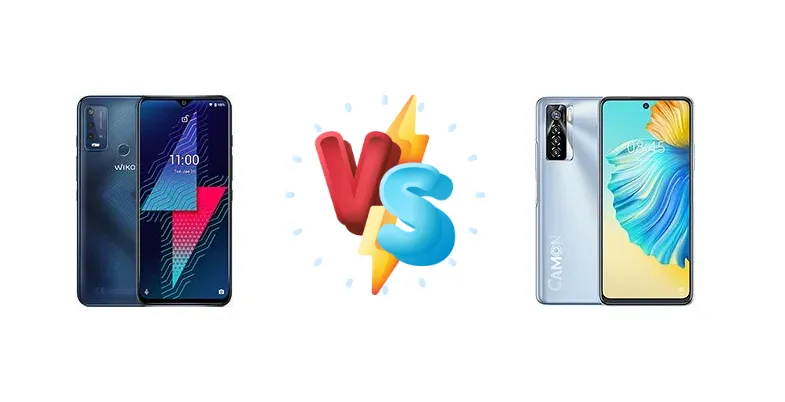
The Wiko Power U30 and Tecno Camon 17 Pro represent distinct approaches to the budget smartphone market. The Wiko prioritizes affordability and potentially longevity through a simpler chipset, while the Tecno aims for a more compelling user experience with a faster processor and quicker charging. This comparison dissects their key differences to determine which device delivers the best value.
🏆 Quick Verdict
For most users, the Tecno Camon 17 Pro is the superior choice. Its Helio G95 chipset provides a noticeable performance boost over the Wiko Power U30’s Helio G35, and the 25W/33W charging significantly reduces downtime compared to the Wiko’s 15W charging. While both offer similar battery endurance ratings, the Tecno’s faster charging is a critical advantage.
| Network |
|---|
| 2G bands | CDMA 800 / 1700 / 1900 | GSM 850 / 900 / 1800 / 1900 |
| 3G bands | HSDPA 850 / 900 / 1900 / 2100 | HSDPA 900 / 2100 |
| 4G bands | 1, 3, 5, 7, 8, 20, 28, 40 | LTE |
| Speed | HSPA 42.2/5.76 Mbps, LTE Cat4 150/50 Mbps | HSPA, LTE |
| Technology | CDMA / HSPA / LTE | GSM / HSPA / LTE |
| Launch |
|---|
| Announced | 2021, June | 2021, May 08 |
| Status | Available. Released 2021, June | Available. Released 2021, June 03 |
| Body |
|---|
| Dimensions | 173.8 x 78.6 x 9.5 mm (6.84 x 3.09 x 0.37 in) | 168.9 x 77 x 9 mm (6.65 x 3.03 x 0.35 in) |
| SIM | Nano-SIM + Nano-SIM | Nano-SIM + Nano-SIM |
| Weight | 214 g (7.55 oz) | 201 g (7.09 oz) |
| Display |
|---|
| Resolution | 720 x 1640 pixels (~263 ppi density) | 1080 x 2460 pixels (~395 ppi density) |
| Size | 6.82 inches, 110.5 cm2 (~80.9% screen-to-body ratio) | 6.8 inches, 109.8 cm2 (~84.4% screen-to-body ratio) |
| Type | IPS LCD | IPS LCD, 90Hz, 500 nits (HBM) |
| Platform |
|---|
| CPU | Octa-core (4x2.3 GHz Cortex-A53 & 4x1.8 GHz Cortex-A53) | Octa-core (2x2.05 GHz Cortex-A76 & 6x2.0 GHz Cortex-A55) |
| Chipset | Mediatek MT6765G Helio G35 (12 nm) | Mediatek MT6785V/CD Helio G95 (12 nm) |
| GPU | PowerVR GE8320 | Mali-G76 MC4 |
| OS | Android 11 | Android 11, HIOS 7.6 |
| Memory |
|---|
| Card slot | microSDXC | microSDXC (dedicated slot) |
| Internal | 64GB 4GB RAM, 128GB 4GB RAM | 128GB 8GB RAM, 256GB 8GB RAM |
| Main Camera |
|---|
| Features | LED flash, HDR | Quad-LED flash, panorama, HDR |
| Quad | - | 64 MP, f/1.8, 26mm (wide), 1/1.72", 0.8µm, PDAF
8 MP, f/2.3, 119˚ (ultrawide), 1/4.0", 1.12µm
2 MP, f/2.4, (monochrome)
Auxiliary lens |
| Single | 8 MP | 48 MP, f/2.2, (wide), 1/2.0", 0.8µm |
| Triple | 13 MP, AF
2 MP
Auxiliary lens | - |
| Video | 1080p@30fps | 4K@30fps, 1080p@30fps |
| Selfie camera |
|---|
| Features | - | Dual-LED flash |
| Single | 8 MP | 48 MP, f/2.2, (wide), 1/2.0", 0.8µm |
| Video | - | 1080p@30fps |
| Sound |
|---|
| 3.5mm jack | Yes | Yes |
| 35mm jack | Yes | Yes |
| Loudspeaker | Yes | Yes, with dual speakers |
| Comms |
|---|
| Bluetooth | 4.2, A2DP | 5.0, A2DP, LE |
| NFC | No | No |
| Positioning | GPS, GLONASS, GALILEO, BDS | GPS |
| Radio | No | FM radio, recording |
| USB | USB Type-C, OTG | USB Type-C 2.0, OTG |
| WLAN | Wi-Fi 802.11 b/g/n | Wi-Fi 802.11 b/g/n/ac, dual-band, Wi-Fi Direct |
| Features |
|---|
| Sensors | Fingerprint (rear-mounted), accelerometer, proximity, compass | Fingerprint (side-mounted), accelerometer, gyro, proximity, compass |
| Battery |
|---|
| Charging | 15W wired | 25W / 33W wired |
| Type | Li-Ion 6000 mAh | 5000 mAh |
| Misc |
|---|
| Colors | Carbon Blue, Midnight Blue, Mint | California Silver, Malibu Blue |
| Models | - | CG8, CG8h |
| Price | About 150 EUR | About 280 EUR |
| SAR | 0.58 W/kg (head) 1.36 W/kg (body) | - |
| Tests |
|---|
| Battery life | - |
Endurance rating 140h
|
| Camera | - |
Photo / Video |
| Display | - |
Contrast ratio: 781:1 (nominal) |
| Loudspeaker | - |
-24.4 LUFS (Very good)
|
| Performance | - |
AnTuTu: 309107 (v8)
GeekBench: 1668 (v5.1)
GFXBench: 17fps (ES 3.1 onscreen) |
Wiko Power U30
- Extremely affordable price point
- Potentially longer battery life due to simpler chipset
- Simple and straightforward user experience
- Significantly slower processor
- Slow 15W charging
- Limited performance for demanding tasks
Tecno Camon 17 Pro
- Faster and more responsive performance
- Significantly faster 25W/33W charging
- Brighter display for better outdoor visibility
- Likely higher price than the Wiko Power U30
- Battery life may be slightly less than Wiko due to more powerful processor
- Camera details are limited
Display Comparison
Both devices share a contrast ratio of 781:1, suggesting similar panel characteristics in terms of black levels. However, the Tecno Camon 17 Pro boasts a measured peak brightness of 538 nits, which will translate to better visibility outdoors compared to the Wiko Power U30, for which brightness data is unavailable. The lack of information regarding panel technology (IPS, AMOLED) for either device makes a definitive assessment of color accuracy difficult, but the higher brightness of the Tecno is a clear advantage.
Camera Comparison
Both devices are advertised with 'Photo / Video' capabilities, but detailed camera specifications are lacking. Without sensor size or aperture information, a direct comparison is challenging. However, the Tecno Camon 17 Pro, positioned as a 'Pro' model, likely incorporates a more sophisticated camera system. The absence of details on optical image stabilization (OIS) for either device suggests it’s unlikely to be present, meaning image stabilization will rely on software processing. The focus should be on real-world image samples to assess the quality of each device’s camera.
Performance
The core difference lies in the chipsets. The Tecno Camon 17 Pro’s Mediatek Helio G95 (12nm) features a more modern CPU architecture – two Cortex-A76 cores clocked at 2.05 GHz alongside six Cortex-A55 cores – compared to the Wiko Power U30’s Helio G35 (12nm) with its older Cortex-A53 configuration. This architectural leap translates to a substantial performance advantage for the Tecno, particularly in demanding applications and gaming. The G95’s more efficient cores also contribute to better sustained performance under load. While both are 12nm chips, the G95’s design is more optimized for performance.
Battery Life
Both the Wiko Power U30 and Tecno Camon 17 Pro achieve an endurance rating of 140 hours, indicating comparable battery life under similar usage conditions. However, the charging speeds are drastically different. The Wiko Power U30 is limited to 15W wired charging, while the Tecno Camon 17 Pro supports 25W or even 33W charging. This means the Tecno can replenish its battery significantly faster, reducing downtime and offering greater convenience. A full charge on the Wiko will take considerably longer.
Buying Guide
Buy the Wiko Power U30 if your primary need is an extremely affordable device for basic tasks like calls, messaging, and light social media use, and you prioritize maximizing battery life between charges over speed. Buy the Tecno Camon 17 Pro if you value a smoother, more responsive experience for gaming, multitasking, and photography, and you want the convenience of significantly faster charging to minimize downtime.
Frequently Asked Questions
❓ Is the Helio G95 in the Tecno Camon 17 Pro capable of playing demanding games like PUBG Mobile?
Yes, the Helio G95 is a capable gaming chipset. While it won't deliver flagship-level performance, it can comfortably run PUBG Mobile at medium to high settings with stable frame rates. The G95’s Cortex-A76 cores provide a significant performance boost over the Wiko’s G35, making it a much better choice for gaming.
❓ How long does it realistically take to fully charge the Wiko Power U30 with its 15W charging?
Given the 15W charging and typical battery capacity for this class of device, a full charge from 0% to 100% on the Wiko Power U30 will likely take between 3 to 4 hours. This is considerably slower than the Tecno Camon 17 Pro, which can achieve a full charge in around 1 to 1.5 hours with its faster charging technology.
❓ Does the Tecno Camon 17 Pro support any form of fast charging protocols like Power Delivery or Quick Charge?
While Tecno doesn't explicitly advertise specific fast charging protocols, the 25W/33W charging suggests compatibility with at least one of these standards. Using a compatible charger will further reduce charging times. However, the included charger may not be the fastest option.