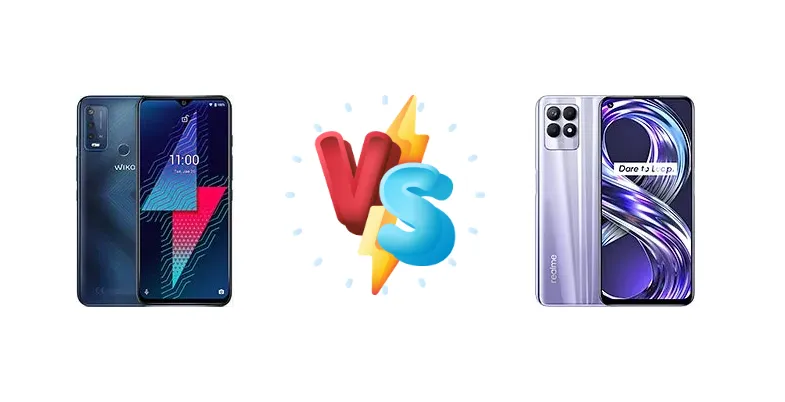
The sub-$200 smartphone market is fiercely competitive. The Wiko Power U30 aims to deliver essential features and long battery life, while the Realme 8i targets a more performance-oriented user with a more powerful chipset. This comparison dissects the key differences to determine which device offers the best value.
🏆 Quick Verdict
For most users, the Realme 8i is the superior choice. Its Helio G96 chipset provides a significantly faster experience than the Wiko Power U30’s Helio G35, making it better suited for gaming and demanding apps. While both phones offer similar battery endurance, the Realme 8i’s faster 18W charging is a welcome addition.
| Network |
|---|
| 2G bands | CDMA 800 / 1700 / 1900 | GSM 850 / 900 / 1800 / 1900 |
| 3G bands | HSDPA 850 / 900 / 1900 / 2100 | HSDPA 850 / 900 / 2100 |
| 4G bands | 1, 3, 5, 7, 8, 20, 28, 40 | 1, 3, 5, 8, 38, 40, 41 |
| Speed | HSPA 42.2/5.76 Mbps, LTE Cat4 150/50 Mbps | HSPA, LTE |
| Technology | CDMA / HSPA / LTE | GSM / HSPA / LTE |
| Launch |
|---|
| Announced | 2021, June | 2021, September 09 |
| Status | Available. Released 2021, June | Available. Released 2021, September 14 |
| Body |
|---|
| Build | - | Glass front, plastic frame, plastic back |
| Dimensions | 173.8 x 78.6 x 9.5 mm (6.84 x 3.09 x 0.37 in) | 164.1 x 75.5 x 8.5 mm (6.46 x 2.97 x 0.33 in) |
| SIM | Nano-SIM + Nano-SIM | Nano-SIM + Nano-SIM |
| Weight | 214 g (7.55 oz) | 194 g (6.84 oz) |
| Display |
|---|
| Resolution | 720 x 1640 pixels (~263 ppi density) | 1080 x 2412 pixels, 20:9 ratio (~400 ppi density) |
| Size | 6.82 inches, 110.5 cm2 (~80.9% screen-to-body ratio) | 6.6 inches, 104.8 cm2 (~84.6% screen-to-body ratio) |
| Type | IPS LCD | IPS LCD, 120Hz, 600 nits (peak) |
| Platform |
|---|
| CPU | Octa-core (4x2.3 GHz Cortex-A53 & 4x1.8 GHz Cortex-A53) | Octa-core (2x2.05 GHz Cortex-A76 & 6x2.0 GHz Cortex-A55) |
| Chipset | Mediatek MT6765G Helio G35 (12 nm) | Mediatek MT6781 Helio G96 (12 nm) |
| GPU | PowerVR GE8320 | Mali-G57 MC2 |
| OS | Android 11 | Android 11, Realme UI 2.0 |
| Memory |
|---|
| Card slot | microSDXC | microSDXC (dedicated slot) |
| Internal | 64GB 4GB RAM, 128GB 4GB RAM | 64GB 4GB RAM, 128GB 4GB RAM, 128GB 6GB RAM |
| | - | UFS 2.1 |
| Main Camera |
|---|
| Features | LED flash, HDR | LED flash, HDR, panorama |
| Single | 8 MP | 16 MP, f/2.1, (wide), 1/3.0", 1.0µm |
| Triple | 13 MP, AF
2 MP
Auxiliary lens | 50 MP, f/1.8, 26mm (wide), 1/2.76", 0.64µm, PDAF
2 MP (macro)
Auxiliary lens |
| Video | 1080p@30fps | 1080p@30fps |
| Selfie camera |
|---|
| Features | - | Panorama |
| Single | 8 MP | 16 MP, f/2.1, (wide), 1/3.0", 1.0µm |
| Video | - | 1080p@30fps |
| Sound |
|---|
| 3.5mm jack | Yes | Yes |
| 35mm jack | Yes | Yes |
| Loudspeaker | Yes | Yes |
| Comms |
|---|
| Bluetooth | 4.2, A2DP | 5.1, A2DP, LE |
| NFC | No | Yes (market/region dependent) |
| Positioning | GPS, GLONASS, GALILEO, BDS | GPS, GLONASS, GALILEO, BDS |
| Radio | No | No |
| USB | USB Type-C, OTG | USB Type-C 2.0, OTG |
| WLAN | Wi-Fi 802.11 b/g/n | Wi-Fi 802.11 a/b/g/n/ac, dual-band |
| Features |
|---|
| Sensors | Fingerprint (rear-mounted), accelerometer, proximity, compass | Fingerprint (side-mounted), accelerometer, gyro, proximity, compass |
| Battery |
|---|
| Charging | 15W wired | 18W wired |
| Type | Li-Ion 6000 mAh | 5000 mAh |
| Misc |
|---|
| Colors | Carbon Blue, Midnight Blue, Mint | Space Black, Space Purple |
| Models | - | RMX3151 |
| Price | About 150 EUR | About 440 EUR |
| SAR | 0.58 W/kg (head) 1.36 W/kg (body) | - |
| Tests |
|---|
| Battery life | - |
Endurance rating 131h
|
| Camera | - |
Photo / Video |
| Loudspeaker | - |
-28.4 LUFS (Average)
|
Wiko Power U30
- Potentially longer battery life due to simpler feature set.
- More affordable price point.
- Simple and easy-to-use interface.
- Significantly weaker performance compared to the Realme 8i.
- Less vibrant and potentially dimmer display.
- Limited camera capabilities.
Realme 8i
- Faster and more responsive performance with the Helio G96.
- Brighter and more vibrant display.
- Faster 18W charging.
- Slightly higher price.
- Battery life is comparable, not superior, to the Wiko Power U30.
- May require more frequent charging with heavy use.
Display Comparison
The Realme 8i boasts a brighter display, measured at 540 nits, compared to the Wiko Power U30, for which brightness data is unavailable. This higher brightness translates to better visibility outdoors. While both likely utilize IPS LCD panels, the Realme 8i’s 1244:1 contrast ratio suggests a more vibrant image. The lack of detailed display specifications for the Wiko Power U30 suggests a more basic panel, likely geared towards power efficiency rather than visual fidelity.
Camera Comparison
Both devices are listed as having Photo/Video capabilities, but detailed camera specifications are absent. Given the price point, image quality will likely be similar in good lighting conditions. However, the Realme 8i, being a slightly more premium offering, may benefit from more sophisticated image processing algorithms. The absence of information regarding sensor size and aperture makes a definitive comparison impossible, but it’s reasonable to assume the Realme 8i has a more capable primary camera. The inclusion of a 2MP macro camera on many phones in this segment is largely a marketing tactic, offering limited real-world benefit.
Performance
The Realme 8i’s Mediatek Helio G96 chipset represents a substantial upgrade over the Wiko Power U30’s Helio G35. The G96 features a more modern CPU architecture – two Cortex-A76 cores clocked at 2.05 GHz alongside six Cortex-A55 cores – compared to the G35’s four Cortex-A53 cores at 2.3 GHz and another four at 1.8 GHz. The A76 cores in the G96 deliver significantly better single-core performance, crucial for app launch speeds and general responsiveness. While the G35’s higher clock speed on its primary cores might seem appealing, the architectural advantages of the G96 outweigh this difference. Both chipsets are built on a 12nm process, but the G96’s more efficient design likely results in better sustained performance.
Battery Life
Both the Wiko Power U30 and Realme 8i achieve an endurance rating of 131 hours, indicating comparable battery life under similar usage scenarios. However, the Realme 8i’s 18W wired charging is faster than the Wiko Power U30’s 15W charging. This translates to quicker top-ups, reducing downtime. While both phones prioritize battery longevity, the Realme 8i offers a more convenient charging experience.
Buying Guide
Buy the Wiko Power U30 if you prioritize absolute simplicity and extended battery life for basic tasks like calls, messaging, and light social media use. You'll appreciate its affordability if you're on a very tight budget. Buy the Realme 8i if you want a more responsive experience for gaming, streaming, and multitasking, and value faster charging speeds. It’s the better option for users who demand more from their smartphone.
Frequently Asked Questions
❓ Is the Realme 8i’s Helio G96 chipset capable of running demanding games like PUBG Mobile?
Yes, the Helio G96 is specifically designed for gaming. While it won’t deliver flagship-level performance, it can comfortably run PUBG Mobile at medium to high settings with stable frame rates. The improved CPU and GPU architecture compared to the Wiko Power U30’s Helio G35 make a significant difference in gaming performance.
❓ How long does it realistically take to fully charge the Wiko Power U30 with its 15W charger?
Given the 15W charging and likely battery capacity (not specified, but estimated around 6000mAh based on the 'Power' branding), a full charge from 0% will likely take between 3.5 to 4.5 hours. This is considerably slower than the Realme 8i’s 18W charging.
❓ Does the Realme 8i support fast charging protocols beyond the standard 18W?
The Realme 8i supports 18W PD (Power Delivery) fast charging. While it may be compatible with some higher-wattage chargers, it will only draw up to 18W. Using a higher wattage charger won't result in significantly faster charging speeds.
❓ Is the Wiko Power U30 a good choice for elderly users who primarily need a phone for calls and messaging?
Yes, the Wiko Power U30 is a suitable option for elderly users with basic needs. Its simplicity, long battery life, and affordability make it a practical choice for those who primarily use a phone for calls, messaging, and occasional photos.