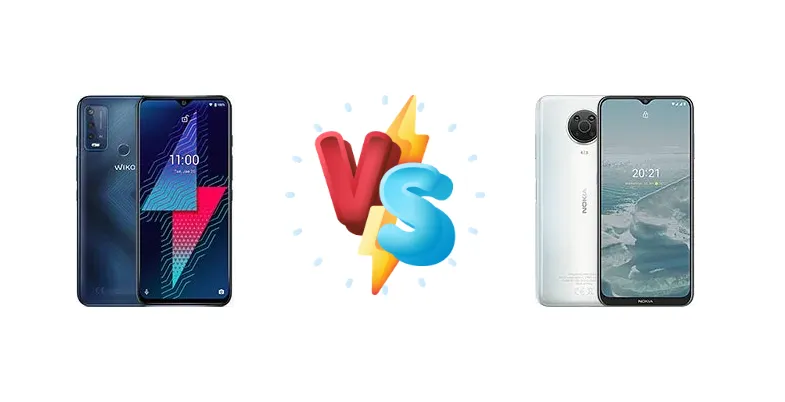
The Wiko Power U30 and Nokia G20 represent the ultra-budget end of the smartphone spectrum, targeting users prioritizing affordability and essential functionality. Both devices utilize the same Mediatek Helio G35 chipset, making the differences subtle but potentially impactful for daily use. This comparison focuses on where those differences matter most – specifically, charging speed and overall value.
🏆 Quick Verdict
For the average user, the Wiko Power U30 emerges as the slightly better choice. While both phones offer identical processing power thanks to the Helio G35, the Wiko’s 15W charging significantly outperforms the Nokia G20’s 10W charging, reducing downtime and improving usability for those who rely heavily on their phones throughout the day.
| Network |
|---|
| 2G bands | CDMA 800 / 1700 / 1900 | GSM 850 / 900 / 1800 / 1900 |
| 3G bands | HSDPA 850 / 900 / 1900 / 2100 | HSDPA 850 / 900 / 1900 / 2100 - International |
| 4G bands | 1, 3, 5, 7, 8, 20, 28, 40 | 1, 3, 5, 7, 8, 20, 28, 38, 40, 41 - International |
| Speed | HSPA 42.2/5.76 Mbps, LTE Cat4 150/50 Mbps | HSPA 42.2/5.76 Mbps, LTE Cat4 150/50 Mbps |
| Technology | CDMA / HSPA / LTE | GSM / HSPA / LTE |
| | - | 1, 2, 3, 4, 5, 7, 8, 12, 17, 28, 66 - LATAM |
| Launch |
|---|
| Announced | 2021, June | 2021, April 08 |
| Status | Available. Released 2021, June | Available. Released 2021, May 17 |
| Body |
|---|
| Dimensions | 173.8 x 78.6 x 9.5 mm (6.84 x 3.09 x 0.37 in) | 164.9 x 76 x 9.2 mm (6.49 x 2.99 x 0.36 in) |
| SIM | Nano-SIM + Nano-SIM | · Nano-SIM· Nano-SIM + Nano-SIM |
| Weight | 214 g (7.55 oz) | 197 g (6.95 oz) |
| | - | Splash protection |
| Display |
|---|
| Resolution | 720 x 1640 pixels (~263 ppi density) | 720 x 1600 pixels, 20:9 ratio (~269 ppi density) |
| Size | 6.82 inches, 110.5 cm2 (~80.9% screen-to-body ratio) | 6.52 inches, 102.6 cm2 (~81.9% screen-to-body ratio) |
| Type | IPS LCD | IPS LCD |
| Platform |
|---|
| CPU | Octa-core (4x2.3 GHz Cortex-A53 & 4x1.8 GHz Cortex-A53) | Octa-core (4x2.3 GHz Cortex-A53 & 4x1.8 GHz Cortex-A53) |
| Chipset | Mediatek MT6765G Helio G35 (12 nm) | Mediatek MT6765G Helio G35 (12 nm) |
| GPU | PowerVR GE8320 | PowerVR GE8320 |
| OS | Android 11 | Android 11, upgradable to Android 13 |
| Memory |
|---|
| Card slot | microSDXC | microSDXC (dedicated slot) |
| Internal | 64GB 4GB RAM, 128GB 4GB RAM | 64GB 4GB RAM, 128GB 4GB RAM |
| Main Camera |
|---|
| Features | LED flash, HDR | LED flash, HDR, panorama |
| Quad | - | 48 MP, f/1.8, (wide), PDAF
5 MP, (ultrawide)
2 MP (macro)
Auxiliary lens |
| Single | 8 MP | 8 MP, (wide) |
| Triple | 13 MP, AF
2 MP
Auxiliary lens | - |
| Video | 1080p@30fps | 1080p@30fps |
| Selfie camera |
|---|
| Single | 8 MP | 8 MP, (wide) |
| Video | - | 1080p@30fps |
| Sound |
|---|
| 3.5mm jack | Yes | Yes |
| 35mm jack | Yes | Yes |
| Loudspeaker | Yes | Yes |
| Comms |
|---|
| Bluetooth | 4.2, A2DP | 5.0, A2DP, LE |
| NFC | No | Yes (market/region dependent) |
| Positioning | GPS, GLONASS, GALILEO, BDS | GPS, GLONASS, BDS |
| Radio | No | FM radio |
| USB | USB Type-C, OTG | USB Type-C 2.0, OTG |
| WLAN | Wi-Fi 802.11 b/g/n | Wi-Fi 802.11 b/g/n |
| Features |
|---|
| Sensors | Fingerprint (rear-mounted), accelerometer, proximity, compass | Fingerprint (side-mounted), accelerometer, gyro, proximity |
| Battery |
|---|
| Charging | 15W wired | 10W wired |
| Type | Li-Ion 6000 mAh | Li-Po 5050 mAh |
| Misc |
|---|
| Colors | Carbon Blue, Midnight Blue, Mint | Glacier, Night |
| Models | - | TA-1336, TA-1343, TA-1347, TA-1372, TA-1365 |
| Price | About 150 EUR | About 90 EUR |
| SAR | 0.58 W/kg (head) 1.36 W/kg (body) | 1.01 W/kg (head) 1.02 W/kg (body) |
| SAR EU | - | 0.49 W/kg (head) 1.13 W/kg (body) |
Wiko Power U30
- Faster 15W charging for quicker top-ups
- Identical processing power to Nokia G20 at a potentially lower price
- Large battery capacity (likely 5000mAh)
- Wiko brand recognition is lower than Nokia
- Software updates may be less frequent
Nokia G20
- Nokia’s reputation for software reliability and updates
- Potentially cleaner Android experience
- Strong brand recognition and trust
- Slower 10W charging significantly increases charging time
- Identical processing power to Wiko Power U30
Display Comparison
Neither Wiko nor Nokia provide detailed display specifications beyond the basic panel type. Given the price point, both likely utilize IPS LCD panels with 720p+ resolution. Expect similar color accuracy and viewing angles. The absence of high refresh rates or advanced features like LTPO is standard for this segment. Bezels are likely to be substantial on both devices, maximizing screen real estate within a budget-friendly form factor.
Camera Comparison
Camera details are sparse, but both phones likely feature a multi-camera setup with a primary sensor and potentially depth or macro lenses. Given the market segment, image quality will be adequate in good lighting conditions but will struggle in low light. The absence of Optical Image Stabilization (OIS) is expected. Focusing on the primary sensor’s megapixel count is less important than the sensor size and image processing algorithms, which are not specified. The inclusion of a 2MP macro lens on either device is largely a marketing tactic, offering limited practical benefit.
Performance
Both the Wiko Power U30 and Nokia G20 are powered by the Mediatek Helio G35 (12 nm) chipset, featuring an octa-core CPU configuration of 4x2.3 GHz Cortex-A53 and 4x1.8 GHz Cortex-A53 cores. This means performance will be virtually identical for everyday tasks like browsing, social media, and light app usage. The GPU performance will also be the same, limiting gaming to less demanding titles at lower settings. RAM configurations are not specified, but likely hover around 3-4GB, which is sufficient for basic multitasking. Thermal management will be adequate for the workload, as the Helio G35 is a low-power chip.
Battery Life
Both devices prioritize battery life, but the Wiko Power U30 gains a significant advantage with its 15W wired charging. The Nokia G20 is limited to 10W charging. While both likely house batteries around the 5000mAh mark (though not confirmed), the faster charging speed of the Wiko translates to a considerably quicker 0-100% charge time. This is crucial for users who need to top up their phones quickly during the day. The difference between a 3-hour charge (Nokia) and a 2-hour charge (Wiko) is substantial.
Buying Guide
Buy the Wiko Power U30 if you need faster charging and prioritize minimizing downtime. Its 15W charging capability is a clear advantage for users who frequently find themselves needing a quick power boost. Buy the Nokia G20 if you prefer the Nokia brand’s reputation for software support and a potentially cleaner Android experience, and are willing to trade charging speed for that peace of mind.
Frequently Asked Questions
❓ How much faster is the charging on the Wiko Power U30 compared to the Nokia G20?
The Wiko Power U30’s 15W charging is approximately 50% faster than the Nokia G20’s 10W charging. This translates to a significant reduction in charging time, potentially shaving off over an hour for a full charge.
❓ Will I notice a difference in performance between these two phones when using apps like WhatsApp and Facebook?
No, you will not notice a performance difference. Both phones utilize the same Mediatek Helio G35 chipset and CPU configuration, meaning they will perform identically for everyday tasks like social media, messaging, and web browsing.
❓ Are software updates guaranteed on either the Wiko Power U30 or the Nokia G20?
Nokia generally provides more consistent software updates and security patches than Wiko. While neither phone is likely to receive major Android version updates for an extended period, the Nokia G20 is more likely to receive timely security updates.
❓ Is the camera quality on either phone good enough for casual snapshots?
Both phones will be adequate for casual snapshots in good lighting conditions. However, expect limited performance in low light, and don't expect professional-quality results. The image processing will likely prioritize speed over detail.