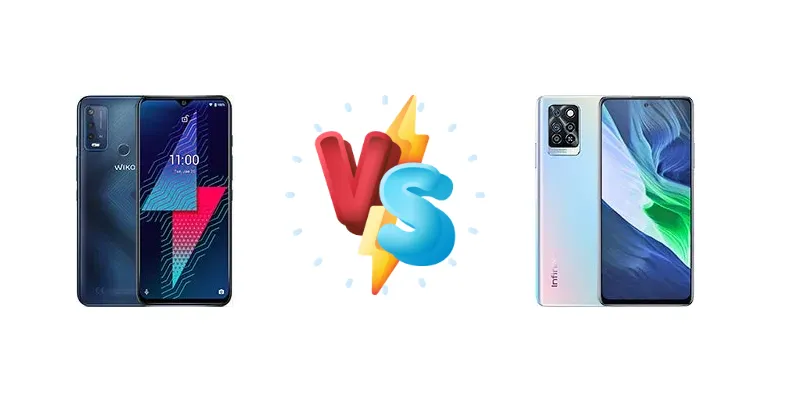
The Wiko Power U30 and Infinix Note 10 Pro NFC represent distinct approaches to the budget smartphone market. The Wiko prioritizes affordability and potentially longevity through a less demanding chipset, while the Infinix aims for a more robust user experience with a faster processor and significantly quicker charging. This comparison dissects their key differences to help you determine which aligns best with your needs.
🏆 Quick Verdict
For most users, the Infinix Note 10 Pro NFC is the superior choice. Its Helio G95 chipset delivers noticeably better performance, and the 33W fast charging is a game-changer compared to the Wiko’s 15W charging. While the Wiko offers a lower entry price, the Infinix provides a more responsive and convenient daily experience.
| Network |
|---|
| 2G bands | CDMA 800 / 1700 / 1900 | GSM 850 / 900 / 1800 / 1900 |
| 3G bands | HSDPA 850 / 900 / 1900 / 2100 | HSDPA 850 / 900 / 1700(AWS) / 1900 / 2100 |
| 4G bands | 1, 3, 5, 7, 8, 20, 28, 40 | 1, 2, 3, 4, 5, 7, 8, 20, 28, 38, 41, 40, 66 |
| Speed | HSPA 42.2/5.76 Mbps, LTE Cat4 150/50 Mbps | HSPA, LTE |
| Technology | CDMA / HSPA / LTE | GSM / HSPA / LTE |
| | - | 1, 3, 7, 8, 20, 28 |
| Launch |
|---|
| Announced | 2021, June | 2021, May 12 |
| Status | Available. Released 2021, June | Available. Released 2021, June 07 |
| Body |
|---|
| Dimensions | 173.8 x 78.6 x 9.5 mm (6.84 x 3.09 x 0.37 in) | 172.8 x 78.3 x 7.8 mm (6.80 x 3.08 x 0.31 in) |
| SIM | Nano-SIM + Nano-SIM | Nano-SIM + Nano-SIM |
| Weight | 214 g (7.55 oz) | - |
| Display |
|---|
| Resolution | 720 x 1640 pixels (~263 ppi density) | 1080 x 2460 pixels (~387 ppi density) |
| Size | 6.82 inches, 110.5 cm2 (~80.9% screen-to-body ratio) | 6.95 inches, 114.7 cm2 (~84.8% screen-to-body ratio) |
| Type | IPS LCD | IPS LCD, 90Hz |
| Platform |
|---|
| CPU | Octa-core (4x2.3 GHz Cortex-A53 & 4x1.8 GHz Cortex-A53) | Octa-core (2x2.05 GHz Cortex-A76 & 6x2.0 GHz Cortex-A55) |
| Chipset | Mediatek MT6765G Helio G35 (12 nm) | Mediatek MT6785V/CD Helio G95 (12 nm) |
| GPU | PowerVR GE8320 | Mali-G76 MC4 |
| OS | Android 11 | Android 11, XOS 7.6 |
| Memory |
|---|
| Card slot | microSDXC | microSDXC (dedicated slot) |
| Internal | 64GB 4GB RAM, 128GB 4GB RAM | 128GB 6GB RAM, 256GB 8GB RAM |
| | - | UFS 2.2 |
| Main Camera |
|---|
| Features | LED flash, HDR | Quad-LED flash, HDR, panorama |
| Quad | - | 64 MP, f/1.9, (wide), 1/1.72", 0.8µm, PDAF
8 MP, f/2.3, 120˚ (ultrawide)
2 MP, f/2.4, (monochrome)
Auxiliary lens |
| Single | 8 MP | 16 MP, (wide) |
| Triple | 13 MP, AF
2 MP
Auxiliary lens | - |
| Video | 1080p@30fps | 4K@30fps, 1080p@30fps |
| Selfie camera |
|---|
| Single | 8 MP | 16 MP, f/2.0, (wide), 1/3.09" |
| Video | - | 1080p@30fps |
| Sound |
|---|
| 3.5mm jack | Yes | Yes |
| 35mm jack | Yes | Yes |
| Loudspeaker | Yes | Yes, with dual speakers |
| Comms |
|---|
| Bluetooth | 4.2, A2DP | 5.0, A2DP, LE |
| NFC | No | Yes |
| Positioning | GPS, GLONASS, GALILEO, BDS | GPS |
| Radio | No | FM radio |
| USB | USB Type-C, OTG | USB Type-C 2.0, OTG |
| WLAN | Wi-Fi 802.11 b/g/n | Wi-Fi 802.11 a/b/g/n/ac, dual-band, Wi-Fi Direct |
| Features |
|---|
| Sensors | Fingerprint (rear-mounted), accelerometer, proximity, compass | Fingerprint (side-mounted), accelerometer, gyro, proximity, compass |
| Battery |
|---|
| Charging | 15W wired | 33W wired |
| Type | Li-Ion 6000 mAh | 5000 mAh |
| Misc |
|---|
| Colors | Carbon Blue, Midnight Blue, Mint | Black, Purple, Nordic Secret |
| Models | - | X695C |
| Price | About 150 EUR | - |
| SAR | 0.58 W/kg (head) 1.36 W/kg (body) | - |
Wiko Power U30
- Lowest possible price point
- Potentially longer battery life due to less demanding chipset
- Simple and straightforward user experience
- Significantly slower performance
- Slow 15W charging
- Likely inferior camera quality
Infinix Note 10 Pro NFC
- Faster and more responsive performance
- 33W fast charging for quick top-ups
- More capable camera system
- Higher price than the Wiko Power U30
- Potentially slightly shorter battery life (offset by fast charging)
- May experience more heat under heavy load
Display Comparison
Neither device boasts a particularly standout display. Both utilize 12nm chipsets, suggesting similar power constraints impacting display capabilities. While specific display specs (resolution, panel type) are missing for the Wiko, the Infinix Note 10 Pro NFC’s display is likely the brighter and more vibrant of the two, given its positioning as a more feature-rich device. The absence of high refresh rates on either phone suggests a focus on power efficiency rather than visual fluidity.
Camera Comparison
Without detailed camera specifications, a direct comparison is difficult. However, the Infinix Note 10 Pro NFC is likely to offer a more versatile camera system. The G95’s ISP (Image Signal Processor) is more advanced, enabling better image processing and potentially superior low-light performance. While both phones likely include a standard array of lenses, the Infinix’s processing power will likely result in more detailed and dynamic photos. The Wiko’s camera will likely suffice for casual snapshots, but the Infinix will appeal to users who prioritize image quality.
Performance
The core difference lies in the chipsets. The Infinix Note 10 Pro NFC’s Mediatek Helio G95 (2x2.05 GHz Cortex-A76 & 6x2.0 GHz Cortex-A55) is a significant upgrade over the Wiko Power U30’s Helio G35 (4x2.3 GHz Cortex-A53 & 4x1.8 GHz Cortex-A53). The G95 utilizes newer Cortex-A76 cores, offering substantially improved single-core performance, crucial for app launch speeds and general responsiveness. The G35’s older Cortex-A53 cores, while efficient, will struggle with demanding tasks. This translates to a smoother multitasking experience and better gaming performance on the Infinix. The G95’s GPU is also more capable, allowing for higher frame rates in games.
Battery Life
Both phones aim for all-day battery life, but achieve it differently. The Wiko Power U30 relies on a less power-hungry chipset to maximize runtime. However, the Infinix Note 10 Pro NFC’s 33W charging is a massive advantage. While battery capacity isn’t specified, the faster charging significantly reduces downtime. The Wiko’s 15W charging will take considerably longer to replenish the battery, making the Infinix a more convenient option for users who frequently need to top up their device.
Buying Guide
Buy the Wiko Power U30 if you absolutely need the lowest possible upfront cost and prioritize extended battery life over performance. It’s ideal for users who primarily use their phone for basic tasks like calls, texts, and light social media. Buy the Infinix Note 10 Pro NFC if you value a smoother, more responsive experience, enjoy mobile gaming, and appreciate the convenience of fast charging. It’s the better option for users who demand more from their smartphone.
Frequently Asked Questions
❓ Will the Infinix Note 10 Pro NFC struggle with graphically intensive games like PUBG Mobile?
While not a flagship gaming phone, the Helio G95 in the Infinix Note 10 Pro NFC is capable of running PUBG Mobile at medium to high settings with reasonable frame rates. Expect some frame drops during intense firefights, but it’s a far more playable experience than the Wiko Power U30’s Helio G35.
❓ Is the 15W charging on the Wiko Power U30 slow enough to be a major inconvenience?
Yes, 15W charging is significantly slower than the 33W charging on the Infinix Note 10 Pro NFC. A full charge on the Wiko will take several hours, making it less convenient for users who need to quickly top up their battery throughout the day. It's best suited for overnight charging.
❓ Does the Infinix Note 10 Pro NFC support VoLTE and VoWiFi for improved call quality?
The Infinix Note 10 Pro NFC *generally* supports VoLTE and VoWiFi, but compatibility depends on your carrier. It's crucial to check with your mobile provider to ensure these features are supported in your region for optimal call quality.
❓ How does the Helio G35 in the Wiko Power U30 handle multitasking with several apps open?
The Helio G35 is a basic processor and will struggle with heavy multitasking. Expect noticeable lag and app reloading when switching between multiple apps. It's best to keep the number of open apps to a minimum for a smoother experience.