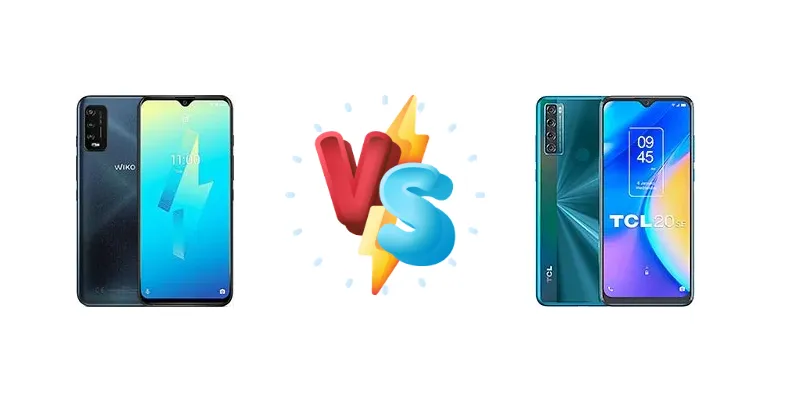
The Wiko Power U10 and TCL 20 SE represent compelling options in the ultra-budget smartphone segment. Both aim to deliver essential functionality at a low price point, but they take different approaches to achieving this. The Wiko prioritizes a large battery and a newer, albeit entry-level, MediaTek chipset, while the TCL opts for a Qualcomm Snapdragon and faster charging. This comparison will dissect their key differences to help you determine which device best suits your needs.
🏆 Quick Verdict
For the average user prioritizing consistent performance and faster charging, the TCL 20 SE emerges as the better choice. Its Snapdragon 460 chipset, built on an 11nm process, offers a more refined experience than the Wiko’s Helio G35, despite the latter’s slightly higher clock speeds. The 18W charging is a significant advantage over the Wiko's likely slower charging.
| Network |
|---|
| 2G bands | CDMA 800 / 1700 / 1900 | GSM 850 / 900 / 1800 / 1900 |
| 3G bands | HSDPA 850 / 900 / 1900 / 2100 | HSDPA 850 / 900 / 1900 / 2100 - EMEA, SEA, APAC |
| 4G bands | 1, 3, 5, 7, 8, 20, 40 | 1, 3, 5, 7, 8, 20, 28, 38, 40, 41 - EMEA, SEA, APAC |
| Speed | HSPA 42.2/5.76 Mbps, LTE Cat4 150/50 Mbps | HSPA, LTE |
| Technology | CDMA / HSPA / LTE | GSM / HSPA / LTE |
| | - | 1, 2, 3, 4, 5, 7, 8, 12, 13, 17, 26, 28, 66 - LATAM |
| Launch |
|---|
| Announced | 2021, June | 2021, January 11 |
| Status | Available. Released 2021, June | Available. Released 2021, April 26 |
| Body |
|---|
| Dimensions | 173.8 x 78.6 x 9.5 mm (6.84 x 3.09 x 0.37 in) | 172.1 x 77.1 x 9.1 mm (6.78 x 3.04 x 0.36 in) |
| SIM | Nano-SIM + Nano-SIM | · Nano-SIM· Nano-SIM + Nano-SIM |
| Weight | 206 g (7.27 oz) | 206 g (7.27 oz) |
| Display |
|---|
| Resolution | 720 x 1640 pixels (~263 ppi density) | 720 x 1640 pixels (~263 ppi density) |
| Size | 6.82 inches, 110.5 cm2 (~80.9% screen-to-body ratio) | 6.82 inches, 110.5 cm2 (~83.2% screen-to-body ratio) |
| Type | IPS LCD | IPS LCD, 450 nits (typ) |
| Platform |
|---|
| CPU | Octa-core (4x2.3 GHz Cortex-A53 & 4x1.8 GHz Cortex-A53) | Octa-core (4x1.8 GHz Kryo 240 & 4x1.6 GHz Kryo 240) |
| Chipset | Mediatek MT6765G Helio G35 (12 nm) | Qualcomm SM4250 Snapdragon 460 (11 nm) |
| GPU | PowerVR GE8320 | Adreno 610 |
| OS | Android 11 (Go edition) | Android 11, upgradable to Android 12, TCL UI |
| Memory |
|---|
| Card slot | microSDXC | microSDXC (uses shared SIM slot) |
| Internal | 32GB 2GB RAM, 32GB 3GB RAM | 64GB 4GB RAM, 128GB 4GB RAM |
| | - | UFS 2.1 (128GB only) |
| Main Camera |
|---|
| Features | LED flash, HDR | Dual-LED flash, HDR, panorama |
| Quad | - | 16 MP, f/1.8, 27mm (wide), 1/2.0", 1.12µm, PDAF
5 MP, f/2.2, 14mm, 115˚ (ultrawide), 1/5.0", 1.12µm
Auxiliary lens
2 MP (macro)
or
48 MP, f/2.0, 27mm (wide), 1/2.0", 0.8µm, PDAF
5 MP, f/2.2, 14mm, 115˚ (ultrawide), 1/5.0", 1.12µm
Auxiliary lens
2 MP (macro) |
| Single | 13 MP, AF | - |
| Video | 1080p@30fps | 1080p@30fps |
| Selfie camera |
|---|
| Features | - | HDR |
| Single | 5 MP | 8 MP, f/2.0, 26mm (wide), 1/4.0", 1.12µm
or
13 MP, f/2.2, 26mm (wide), 1/3.0", 1.12µm |
| Video | - | 1080p@30fps |
| Sound |
|---|
| 3.5mm jack | Yes | Yes |
| 35mm jack | Yes | Yes |
| Loudspeaker | Yes | Yes, with dual speakers |
| | - | 24-bit/192kHz audio |
| Comms |
|---|
| Bluetooth | 4.2, A2DP | 5.0, A2DP, LE, aptX |
| NFC | No | Yes |
| Positioning | GPS, GLONASS, GALILEO, BDS | GPS, GLONASS, GALILEO, BDS |
| Radio | FM Radio | FM radio |
| USB | USB Type-C 2.0, OTG | USB Type-C 2.0, OTG |
| WLAN | Wi-Fi 802.11 b/g/n | Wi-Fi 802.11 b/g/n, Wi-Fi Direct |
| Features |
|---|
| Sensors | Fingerprint (side-mounted), accelerometer, proximity, compass | Fingerprint (rear-mounted), accelerometer, proximity, compass |
| Battery |
|---|
| Charging | - | 18W wired |
| Type | Li-Ion 5000 mAh | Li-Po 5000 mAh |
| Misc |
|---|
| Colors | Carbon Blue, Denim Blue, Turquoise | Aurora Green, Nuit Black |
| Models | W-V745-EEA, W-V745-OPE | T671H, T671F, T671O, T671E |
| Price | About 100 EUR | About 150 EUR |
| SAR | 0.52 W/kg (head) 1.36 W/kg (body) | - |
Wiko Power U10
- Potentially larger battery capacity for extended runtime.
- Slightly higher CPU clock speeds on paper.
- May be more affordable depending on regional pricing.
- Less efficient MediaTek Helio G35 chipset.
- Likely slower charging speeds.
- Potentially more throttling under sustained load.
TCL 20 SE
- More efficient Qualcomm Snapdragon 460 chipset.
- Faster 18W wired charging.
- Better sustained performance and thermal management.
- Potentially smaller battery capacity.
- May be slightly more expensive.
- Camera performance may not be significantly better.
Display Comparison
Neither device is expected to boast a premium display. Details are missing, but given the price bracket, both likely feature LCD panels with 720p+ resolution. The TCL 20 SE’s display quality will likely be marginally better due to TCL’s broader experience in display technology, but neither will challenge flagship-level brightness or color accuracy. Expect significant bezels on both devices.
Camera Comparison
Camera performance is likely to be similar, with both devices targeting the entry-level market. Details are scarce, but it’s safe to assume both will feature a primary camera and potentially a depth or macro sensor. The TCL 20 SE may have a slight edge due to Qualcomm’s image signal processor (ISP), which generally offers better noise reduction and dynamic range. However, without specific sensor size and aperture information, it’s difficult to definitively declare a winner. Expect limited low-light performance from both.
Performance
The core difference lies in the chipsets. The TCL 20 SE’s Qualcomm Snapdragon 460 (11nm) benefits from Qualcomm’s optimized architecture and a more efficient manufacturing process compared to the Wiko Power U10’s MediaTek Helio G35 (12nm). While the Helio G35 boasts slightly higher peak clock speeds (2.3GHz vs 1.8GHz), the Snapdragon 460’s Kryo cores and 11nm node translate to better sustained performance and thermal management. This means the TCL 20 SE will likely exhibit less throttling during prolonged use, offering a smoother experience for gaming and multitasking. The CPU configuration of both devices is an octa-core setup with a similar split of high and low-power cores, but the Snapdragon’s architecture is more efficient.
Battery Life
The Wiko Power U10 likely has a larger battery capacity, given its name. However, the TCL 20 SE’s 18W wired charging is a significant advantage. While the Wiko’s battery may last longer on a single charge due to its size, the TCL 20 SE can replenish its battery much faster, reducing downtime. The Snapdragon 460’s efficiency also contributes to better overall battery life, potentially closing the gap between the two devices despite the Wiko’s larger capacity.
Buying Guide
Buy the Wiko Power U10 if you absolutely need maximum battery life and are willing to compromise on performance for basic tasks like calls, messaging, and light social media use. Buy the TCL 20 SE if you value a smoother, more responsive user experience, faster charging, and a chipset from a more established manufacturer, even if it means slightly less battery endurance.
Frequently Asked Questions
❓ Will the TCL 20 SE be able to handle popular games like PUBG Mobile or Call of Duty?
The Snapdragon 460 in the TCL 20 SE can run PUBG Mobile and Call of Duty, but you’ll need to lower the graphics settings to medium or low to achieve a playable frame rate. Don't expect a flagship gaming experience, but it's capable of casual gaming sessions. The Wiko Power U10 will struggle more with these titles due to its less powerful chipset.
❓ How long will it take to fully charge the TCL 20 SE with the 18W charger?
With the included 18W charger, the TCL 20 SE should fully charge from 0% to 100% in approximately 2 to 2.5 hours. This is significantly faster than the Wiko Power U10, which likely supports slower charging speeds and will take considerably longer to reach a full charge.
❓ Is the camera on either phone good enough for social media posts?
Both phones will be adequate for casual social media posts in good lighting conditions. However, don't expect exceptional image quality. The TCL 20 SE may produce slightly better results due to Qualcomm's image processing, but both will struggle in low-light scenarios.