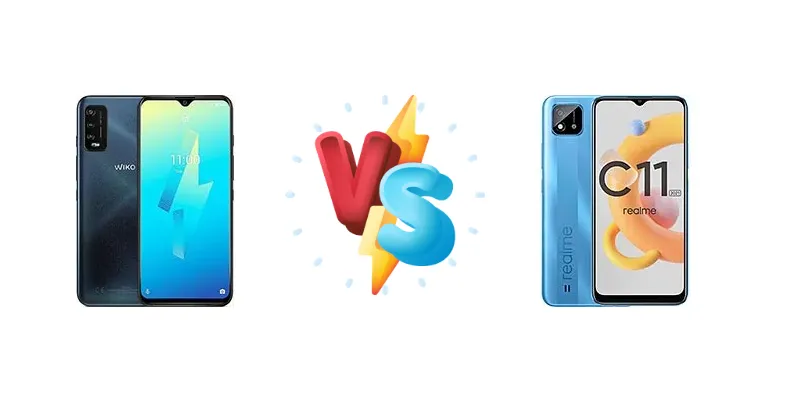
Both the Wiko Power U10 and the Realme C11 (2021) target the ultra-budget smartphone market, but they take distinctly different approaches to achieving affordability. The Wiko leverages a newer, albeit still entry-level, Mediatek Helio G35 chipset, while the Realme opts for the older, more power-hungry Unisoc SC9863A. This comparison dissects these core differences to determine which device offers the best value for users prioritizing performance and efficiency.
🏆 Quick Verdict
For the average user, the Wiko Power U10 emerges as the better choice. Its Mediatek Helio G35, built on a 12nm process, provides a more efficient and modern CPU architecture compared to the Realme C11 (2021)'s 28nm Unisoc SC9863A, translating to smoother multitasking and potentially better battery life despite similar capacity.
| Network |
|---|
| 2G bands | CDMA 800 / 1700 / 1900 | GSM 850 / 900 / 1800 / 1900 |
| 3G bands | HSDPA 850 / 900 / 1900 / 2100 | HSDPA 850 / 900 / 1900 / 2100 |
| 4G bands | 1, 3, 5, 7, 8, 20, 40 | 1, 3, 5, 8, 38, 40, 41 |
| Speed | HSPA 42.2/5.76 Mbps, LTE Cat4 150/50 Mbps | HSPA, LTE |
| Technology | CDMA / HSPA / LTE | GSM / HSPA / LTE |
| Launch |
|---|
| Announced | 2021, June | 2021, June 28 |
| Status | Available. Released 2021, June | Available. Released 2021, June 28 |
| Body |
|---|
| Build | - | Glass front, plastic frame, plastic back |
| Dimensions | 173.8 x 78.6 x 9.5 mm (6.84 x 3.09 x 0.37 in) | 165.2 x 76.4 x 8.9 mm (6.50 x 3.01 x 0.35 in) |
| SIM | Nano-SIM + Nano-SIM | Nano-SIM + Nano-SIM |
| Weight | 206 g (7.27 oz) | 190 g (6.70 oz) |
| | - | Splash resistant design |
| Display |
|---|
| Resolution | 720 x 1640 pixels (~263 ppi density) | 720 x 1600 pixels, 20:9 ratio (~269 ppi density) |
| Size | 6.82 inches, 110.5 cm2 (~80.9% screen-to-body ratio) | 6.52 inches, 102.6 cm2 (~81.3% screen-to-body ratio) |
| Type | IPS LCD | IPS LCD, 400 nits (typ) |
| Platform |
|---|
| CPU | Octa-core (4x2.3 GHz Cortex-A53 & 4x1.8 GHz Cortex-A53) | Octa-core (4x1.6 GHz Cortex-A55 & 4x1.2 GHz Cortex-A55) |
| Chipset | Mediatek MT6765G Helio G35 (12 nm) | Unisoc SC9863A (28 nm) |
| GPU | PowerVR GE8320 | IMG8322 |
| OS | Android 11 (Go edition) | Android 11, Realme Go UI |
| Memory |
|---|
| Card slot | microSDXC | microSDXC (dedicated slot) |
| Internal | 32GB 2GB RAM, 32GB 3GB RAM | 32GB 2GB RAM, 64GB 4GB RAM |
| | - | eMMC 5.1 |
| Main Camera |
|---|
| Features | LED flash, HDR | LED flash, HDR, panorama |
| Single | 13 MP, AF | 8 MP, f/2.0, (wide), AF |
| Video | 1080p@30fps | 1080p@30fps |
| Selfie camera |
|---|
| Features | - | HDR, panorama |
| Single | 5 MP | 5 MP, f/2.2, (wide) |
| Video | - | 1080p@30fps |
| Sound |
|---|
| 3.5mm jack | Yes | Yes |
| 35mm jack | Yes | Yes |
| Loudspeaker | Yes | Yes |
| Comms |
|---|
| Bluetooth | 4.2, A2DP | 4.2, A2DP |
| NFC | No | No |
| Positioning | GPS, GLONASS, GALILEO, BDS | GPS, GLONASS, GALILEO, BDS |
| Radio | FM Radio | Unspecified |
| USB | USB Type-C 2.0, OTG | microUSB 2.0, OTG |
| WLAN | Wi-Fi 802.11 b/g/n | Wi-Fi 802.11 b/g/n |
| Features |
|---|
| Sensors | Fingerprint (side-mounted), accelerometer, proximity, compass | Accelerometer, gyro, proximity, compass |
| Battery |
|---|
| Charging | - | 10W wired
Reverse wired |
| Type | Li-Ion 5000 mAh | 5000 mAh |
| Misc |
|---|
| Colors | Carbon Blue, Denim Blue, Turquoise | Cool Blue, Cool Grey |
| Models | W-V745-EEA, W-V745-OPE | RMX3231 |
| Price | About 100 EUR | About 80 EUR |
| SAR | 0.52 W/kg (head) 1.36 W/kg (body) | - |
Wiko Power U10
- More efficient chipset (12nm vs 28nm)
- Modern CPU architecture (Cortex-A53)
- Potentially better sustained performance
- Lacks reverse wired charging
- Limited information on display quality
Realme C11 (2021)
- Reverse wired charging capability
- Potentially lower initial cost
- Simple and straightforward operation
- Less efficient chipset (28nm)
- Older CPU architecture (Cortex-A55)
- Likely more thermal throttling
Display Comparison
Neither device boasts a standout display. Details regarding panel type, resolution, and brightness are absent from the provided data, suggesting both utilize basic LCD panels common in this price bracket. The focus here is on core performance, not visual fidelity. Expect similar viewing experiences in typical indoor conditions, but neither will excel in direct sunlight.
Camera Comparison
Without sensor size or aperture information, a detailed camera comparison is impossible. Both phones likely feature basic camera setups geared towards casual photography. The absence of details suggests neither device will excel in low-light conditions or offer advanced features. Any 2MP macro or depth sensors present on either device are likely to offer minimal benefit to the average user.
Performance
The core difference lies in the chipsets. The Wiko Power U10’s Mediatek Helio G35 (12nm) features an octa-core CPU with a split configuration of 4x2.3 GHz Cortex-A53 and 4x1.8 GHz Cortex-A53 cores. This is a more modern architecture than the Realme C11 (2021)’s Unisoc SC9863A (28nm), which uses 4x1.6 GHz Cortex-A55 and 4x1.2 GHz Cortex-A55 cores. The 12nm fabrication process of the Helio G35 is significantly more efficient than the 28nm process of the Unisoc chip. This translates to less heat generation and potentially better sustained performance. While clock speeds aren't everything, the Cortex-A53 cores in the Helio G35 are generally more capable than the A55 cores in the Unisoc, despite the lower clock speeds on some cores. The Unisoc's larger process node will likely result in more throttling under sustained load.
Battery Life
Battery capacity is not provided for either device, making a direct comparison difficult. However, the Wiko Power U10’s more efficient chipset suggests it will extract more usage from a given battery capacity. The Realme C11 (2021) offers 10W wired charging and reverse wired charging, a feature absent on the Wiko. While 10W charging is slow by modern standards, the reverse charging capability could be useful for topping up accessories like wireless earbuds, but at the cost of overall battery efficiency.
Buying Guide
Buy the Wiko Power U10 if you need a phone that feels responsive for everyday tasks like browsing, social media, and light app usage. Its more modern CPU architecture will provide a better user experience. Buy the Realme C11 (2021) if you prioritize reverse wired charging and are willing to accept potentially lower performance and reduced battery efficiency in exchange for that feature.
Frequently Asked Questions
❓ Will the Unisoc SC9863A in the Realme C11 (2021) struggle with multitasking?
Yes, the Unisoc SC9863A, built on a 28nm process, is less efficient and has a less capable CPU architecture than the Helio G35. Expect noticeable slowdowns when switching between multiple apps or running demanding applications. It's best suited for single-tasking and light usage.
❓ Is the reverse wired charging on the Realme C11 (2021) actually useful?
The 10W reverse wired charging is a niche feature. It can be convenient for topping up small accessories like wireless earbuds or a smartwatch, but it's a slow process and will significantly drain the Realme C11 (2021)'s battery. It's not a replacement for a dedicated power bank.
❓ Which phone is better for playing casual mobile games like Candy Crush or Subway Surfers?
The Wiko Power U10's Helio G35 will provide a smoother experience for casual games due to its more efficient CPU and potentially better thermal management. While neither phone is a gaming powerhouse, the U10 will handle these titles with fewer stutters and frame drops.