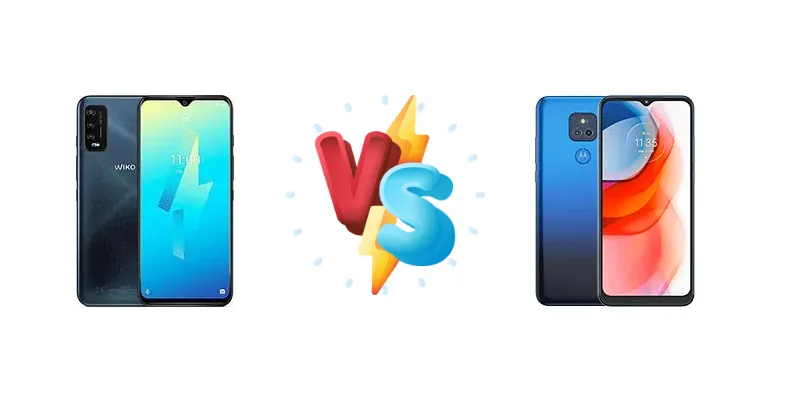
The ultra-budget smartphone market is fiercely competitive. Both the Wiko Power U10 and the Motorola Moto G Play (2021) aim to deliver essential smartphone functionality at a minimal cost. However, they take different approaches to achieving this, with the Wiko prioritizing a slightly newer chipset and the Motorola focusing on Qualcomm’s established efficiency. This comparison dissects their key differences to help you choose the right device.
🏆 Quick Verdict
For the average user prioritizing consistent performance and a more refined software experience, the Motorola Moto G Play (2021) is the better choice. While the Wiko Power U10’s Helio G35 offers a theoretical clock speed advantage, the Snapdragon 460’s architecture and Qualcomm’s optimization provide a smoother, more reliable experience in everyday tasks.
| Network |
|---|
| 2G bands | CDMA 800 / 1700 / 1900 | GSM 850 / 900 / 1800 / 1900 |
| 3G bands | HSDPA 850 / 900 / 1900 / 2100 | HSDPA 850 / 900 / 1700(AWS) / 1900 / 2100 |
| 4G bands | 1, 3, 5, 7, 8, 20, 40 | 1, 2, 3, 4, 5, 7, 8, 12, 13, 17, 25, 26, 38, 41, 66, 71 |
| Speed | HSPA 42.2/5.76 Mbps, LTE Cat4 150/50 Mbps | HSPA, LTE |
| Technology | CDMA / HSPA / LTE | GSM / CDMA / HSPA / LTE |
| | - | 2, 4, 5, 12, 14, 30, 66 |
| Launch |
|---|
| Announced | 2021, June | 2021, January 08 |
| Status | Available. Released 2021, June | Available. Released 2021, January 14 |
| Body |
|---|
| Build | - | Plastic frame, plastic back |
| Dimensions | 173.8 x 78.6 x 9.5 mm (6.84 x 3.09 x 0.37 in) | 166.6 x 76 x 9.4 mm (6.56 x 2.99 x 0.37 in) |
| SIM | Nano-SIM + Nano-SIM | Nano-SIM |
| Weight | 206 g (7.27 oz) | 204 g (7.20 oz) |
| | - | Water-repellent coating |
| Display |
|---|
| Resolution | 720 x 1640 pixels (~263 ppi density) | 720 x 1600 pixels, 20:9 ratio (~270 ppi density) |
| Size | 6.82 inches, 110.5 cm2 (~80.9% screen-to-body ratio) | 6.5 inches, 102.0 cm2 (~80.6% screen-to-body ratio) |
| Type | IPS LCD | IPS LCD |
| Platform |
|---|
| CPU | Octa-core (4x2.3 GHz Cortex-A53 & 4x1.8 GHz Cortex-A53) | Octa-core (4x1.8 GHz Kryo 240 & 4x1.6 GHz Kryo 240) |
| Chipset | Mediatek MT6765G Helio G35 (12 nm) | Qualcomm SM4250 Snapdragon 460 (11 nm) |
| GPU | PowerVR GE8320 | Adreno 610 |
| OS | Android 11 (Go edition) | Android 10 |
| Memory |
|---|
| Card slot | microSDXC | microSDXC (dedicated slot) |
| Internal | 32GB 2GB RAM, 32GB 3GB RAM | 32GB 3GB RAM |
| | - | eMMC 5.1 |
| Main Camera |
|---|
| Dual | - | 13 MP, f/2.0, (wide), 1/3.1", 1.12µm, PDAF
Auxiliary lens |
| Features | LED flash, HDR | LED flash, HDR, panorama |
| Single | 13 MP, AF | - |
| Video | 1080p@30fps | 1080p@30/60fps |
| Selfie camera |
|---|
| Features | - | HDR |
| Single | 5 MP | 5 MP, f/2.2, (wide), 1.12µm |
| Video | - | 1080p@30fps |
| Sound |
|---|
| 3.5mm jack | Yes | Yes |
| 35mm jack | Yes | Yes |
| Loudspeaker | Yes | Yes |
| Comms |
|---|
| Bluetooth | 4.2, A2DP | 5.0, A2DP, LE |
| NFC | No | No |
| Positioning | GPS, GLONASS, GALILEO, BDS | GPS, GLONASS, GALILEO |
| Radio | FM Radio | Unspecified |
| USB | USB Type-C 2.0, OTG | USB Type-C 2.0 |
| WLAN | Wi-Fi 802.11 b/g/n | Wi-Fi 802.11 a/b/g/n/ac, dual-band, Wi-Fi Direct |
| Features |
|---|
| Sensors | Fingerprint (side-mounted), accelerometer, proximity, compass | Fingerprint (rear-mounted), accelerometer, proximity |
| Battery |
|---|
| Charging | - | 10W wired |
| Type | Li-Ion 5000 mAh | Li-Po 5000 mAh |
| Misc |
|---|
| Colors | Carbon Blue, Denim Blue, Turquoise | Misty Blue |
| Models | W-V745-EEA, W-V745-OPE | XT2093-3, XT2093-7, XT2093-DL, XT2093DL |
| Price | About 100 EUR | About 60 EUR |
| SAR | 0.52 W/kg (head) 1.36 W/kg (body) | - |
Wiko Power U10
- Potentially higher peak CPU clock speeds
- May offer a larger battery capacity (unconfirmed)
- Aggressive pricing may make it the cheapest option
- Less efficient Mediatek Helio G35 chipset
- Older Cortex-A53 CPU architecture
- Likely less optimized software experience
Motorola Moto G Play (2021)
- More efficient Qualcomm Snapdragon 460 chipset
- Modern Kryo 240 CPU architecture
- Qualcomm’s optimized software and ISP
- Slower 10W charging
- May be slightly more expensive than the Wiko Power U10
- Basic camera system
Display Comparison
Neither device boasts a standout display. Details regarding panel type, resolution, and brightness are absent for the Wiko Power U10, suggesting a basic LCD. The Moto G Play (2021) also utilizes an LCD, typical for this price point. The focus here isn’t on visual fidelity, but rather on basic usability. The absence of high refresh rates or advanced features like HDR is expected. The Wiko’s potential lack of detailed display specs suggests a cost-cutting measure that may result in lower color accuracy and viewing angles compared to the Moto G Play.
Camera Comparison
Both phones are unlikely to deliver exceptional camera performance. Details are scarce, but given the price bracket, expect basic image sensors. The Moto G Play (2021) likely benefits from Qualcomm’s image signal processor (ISP), which offers better noise reduction and dynamic range compared to Mediatek’s ISP in the Wiko Power U10. The presence of a dedicated night mode on the Moto G Play, even if basic, is a significant advantage. The inclusion of 2MP macro lenses on both devices is largely marketing fluff; their limited resolution and lack of optical image stabilization (OIS) render them of limited practical use.
Performance
The core difference lies in the chipsets. The Wiko Power U10 features the Mediatek Helio G35, a 12nm chip with an octa-core configuration split between 2.3 GHz and 1.8 GHz Cortex-A53 cores. The Motorola Moto G Play (2021) utilizes the Qualcomm Snapdragon 460, built on an 11nm process. While the Helio G35’s higher clock speeds *suggest* faster performance, the Snapdragon 460’s Kryo 240 cores, coupled with the more efficient 11nm process, generally translate to better sustained performance and thermal management. The Snapdragon 460’s architecture is more modern, offering improved instructions per clock (IPC) compared to the older Cortex-A53 cores in the Helio G35. This means the Moto G Play will likely handle multitasking and app switching more smoothly.
Battery Life
The Wiko Power U10’s battery capacity is unknown, but the ‘Power’ branding suggests a larger battery. The Moto G Play (2021) features a 5000mAh battery, a substantial capacity for a budget device. However, the Moto G Play is limited to 10W wired charging. The Wiko’s charging speed is also unknown, but even with a potentially larger battery, the Snapdragon 460’s superior power efficiency in the Moto G Play will likely result in comparable, if not better, real-world battery life. The 10W charging on the Moto G Play will take a significant amount of time to fully charge the 5000mAh battery.
Buying Guide
Buy the Wiko Power U10 if you absolutely need the highest possible clock speed for light gaming and are comfortable with potentially less optimized software. Buy the Motorola Moto G Play (2021) if you value a stable, efficient platform for everyday tasks like browsing, social media, and communication, and appreciate the benefits of Qualcomm’s software support and power management.
Frequently Asked Questions
❓ Will the Wiko Power U10 struggle with multitasking compared to the Moto G Play?
Yes, the Wiko Power U10’s older Cortex-A53 cores and less efficient chipset are likely to result in noticeable slowdowns when running multiple apps simultaneously. The Snapdragon 460 in the Moto G Play is better equipped to handle multitasking smoothly.
❓ Is the 10W charging on the Moto G Play (2021) a significant drawback?
While 10W charging is slow by modern standards, the Moto G Play’s 5000mAh battery and the Snapdragon 460’s efficiency mean you won’t need to charge it as frequently. Overnight charging is a viable option, mitigating the slow charging speed.
❓ Can either of these phones handle basic mobile gaming like PUBG Mobile or Call of Duty Mobile?
Both phones can *run* these games at the lowest settings, but expect significant frame rate drops and stuttering. The Snapdragon 460 in the Moto G Play will provide a slightly more stable experience, but neither phone is designed for serious gaming.