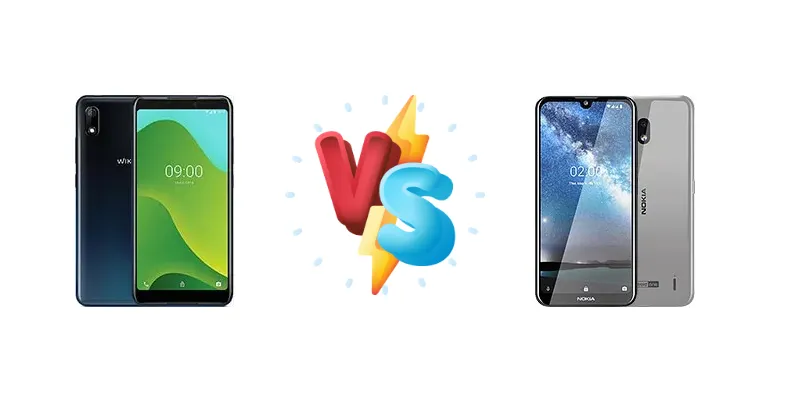
The Wiko Jerry4 and Nokia 2.2 represent the extreme end of the smartphone price spectrum. Both aim to deliver essential smartphone functionality at a minimal cost, but they take different approaches. The Jerry4 relies on a simpler, older architecture, while the Nokia 2.2 leverages a more modern, albeit still entry-level, Mediatek chipset. This comparison will dissect their strengths and weaknesses to determine which offers the best value.
🏆 Quick Verdict
For the average user prioritizing responsiveness and a slightly smoother experience, the Nokia 2.2 is the better choice. Its Mediatek Helio A22 chipset, built on a 12nm process, provides a noticeable performance uplift over the Wiko Jerry4’s Cortex-A7, despite both being quad-core. While neither phone excels, the Nokia 2.2 offers a more future-proofed platform.
| Network |
|---|
| 2G bands | GSM 850 / 900 / 1800 / 1900 | GSM 850 / 900 / 1800 / 1900 |
| 3G bands | HSDPA 900 / 2100 | HSDPA 850 / 900 / 2100 - APAC, EMEA, India |
| 4G bands | - | 1, 3, 5, 7, 8, 20, 38, 40 - APAC, EMEA |
| Speed | HSPA 21.1/5.76 Mbps | HSPA 42.2/5.76 Mbps, LTE Cat4 150/50 Mbps |
| Technology | GSM / HSPA | GSM / HSPA / LTE |
| | - | 1, 3, 5, 40, 41 - India |
| Launch |
|---|
| Announced | 2019, July. Released 2019, July | 2019, June 06. Released 2019, June 11 |
| Status | Discontinued | Discontinued |
| Body |
|---|
| Build | - | Glass front, plastic back, plastic frame |
| Dimensions | 160 x 77 x 9 mm (6.30 x 3.03 x 0.35 in) | 146 x 70.6 x 9.3 mm (5.75 x 2.78 x 0.37 in) |
| SIM | Dual SIM (Micro-SIM, dual stand-by) | · Nano-SIM· Nano-SIM + Nano-SIM |
| Weight | 167 g (5.89 oz) | 153 g (5.40 oz) |
| Display |
|---|
| Resolution | 720 x 1440 pixels, 18:9 ratio (~269 ppi density) | 720 x 1520 pixels, 19:9 ratio (~295 ppi density) |
| Size | 5.99 inches, 92.6 cm2 (~75.2% screen-to-body ratio) | 5.71 inches, 81.4 cm2 (~79.0% screen-to-body ratio) |
| Type | IPS LCD | IPS LCD |
| | - | Always-on display |
| Platform |
|---|
| CPU | Quad-core 1.3 GHz Cortex-A7 | Quad-core 2.0 GHz Cortex-A53 |
| Chipset | - | Mediatek MT6761 Helio A22 (12 nm) |
| GPU | Mali-T820 MP1 | PowerVR GE8320 |
| OS | Android 9.0 Pie (Go Edition) | Android 9.0 (Pie), upgradable to Android 11, Android One |
| Memory |
|---|
| Card slot | microSDHC | microSDXC (uses shared SIM slot) |
| Internal | 16GB 1GB RAM | 16GB 2GB RAM, 32GB 3GB RAM |
| | - | eMMC 5.1 |
| Main Camera |
|---|
| Features | LED flash, HDR, panorama | LED flash, HDR, panorama |
| Single | 8 MP, AF | 13 MP, f/2.2, 1/3.1", 1.12µm, AF |
| Video | 1080p@30fps | 1080p@30fps |
| Selfie camera |
|---|
| Features | LED flash | - |
| Single | 5 MP | 5 MP |
| Video | - | 1080p@30fps |
| Sound |
|---|
| 3.5mm jack | Yes | Yes |
| 35mm jack | Yes | Yes |
| Loudspeaker | Yes, with dual speakers | Yes |
| Comms |
|---|
| Bluetooth | 4.2, A2DP | 4.2, A2DP, LE |
| NFC | No | No |
| Positioning | GPS | GPS, GLONASS, BDS |
| Radio | FM radio | FM radio |
| USB | microUSB 2.0, OTG | microUSB 2.0, OTG |
| WLAN | Wi-Fi 802.11 b/g/n | Wi-Fi 802.11 b/g/n |
| Features |
|---|
| Sensors | Accelerometer, proximity, compass | Accelerometer, proximity |
| Battery |
|---|
| Charging | - | 10W wired |
| Type | Li-Po 3730 mAh | Li-Ion 3000 mAh, removable |
| Misc |
|---|
| Colors | Gradient Dark Blue, Gold | Steel, Tungsten Black |
| Models | - | TA-1183, TA-1179, TA-1191, TA-1188 |
| Price | About 80 EUR | About 100 EUR |
| SAR | 0.50 W/kg (head) 1.61 W/kg (body) | 0.43 W/kg (head) 1.37 W/kg (body) |
| SAR EU | - | 0.45 W/kg (head) 1.61 W/kg (body) |
Wiko Jerry4
- Lowest possible price point
- Functional for basic communication
- Simple and easy to use
- Significantly slower performance
- Outdated CPU architecture
- Likely limited software support
Nokia 2.2
- More responsive performance
- More efficient chipset (12nm)
- Potential for longer software support
- Still a budget device with limitations
- Camera quality is basic
- Limited RAM and storage
Display Comparison
Neither device boasts a standout display. Specifics regarding panel type, resolution, or brightness are unavailable for the Wiko Jerry4, suggesting a very basic LCD. The Nokia 2.2 also utilizes a standard LCD, but its focus is on efficiency rather than visual fidelity. Bezels are likely substantial on both, reflecting their budget nature. Color accuracy is expected to be limited on both devices, prioritizing cost over color science.
Camera Comparison
Camera performance on both devices will be limited. Details are scarce, but both likely feature basic sensors. The Nokia 2.2’s camera system is likely to be slightly more capable due to the processing power of the Helio A22 chipset, allowing for better image processing. However, don’t expect high-quality photos in challenging lighting conditions. The presence of a 2MP macro camera on the Nokia 2.2 is largely a marketing gimmick, offering minimal practical benefit due to the low resolution and lack of optical image stabilization.
Performance
The Nokia 2.2’s Mediatek Helio A22 chipset is the clear winner here. While both phones feature quad-core CPUs, the A22 utilizes Cortex-A53 cores clocked at 2.0 GHz, a significant improvement over the Jerry4’s 1.3 GHz Cortex-A7 cores. The A53 architecture is more efficient and delivers better instructions per clock cycle. Furthermore, the Helio A22 is fabricated on a 12nm process, enhancing power efficiency and reducing thermal throttling compared to the likely larger node process used for the Jerry4’s CPU. This translates to a snappier user experience on the Nokia 2.2, particularly when multitasking or launching apps.
Battery Life
Battery capacity is not specified for either device. However, the Nokia 2.2 benefits from the 12nm Helio A22 chipset, which consumes less power than the Jerry4’s older CPU. This efficiency advantage, combined with the 10W wired charging support, suggests the Nokia 2.2 will likely offer slightly longer battery life and faster charging times, even if the battery capacities are similar. The Jerry4’s less efficient CPU will likely result in more frequent charging needs.
Buying Guide
Buy the Wiko Jerry4 if you absolutely need the lowest possible price and are willing to accept significantly slower performance for basic tasks like messaging and calls. It’s a functional device for those with minimal smartphone needs. Buy the Nokia 2.2 if you prefer a more responsive user experience, even for simple tasks, and appreciate the benefits of a more efficient chipset, potentially leading to slightly better battery life and a longer software support window.
Frequently Asked Questions
❓ Is the Mediatek Helio A22 chipset capable of running popular apps like WhatsApp and Facebook smoothly?
Yes, the Mediatek Helio A22 is sufficient for running lightweight apps like WhatsApp and Facebook. While it won't offer a blazing-fast experience, it provides a noticeably smoother and more responsive experience compared to the Wiko Jerry4’s older processor, especially when multitasking between these apps.
❓ How does the software experience differ between the Wiko Jerry4 and Nokia 2.2?
The Nokia 2.2 is part of the Android One program, meaning it runs a near-stock version of Android with guaranteed software updates and security patches for a defined period. The Wiko Jerry4 likely runs a heavily customized version of Android, potentially with limited updates and a less refined user experience. This difference in software support is a significant advantage for the Nokia 2.2.
❓ Will the Nokia 2.2 struggle with demanding games?
Yes, the Nokia 2.2 is not designed for demanding games. The Helio A22 chipset and limited RAM will result in low frame rates and significant lag in most modern games. It's best suited for casual gaming or older, less graphically intensive titles.