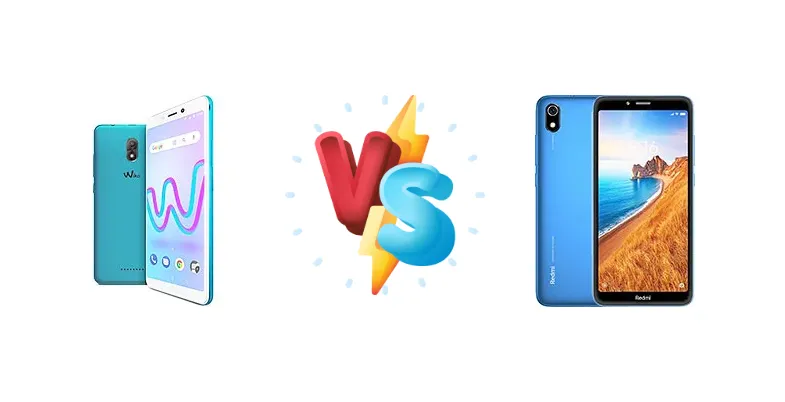
The Wiko Jerry3 and Xiaomi Redmi 7A represent the extreme end of the smartphone price spectrum. Both aim to deliver basic smartphone functionality at an incredibly low cost, but they take very different approaches. The Jerry3 relies on a simple, older architecture, while the Redmi 7A leverages Qualcomm's Snapdragon 439. This comparison will dissect the key differences to help you determine which device best suits your needs.
🏆 Quick Verdict
For the average user, the Xiaomi Redmi 7A is the clear winner. Its Snapdragon 439 chipset provides a substantial performance boost over the Wiko Jerry3’s Cortex-A7, offering a smoother experience for everyday tasks and even light multitasking. While both phones are limited, the Redmi 7A offers more future-proofing and usability for a small price premium.
| Network |
|---|
| 2G bands | GSM 850 / 900 / 1800 / 1900 | GSM 850 / 900 / 1800 / 1900 |
| 3G bands | HSDPA 900 / 2100 | HSDPA 850 / 900 / 1900 / 2100 |
| 4G bands | - | 1, 2, 3, 4, 5, 7, 8, 20, 38, 40 - Global |
| Speed | HSPA 21.1/5.76 Mbps | HSPA, LTE |
| Technology | GSM / HSPA | GSM / HSPA / LTE |
| | - | 1, 3, 5, 8, 34, 38, 39, 40, 41 - China |
| Launch |
|---|
| Announced | 2019. Released 2019 | 2019, May 24. Released 2019, July 04 |
| Status | Discontinued | Discontinued |
| Body |
|---|
| Build | - | Glass front, plastic back, plastic frame |
| Dimensions | 148 x 72 x 9.1 mm (5.83 x 2.83 x 0.36 in) | 146.3 x 70.4 x 9.6 mm (5.76 x 2.77 x 0.38 in) |
| SIM | Dual SIM (Micro-SIM, dual stand-by) | Nano-SIM + Nano-SIM |
| Weight | 172 g (6.07 oz) | 165 g (5.82 oz) |
| | - | Splash resistant |
| Display |
|---|
| Resolution | 480 x 960 pixels, 18:9 ratio (~197 ppi density) | 720 x 1440 pixels, 18:9 ratio (~295 ppi density) |
| Size | 5.45 inches, 76.7 cm2 (~71.9% screen-to-body ratio) | 5.45 inches, 76.7 cm2 (~74.4% screen-to-body ratio) |
| Type | IPS LCD | IPS LCD |
| Platform |
|---|
| CPU | Quad-core 1.3 GHz Cortex-A7 | Octa-core (4x1.95 GHz Cortex-A53 & 4x1.45 GHz Cortex A53) |
| Chipset | - | Qualcomm SDM439 Snapdragon 439 (12 nm) |
| GPU | Mali-400 MP2 | Adreno 505 |
| OS | Android 8.0 Oreo (Go edition) | Android 9.0 (Pie), upgradable to Android 10, MIUI 12 |
| Memory |
|---|
| Card slot | microSDXC | microSDXC (dedicated slot) |
| Internal | 16GB 1GB RAM | 16GB 2GB RAM, 32GB 2GB RAM, 32GB 3GB RAM |
| | eMMC 5.1 | eMMC 5.1 |
| Main Camera |
|---|
| Features | LED flash, HDR | LED flash, HDR |
| Single | 5 MP | 13 MP, f/2.2, 1/3.1", 1.12µm, PDAF - China
or
12 MP, f/2.2, 1/2.9", 1.25µm, PDAF - Global, India |
| Video | 1080p@30fps | 1080p@30fps |
| Selfie camera |
|---|
| Features | - | HDR |
| Single | 5 MP | 5 MP, f/2.2, 1/5.0", 1.12µm |
| Video | - | 1080p@30fps |
| Sound |
|---|
| 3.5mm jack | Yes | Yes |
| 35mm jack | Yes | Yes |
| Loudspeaker | Yes | Yes |
| | eMMC 5.1 | - |
| Comms |
|---|
| Bluetooth | 4.0, A2DP | 4.2, A2DP, LE |
| NFC | No | No |
| Positioning | GPS | GPS, GLONASS, BDS |
| Radio | FM radio | FM Radio, built-in antenna |
| USB | microUSB 2.0 | microUSB 2.0, OTG |
| WLAN | Wi-Fi 802.11 b/g/n | Wi-Fi 802.11 b/g/n, Wi-Fi Direct |
| Features |
|---|
| Sensors | Accelerometer, proximity, compass | Accelerometer, proximity, compass |
| Battery |
|---|
| Charging | - | 10W wired |
| Type | Li-Po 2500 mAh | Li-Po 4000 mAh, non-removable |
| Misc |
|---|
| Colors | Anthracite, Gold, Bleen, Cherry Red | Matte Black, Morning blue, Matte Blue, Matte Gold, Gem Red, Gem Blue |
| Models | - | MZB7995IN, M1903C3EG, M1903C3EH, M1903C3EI |
| Price | About 60 EUR | About 130 EUR |
| SAR | - | 1.00 W/kg (head) 1.12 W/kg (body) |
| SAR EU | - | 0.56 W/kg (head) 1.17 W/kg (body) |
Wiko Jerry3
- Potentially the lowest price point available.
- Simple and easy to use interface.
- Compact and lightweight design.
- Significantly slower performance.
- Outdated processor architecture.
- Likely limited software support.
Xiaomi Redmi 7A
- Much faster processor for smoother performance.
- Larger 4000mAh battery with 10W charging.
- More future-proofing and software support.
- Still a budget device with limitations.
- Camera quality is not exceptional.
- May have pre-installed bloatware.
Display Comparison
Neither device is expected to boast a high-quality display. Given the price point, both likely utilize LCD panels with modest resolutions. The Wiko Jerry3’s display specifications are unavailable, suggesting a basic implementation. The Redmi 7A, similarly, doesn’t prioritize display quality. Expect similar levels of color accuracy and brightness, with neither phone likely to excel in outdoor visibility. Bezels are expected to be substantial on both devices, maximizing screen real estate within a compact form factor.
Camera Comparison
Camera performance on both devices will be limited. Without specific sensor details for the Wiko Jerry3, it’s safe to assume a basic camera setup. The Redmi 7A likely features a 13MP main sensor, which, while not exceptional, will outperform any camera likely found in the Jerry3. Image processing will be basic on both, with limited dynamic range and detail in challenging lighting conditions. The prevalence of 2MP auxiliary sensors on budget phones is likely present on the Redmi 7A, but these offer minimal practical benefit. Focus should be placed on the main sensor's capabilities, where the Redmi 7A has a clear advantage.
Performance
This is where the Redmi 7A truly shines. The Qualcomm Snapdragon 439, built on a 12nm process, is a significant leap forward from the Wiko Jerry3’s Quad-core 1.3 GHz Cortex-A7. The Snapdragon 439 features an Octa-core configuration (4x1.95 GHz Cortex-A53 & 4x1.45 GHz Cortex A53), providing substantially more processing power and enabling smoother multitasking. The Cortex-A7 in the Jerry3 is an older architecture, designed for power efficiency rather than performance. This translates to noticeable lag and slowdowns when running multiple apps or demanding tasks on the Wiko. The 12nm process of the Snapdragon 439 also contributes to better thermal efficiency, reducing the likelihood of throttling under sustained load.
Battery Life
Battery capacity is not specified for the Wiko Jerry3, but given its focus on affordability, it’s likely to be a relatively small capacity. The Xiaomi Redmi 7A features a 4000mAh battery, which, combined with the efficient Snapdragon 439, should provide all-day battery life for moderate usage. The Redmi 7A also supports 10W wired charging, offering a faster charging experience than the Jerry3, which likely relies on slower charging speeds. This faster charging capability is a significant convenience factor for users who need to quickly top up their battery.
Buying Guide
Buy the Wiko Jerry3 if you absolutely need the lowest possible price and only intend to use the phone for basic calling and texting. It's a functional device for those with minimal smartphone requirements. Buy the Xiaomi Redmi 7A if you want a more responsive experience, even for simple tasks like browsing the web or using social media. The extra processing power and 10W charging make it a significantly more versatile and enjoyable device.
Frequently Asked Questions
❓ Will the Xiaomi Redmi 7A struggle with popular apps like WhatsApp and Facebook?
While the Redmi 7A isn't a powerhouse, the Snapdragon 439 is capable of running apps like WhatsApp and Facebook smoothly. You might experience some slowdowns with multiple apps open simultaneously, but for typical social media usage, it should be sufficient. The Wiko Jerry3, with its older processor, will likely struggle more with these apps.
❓ Is the Redmi 7A a good choice for someone who primarily uses their phone for calls and texts?
Yes, the Redmi 7A is an excellent choice for basic communication. The larger battery provides ample talk time, and the Snapdragon 439 ensures a responsive experience even when switching between the phone and messaging apps. It offers a significant upgrade in usability over the Wiko Jerry3 for even these simple tasks.
❓ Does the Redmi 7A support software updates?
Xiaomi generally provides software updates for their devices, though the Redmi 7A is an older model, so the number of future updates may be limited. However, it's likely to receive more updates than the Wiko Jerry3, which often lacks long-term software support from smaller manufacturers.