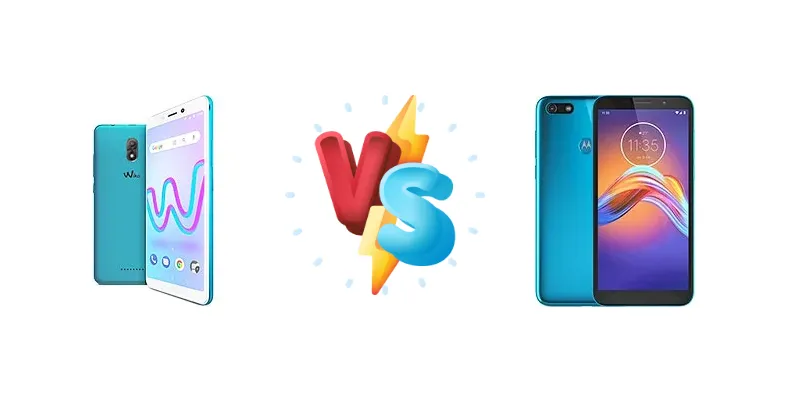
The Wiko Jerry3 and Motorola Moto E6 Play represent the extreme end of the smartphone price spectrum. Both aim to deliver basic functionality at an incredibly low cost, but they achieve this with different hardware approaches. This comparison dissects their strengths and weaknesses to determine which offers the best value for users prioritizing affordability.
🏆 Quick Verdict
For the average user, the Motorola Moto E6 Play is the better choice. Its Mediatek MT6739 chipset, featuring Cortex-A53 cores, provides a noticeable performance uplift over the Wiko Jerry3’s older Cortex-A7 processor. While both are entry-level, the E6 Play offers a smoother, more responsive experience.
| Network |
|---|
| 2G bands | GSM 850 / 900 / 1800 / 1900 | GSM 850 / 900 / 1800 / 1900 |
| 3G bands | HSDPA 900 / 2100 | HSDPA 850 / 900 / 1900 / 2100 |
| 4G bands | - | 1, 3, 5, 7, 8, 20, 38, 40, 41 |
| Speed | HSPA 21.1/5.76 Mbps | HSPA, LTE |
| Technology | GSM / HSPA | GSM / HSPA / LTE |
| Launch |
|---|
| Announced | 2019. Released 2019 | 2019, October. Released 2019, November |
| Status | Discontinued | Discontinued |
| Body |
|---|
| Build | - | Glass front, plastic back, plastic frame |
| Dimensions | 148 x 72 x 9.1 mm (5.83 x 2.83 x 0.36 in) | 146.5 x 70.9 x 8.3 mm (5.77 x 2.79 x 0.33 in) |
| SIM | Dual SIM (Micro-SIM, dual stand-by) | Nano-SIM + Nano-SIM |
| Weight | 172 g (6.07 oz) | 140 g (4.94 oz) |
| Display |
|---|
| Resolution | 480 x 960 pixels, 18:9 ratio (~197 ppi density) | 720 x 1440 pixels, 18:9 ratio (~295 ppi density) |
| Size | 5.45 inches, 76.7 cm2 (~71.9% screen-to-body ratio) | 5.5 inches, 77.0 cm2 (~74.1% screen-to-body ratio) |
| Type | IPS LCD | IPS LCD |
| Platform |
|---|
| CPU | Quad-core 1.3 GHz Cortex-A7 | Quad-core 1.5 GHz Cortex-A53 |
| Chipset | - | Mediatek MT6739 (28 nm) |
| GPU | Mali-400 MP2 | PowerVR GE8100 |
| OS | Android 8.0 Oreo (Go edition) | Android 9.0 (Pie) |
| Memory |
|---|
| Card slot | microSDXC | microSDXC (dedicated slot) |
| Internal | 16GB 1GB RAM | 32GB 2GB RAM |
| | eMMC 5.1 | eMMC 5.1 |
| Main Camera |
|---|
| Features | LED flash, HDR | LED flash, HDR, panorama |
| Single | 5 MP | 13 MP, f/2.2, 1/3.1", 1.12µm, PDAF |
| Video | 1080p@30fps | 1080p@30fps |
| Selfie camera |
|---|
| Features | - | HDR |
| Single | 5 MP | 5 MP, f/2.2, 1/5.0", 1.12µm |
| Video | - | 1080p@30fps |
| Sound |
|---|
| 3.5mm jack | Yes | Yes |
| 35mm jack | Yes | Yes |
| Loudspeaker | Yes | Yes |
| | eMMC 5.1 | - |
| Comms |
|---|
| Bluetooth | 4.0, A2DP | 4.2, A2DP, LE |
| NFC | No | No |
| Positioning | GPS | GPS, GLONASS |
| Radio | FM radio | FM radio |
| USB | microUSB 2.0 | microUSB 2.0, OTG |
| WLAN | Wi-Fi 802.11 b/g/n | Wi-Fi 802.11 b/g/n |
| Features |
|---|
| Sensors | Accelerometer, proximity, compass | Fingerprint (rear-mounted), accelerometer, proximity |
| Battery |
|---|
| Type | Li-Po 2500 mAh | Li-Po 3000 mAh, non-removable |
| Misc |
|---|
| Colors | Anthracite, Gold, Bleen, Cherry Red | Turquoise Blue, Anthracite |
| Models | - | XT2029, XT2029-1 |
| Price | About 60 EUR | About 160 EUR |
| SAR EU | - | 0.55 W/kg (head) 1.78 W/kg (body) |
Wiko Jerry3
- Potentially lower price point
- Simple and straightforward interface
- Compact size (likely)
- Outdated Cortex-A7 processor
- Poor performance for anything beyond basic tasks
- Likely limited software support
Motorola Moto E6 Play
- More modern Mediatek MT6739 chipset
- Cortex-A53 cores offer better performance
- Slightly improved power efficiency
- Still an entry-level device with limited capabilities
- Basic camera quality
- Slow charging speeds
Display Comparison
Neither device boasts a standout display. Given the price point, details like panel type and resolution are not provided. However, the focus should be on usability, and both likely feature low-resolution LCD panels. The absence of information suggests neither phone prioritizes display quality, making this a non-differentiator. Expect basic viewing angles and color reproduction on both.
Camera Comparison
Both devices likely feature basic camera setups geared towards casual snapshots. Without specific sensor details, it’s safe to assume both will struggle in low-light conditions. The presence of a 2MP macro camera on the Moto E6 Play is largely marketing fluff; its limited resolution offers minimal practical benefit. Image processing will be basic on both, prioritizing speed over quality. Expect washed-out colors and a lack of detail in challenging lighting scenarios.
Performance
The core difference lies in the chipsets. The Motorola Moto E6 Play’s Mediatek MT6739, built on a 28nm process, utilizes quad-core Cortex-A53 processors clocked at 1.5 GHz. This is a significant upgrade over the Wiko Jerry3’s quad-core 1.3 GHz Cortex-A7. The Cortex-A53 architecture is more efficient and offers better performance per clock cycle than the older Cortex-A7. The 28nm manufacturing process of the MT6739 also contributes to better power efficiency. This translates to a more fluid user experience on the Moto E6 Play, especially when multitasking or launching apps. The Jerry3 will likely struggle with even moderate workloads.
Battery Life
Battery capacity details are missing for both devices. However, given their entry-level status, expect capacities around 3000mAh. The Mediatek MT6739’s improved power efficiency in the Moto E6 Play will likely result in slightly better battery life despite potentially similar capacities. Charging speeds are also likely to be slow on both, relying on micro-USB connectivity.
Buying Guide
Buy the Wiko Jerry3 if you absolutely need the lowest possible price and are willing to accept significantly slower performance for basic tasks like calling and messaging. Buy the Motorola Moto E6 Play if you prioritize a slightly more responsive user experience, even for simple operations, and want a device that feels less sluggish in everyday use. The E6 Play is the better option for those who occasionally browse the web or use light social media apps.
Frequently Asked Questions
❓ Will the Motorola Moto E6 Play handle popular apps like WhatsApp and Facebook smoothly?
The Moto E6 Play, with its Cortex-A53 processor, will handle WhatsApp and Facebook reasonably well. However, expect some lag when scrolling through image-heavy feeds or switching between apps. It's not designed for intensive multitasking.
❓ Is the Wiko Jerry3 suitable for a first-time smartphone user?
The Wiko Jerry3 could work for a first-time smartphone user with extremely basic needs – primarily making calls and sending texts. However, its slow performance may lead to frustration when attempting to use even simple apps. The Moto E6 Play is a better starting point.
❓ Can either of these phones run the latest version of Android?
Both devices likely shipped with older versions of Android, potentially Android Go Edition to optimize performance on limited hardware. Updates are unlikely to be frequent or extensive, so don't expect to be running the newest Android version for long.