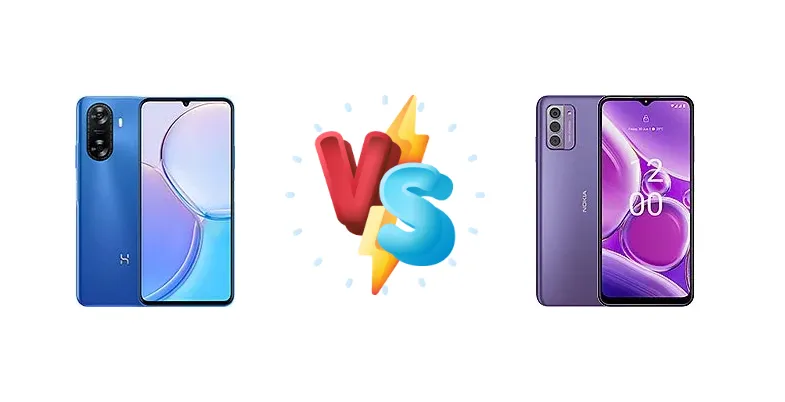
The Wiko Hi Enjoy 60s and Nokia G42 represent compelling options in the increasingly competitive sub-$200 5G smartphone market. While both aim to deliver affordable connectivity, they take different approaches to core components like the chipset and charging technology. This comparison dissects those differences to determine which device offers the best value for your money.
🏆 Quick Verdict
For most users prioritizing raw processing power and potentially smoother multitasking, the Wiko Hi Enjoy 60s emerges as the winner. Its Mediatek Dimensity 700, built on a 7nm process, offers a performance edge over the Nokia G42’s Snapdragon 480+. However, the Nokia G42’s inclusion of PD3.0 and QC3 charging provides greater charging flexibility.
| Network |
|---|
| 2G bands | GSM 850 / 900 / 1800 / 1900 | GSM 850 / 900 / 1800 / 1900 |
| 3G bands | HSDPA 850 / 900 / 2100 | HSDPA 850 / 900 / 1700(AWS) / 1900 / 2100 |
| 4G bands | LTE | 1, 2, 3, 4, 5, 7, 8, 12, 17, 13, 20, 28, 38, 39, 40, 41, 66 |
| 5G bands | SA/NSA | 1, 2, 3, 5, 7, 8, 28, 40, 41, 66, 77, 78 SA/NSA |
| Speed | HSPA, LTE, 5G | HSPA, LTE, 5G |
| Technology | GSM / HSPA / LTE / 5G | GSM / HSPA / LTE / 5G |
| Launch |
|---|
| Announced | 2023, November 07 | 2023, June 28 |
| Status | Available. Released 2023, November 07 | Available. Released 2023, June 28 |
| Body |
|---|
| Build | - | Glass front, plastic back, plastic frame |
| Dimensions | 168.3 x 77.7 x 9 mm (6.63 x 3.06 x 0.35 in) | 165 x 75.8 x 8.6 mm (6.50 x 2.98 x 0.34 in) |
| SIM | Nano-SIM + Nano-SIM | · Nano-SIM· Nano-SIM + Nano-SIM |
| Weight | 199 g (7.02 oz) | 193.8 g (6.84 oz) |
| Display |
|---|
| Protection | - | Corning Gorilla Glass 3 |
| Resolution | 720 x 1600 pixels, 20:9 ratio (~260 ppi density) | 720 x 1612 pixels, 20:9 ratio (~269 ppi density) |
| Size | 6.75 inches, 110.0 cm2 (~84.1% screen-to-body ratio) | 6.56 inches, 103.4 cm2 (~82.7% screen-to-body ratio) |
| Type | TFT LCD | IPS LCD, 90Hz, 450 nits (typ), 560 nits (peak) |
| Platform |
|---|
| CPU | Octa-core (2x2.2 GHz Cortex-A76 & 6x2.0 GHz Cortex-A55) | Octa-core (2x2.2 GHz Kryo 460 & 6x1.8 GHz Kryo 460) |
| Chipset | Mediatek Dimensity 700 (7 nm) | Qualcomm SM4350-AC Snapdragon 480+ 5G (8 nm) |
| GPU | Mali-G57 MC2 | Adreno 619 |
| OS | HarmonyOS 3.0 | Android 13, upgradable to Android 14 |
| Memory |
|---|
| Card slot | microSDXC | microSDXC |
| Internal | 128GB, 256GB | 128GB 4GB RAM, 128GB 6GB RAM, 256GB 8GB RAM |
| Main Camera |
|---|
| Dual | 13 MP, f/1.8, (wide), AF
Auxiliary lens | - |
| Features | LED flash, panorama | LED flash, HDR, panorama |
| Triple | - | 50 MP, f/1.8, (wide), AF
2 MP (macro)
Auxiliary lens |
| Video | 1080p@30fps | 1080p@30fps |
| Selfie camera |
|---|
| Single | 8 MP, f/2.0, (wide) | 8 MP |
| Video | 1080p@30fps | Yes |
| Sound |
|---|
| 35mm jack | Yes | Yes |
| Loudspeaker | Yes | Yes |
| Comms |
|---|
| Bluetooth | 5.1, A2DP, LE | 5.1, A2DP, LE |
| NFC | No | Yes (market/region dependent) |
| Positioning | GPS, GLONASS, GALILEO, BDS, QZSS | GPS, GLONASS, GALILEO, BDS |
| Radio | Unspecified | FM radio |
| USB | USB Type-C 2.0, OTG | USB Type-C 2.0, OTG |
| WLAN | Wi-Fi 802.11 a/b/g/n/ac, dual-band | Wi-Fi 802.11 a/b/g/n/ac/6, dual-band |
| Features |
|---|
| Sensors | Fingerprint (side-mounted), accelerometer, proximity, compass | Fingerprint (side-mounted), accelerometer, proximity, compass |
| Battery |
|---|
| Charging | 22.5W wired | 20W wired, PD3.0, QC3 |
| Type | Li-Po 6000 mAh | Li-Po 5000 mAh |
| Misc |
|---|
| Colors | Black, Blue, White | Gray, Purple, Red |
| Models | GAR-AN60 | - |
| Price | About 200 EUR | $ 545.00 / £ 124.99 |
Wiko Hi Enjoy 60s
- More powerful chipset (Dimensity 700)
- Potentially better thermal management (7nm process)
- Slightly faster peak charging wattage (22.5W)
- Charging lacks PD3.0/QC3 compatibility
- Battery capacity unknown
Nokia G42
- PD3.0 and QC3 fast charging support
- Wider charger compatibility
- Nokia’s software optimization
- Less powerful chipset (Snapdragon 480+)
- 8nm process may lead to more throttling
Display Comparison
Neither device’s display specifications are provided, so a direct comparison is limited. However, given the price point, both likely utilize LCD panels. The Nokia G42, benefiting from Nokia’s software optimization, may offer slightly more accurate color reproduction. Bezels are expected to be comparable, reflecting the budget nature of both devices. Without refresh rate or resolution data, it’s difficult to assess visual smoothness or sharpness.
Camera Comparison
Without sensor details, a detailed camera comparison is impossible. However, it’s safe to assume both phones feature budget-oriented camera systems. The absence of information suggests neither device boasts advanced features like OIS or particularly large sensors. Image processing will likely be the differentiating factor, with Nokia’s software potentially offering more refined results, but the Dimensity 700’s ISP may provide a slight edge in processing speed. The inclusion of a 2MP macro lens on either device is likely a marketing feature with limited practical benefit.
Performance
The core difference lies in the chipsets. The Wiko Hi Enjoy 60s features the Mediatek Dimensity 700 (7nm), while the Nokia G42 uses the Qualcomm Snapdragon 480+ 5G (8nm). While both are octa-core CPUs with a 2x2.2 GHz prime core configuration, the Dimensity 700’s 7nm fabrication process generally translates to better power efficiency and thermal performance compared to the Snapdragon 480+'s 8nm node. This means the Wiko Hi Enjoy 60s is less likely to throttle under sustained load. The Snapdragon 480+’s Kryo 460 cores, while competent, are generally less powerful than the Cortex-A76 cores found in the Dimensity 700. This difference will be noticeable in demanding applications and games.
Battery Life
Battery capacity isn’t specified for either device. However, the Nokia G42’s 20W charging with PD3.0 and QC3 support offers a significant advantage in charging flexibility and potentially faster charging speeds with compatible chargers. The Wiko Hi Enjoy 60s’ 22.5W charging is slightly higher on paper, but lacks the widespread compatibility of PD3.0 and QC3. In real-world usage, the difference in charging time will depend on the battery capacity and the charger used, but the Nokia G42’s support for industry standards provides a more versatile experience.
Buying Guide
Buy the Wiko Hi Enjoy 60s if you need a phone capable of handling moderate gaming and multitasking without significant slowdowns, and if you prioritize chipset performance over charging protocol versatility. Buy the Nokia G42 if you value a more standardized and potentially wider compatibility with fast chargers, and if your usage primarily revolves around basic communication and light social media browsing.
Frequently Asked Questions
❓ Will the Dimensity 700 in the Wiko Hi Enjoy 60s handle demanding games like PUBG Mobile?
The Dimensity 700 is capable of running PUBG Mobile, but expect to play at medium settings for a consistently smooth experience. The 7nm process helps mitigate throttling, but sustained high frame rates may not be achievable. The Snapdragon 480+ in the Nokia G42 will likely require lower settings for comparable performance.
❓ Does the Nokia G42’s fast charging work with any USB-C charger, or do I need a specific one?
While the Nokia G42 supports PD3.0 and QC3, you’ll get the fastest charging speeds with a charger that specifically supports those protocols. Any USB-C PD charger will work, but may not deliver the full 20W. Using a standard USB-C charger will result in significantly slower charging times.
❓ Is the difference in chipset performance between the Dimensity 700 and Snapdragon 480+ noticeable for everyday tasks like browsing and social media?
For basic tasks, the difference will be minimal. Both chipsets are sufficient for smooth browsing, social media, and messaging. However, when multitasking or opening multiple apps, the Dimensity 700’s superior processing power will become more apparent, resulting in faster app loading times and a more responsive user experience.