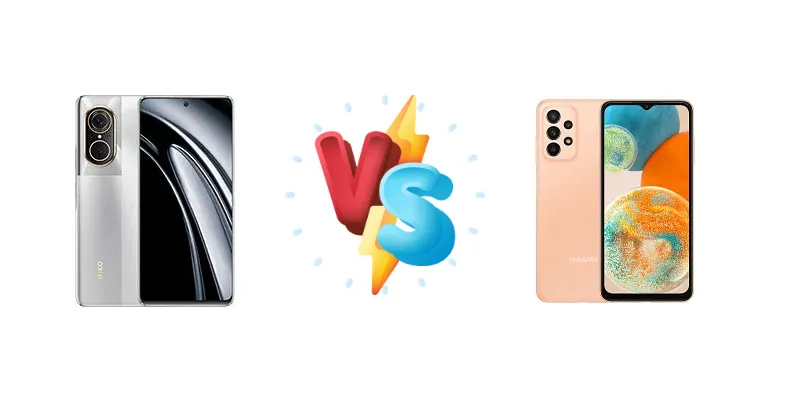
Both the Wiko 5G and Samsung Galaxy A23 5G target the competitive sub-$300 5G smartphone market. While both leverage the Qualcomm Snapdragon 695 5G chipset, they diverge significantly in charging speed and display characteristics, creating a clear distinction for potential buyers. This comparison will dissect these differences to determine which device delivers the most compelling user experience.
🏆 Quick Verdict
For the average user prioritizing rapid replenishment, the Wiko 5G emerges as the winner. Its 66W charging capability drastically reduces downtime compared to the Galaxy A23 5G’s 25W charging, despite both phones sharing the same Snapdragon 695 5G chipset and battery endurance rating. However, Samsung’s brand recognition and established software support remain strong considerations.
| Network |
|---|
| 2G bands | GSM 850 / 900 / 1800 / 1900 | GSM 850 / 900 / 1800 / 1900 |
| 3G bands | HSDPA 850 / 900 / 1900 / 2100 | HSDPA 850 / 900 / 1700(AWS) / 1900 / 2100 |
| 4G bands | LTE | 1, 2, 3, 4, 5, 7, 8, 12, 17, 20, 26, 28, 32, 38, 40, 41, 66 - International |
| 5G bands | SA/NSA | 1, 3, 7, 8, 20, 28, 38, 40, 41, 77, 78 SA/NSA/Sub6 - International |
| Speed | HSPA, LTE, 5G | HSPA, LTE, 5G |
| Technology | GSM / CDMA / HSPA / CDMA2000 / LTE / 5G | GSM / HSPA / LTE / 5G |
| | - | 2, 5, 30, 66, 77 SA/NSA/Sub6/mmWave - USA |
| Launch |
|---|
| Announced | 2022, December 27 | 2022, August 05 |
| Status | Available. Released 2022, December 27 | Available. Released 2022, September 02 |
| Body |
|---|
| Build | - | Glass front (Gorilla Glass 5), plastic frame, plastic back |
| Dimensions | 164.6 x 75.6 x 7.9 mm (6.48 x 2.98 x 0.31 in) | 165.4 x 76.9 x 8.4 mm (6.51 x 3.03 x 0.33 in) |
| SIM | Nano-SIM + Nano-SIM | · Nano-SIM· Nano-SIM + Nano-SIM |
| Weight | 191 g (6.74 oz) | 197 g (6.95 oz) |
| Display |
|---|
| Protection | - | Corning Gorilla Glass 5 |
| Resolution | 1080 x 2388 pixels (~387 ppi density) | 1080 x 2408 pixels, 20:9 ratio (~400 ppi density) |
| Size | 6.78 inches, 111.4 cm2 (~89.5% screen-to-body ratio) | 6.6 inches, 104.9 cm2 (~82.5% screen-to-body ratio) |
| Type | IPS LCD, 120Hz | PLS LCD, 120Hz |
| Platform |
|---|
| CPU | Octa-core (2x2.2 GHz Kryo 660 Gold & 6x1.7 GHz Kryo 660 Silver) | Octa-core (2x2.2 GHz Kryo 660 Gold & 6x1.7 GHz Kryo 660 Silver) |
| Chipset | Qualcomm SM6375 Snapdragon 695 5G (6 nm) | Qualcomm SM6375 Snapdragon 695 5G (6 nm) |
| GPU | Adreno 619 | Adreno 619 |
| OS | HarmonyOS 3.0 | Android 12, upgradable to Android 14, One UI 6 |
| Memory |
|---|
| Card slot | No | microSDXC (dedicated slot) |
| Internal | 128GB 8GB RAM, 256GB 8GB RAM | 64GB 4GB RAM, 64GB 6GB RAM, 128GB 4GB RAM, 128GB 6GB RAM, 128GB 8GB RAM |
| Main Camera |
|---|
| Features | LED flash, HDR, panorama | LED flash, panorama, HDR |
| Quad | 108 MP, f/1.9, (wide), 1/1.52", 0.7µm, PDAF
8 MP, f/2.2, 112˚ (ultrawide)
2 MP (macro)
Auxiliary lens | 50 MP, f/1.8, 26mm (wide), 1/2.76", 0.64µm, PDAF, OIS
5 MP, f/2.2, 13mm, 123˚ (ultrawide), 1/5.0", 1.12µm
2 MP (macro)
Auxiliary lens |
| Video | 1080p@30fps, gyro-EIS | 1080p@30fps |
| Selfie camera |
|---|
| Single | 16 MP, f/2.2, 22mm (wide) | 8 MP, f/2.0, 25mm (wide), 1/4.0", 1.12µm - USA
8 MP, f/2.2, 25mm (wide), 1/4.0", 1.12µm - International |
| Video | 1080p@30fps | 1080p@30fps |
| Sound |
|---|
| 3.5mm jack | No | Yes |
| 35mm jack | No | Yes |
| Loudspeaker | Yes | Yes |
| Comms |
|---|
| Bluetooth | 5.1, A2DP, LE | 5.1, A2DP, LE |
| NFC | No | Yes |
| Positioning | GPS, GLONASS, GALILEO, BDS, QZSS | GPS, GLONASS, GALILEO, BDS |
| Radio | No | FM radio (market/region dependent) |
| USB | USB Type-C 2.0, OTG | USB Type-C 2.0 |
| WLAN | Wi-Fi 802.11 a/b/g/n/ac, dual-band, Wi-Fi Direct | Wi-Fi 802.11 a/b/g/n/ac, dual-band, Wi-Fi Direct |
| Features |
|---|
| Sensors | Fingerprint (side-mounted), accelerometer, compass | Fingerprint (side-mounted), accelerometer, gyro, compass, barometer (USA only) |
| | - | Virtual proximity sensing |
| Battery |
|---|
| Charging | 66W wired, 60% in 15 min, 100% in 35 min
5W reverse wired | 25W wired |
| Type | Li-Po 4000 mAh | Li-Po 5000 mAh |
| Misc |
|---|
| Colors | Black, Silver | Black, White, Peach, Blue |
| Models | - | SM-A236U, SM-A236U1, SM-A236B, SM-A236B/DS, SM-A236B/DSN, SM-A236E, SM-S236DL |
| Price | About 270 EUR | $ 84.44 / £ 129.00 / € 125.28 / ₹ 21,000 |
| SAR | - | 0.68 W/kg (head) 0.57 W/kg (body) |
| SAR EU | - | 1.49 W/kg (head) 1.25 W/kg (body) |
| Tests |
|---|
| Battery life | - |
Endurance rating 138h
|
| Camera | - |
Photo / Video |
| Display | - |
Contrast ratio: 1328:1 (nominal) |
| Loudspeaker | - |
-25.9 LUFS (Very good)
|
| Performance | - |
AnTuTu: 318821 (v9)
GeekBench: 1940 (v5.1)
GFXBench: 16fps (ES 3.1 onscreen) |
Wiko 5G
- Significantly faster 66W charging
- Potential for better value given similar specs
- 5W reverse wired charging for accessories
- Less established brand recognition
- Limited software update commitment (likely)
Samsung Galaxy A23 5G
- Strong brand reputation and support
- Mature software ecosystem (One UI)
- Wider availability and service network
- Slow 25W charging
- Potentially higher price for similar performance
Display Comparison
The Samsung Galaxy A23 5G boasts a measured peak brightness of 508 nits and a 1328:1 contrast ratio. While respectable, these figures don’t inherently translate to a superior viewing experience compared to the Wiko 5G, as the Wiko’s display specifications are not provided. The contrast ratio, being identical, suggests similar black levels and color depth. Without knowing the Wiko 5G’s panel technology (LCD vs AMOLED) or color gamut coverage, it’s difficult to definitively declare a winner, but the A23’s measured brightness provides a concrete benchmark.
Camera Comparison
Both devices are listed as having Photo/Video capabilities, but lack specific details regarding sensor size, aperture, or optical image stabilization (OIS). This makes a direct camera comparison impossible. The presence of a 2MP macro camera on the A23 5G is likely a marketing feature with limited real-world utility. Without knowing the megapixel count and sensor size of the primary cameras, it’s impossible to assess image quality or low-light performance. Image processing algorithms, a key differentiator between brands, are also unknown.
Performance
Both the Wiko 5G and Samsung Galaxy A23 5G are powered by the Qualcomm SM6375 Snapdragon 695 5G (6 nm) chipset, featuring an octa-core CPU configuration with 2x2.2 GHz Kryo 660 Gold and 6x1.7 GHz Kryo 660 Silver cores. This means CPU performance will be virtually identical between the two devices. The absence of information regarding RAM type (LPDDR4x vs LPDDR5) or storage speed (UFS 2.2 vs UFS 3.1) prevents a deeper analysis of potential performance bottlenecks. Thermal management, crucial for sustained performance, is also unknown, but the 6nm process node suggests reasonable efficiency.
Battery Life
Both the Wiko 5G and Samsung Galaxy A23 5G share an endurance rating of 138 hours, suggesting similar battery life under typical usage scenarios. However, the charging capabilities are drastically different. The Wiko 5G supports 66W wired charging, achieving 60% charge in 15 minutes and 100% in 35 minutes. Conversely, the Galaxy A23 5G is limited to 25W wired charging. This significant difference in charging speed means the Wiko 5G can be rapidly topped up, mitigating any concerns about battery life, while the A23 5G requires considerably longer to reach full charge.
Buying Guide
Buy the Wiko 5G if you need a phone that can quickly get back to 100% charge, minimizing interruptions throughout your day. Its 66W charging is a standout feature in this price bracket. Buy the Samsung Galaxy A23 5G if you prioritize a well-established brand with a mature software ecosystem and are less concerned with charging speed. Samsung’s wider availability and support network are significant advantages.
Frequently Asked Questions
❓ How much faster is the Wiko 5G's charging compared to the Galaxy A23 5G in real-world use?
The Wiko 5G can reach 60% charge in 15 minutes, while the Galaxy A23 5G will take considerably longer to achieve the same level with its 25W charging. A full charge on the Wiko 5G takes 35 minutes, whereas the A23 5G will require well over an hour, potentially closer to two, depending on the initial battery level.
❓ Will the Snapdragon 695 5G in either phone struggle with demanding games like PUBG or Genshin Impact?
The Snapdragon 695 5G is a capable chipset for casual gaming, but demanding titles like PUBG or Genshin Impact will likely require reduced graphics settings to maintain a stable frame rate. Thermal throttling could also become a factor during extended gaming sessions, though the 6nm process node should mitigate this to some extent. Neither phone is a dedicated gaming device.
❓ Does the Samsung Galaxy A23 5G receive regular software updates and security patches?
Samsung generally provides good software support for its A-series devices, including regular security patches and OS updates for several years. This is a key advantage over Wiko, which typically has a shorter software support lifecycle.