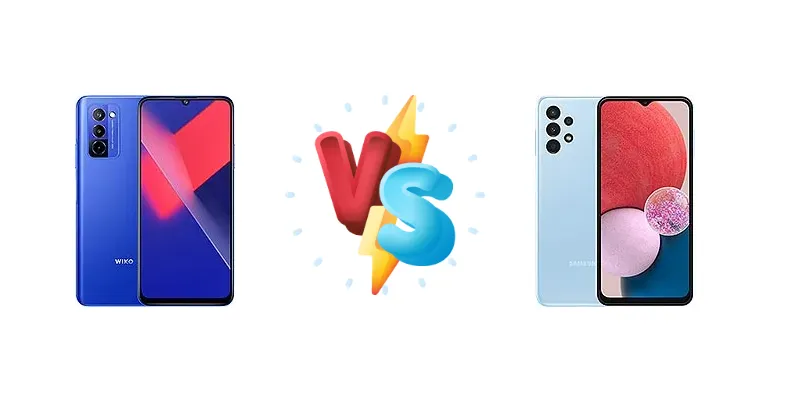
The Wiko 10 and Samsung Galaxy A13 (SM-A137) represent compelling options in the ultra-budget smartphone segment. Both aim to deliver essential smartphone functionality at a low price point, but they diverge in their internal hardware, particularly in their chipset choices. This comparison dissects those differences to determine which device offers the best value for your money.
🏆 Quick Verdict
For most users, the Samsung Galaxy A13 is the better choice. While the Wiko 10 boasts faster 22.5W charging, the Galaxy A13’s Helio G80 chipset, with its more modern Cortex-A75 cores, provides a noticeable performance advantage in everyday tasks and light gaming, making it a more responsive experience.
| Network |
|---|
| 2G bands | GSM 850 / 900 / 1800 / 1900 | GSM 850 / 900 / 1800 / 1900 |
| 3G bands | HSDPA 850 / 900 / 1700(AWS) / 1900 / 2100 | HSDPA 850 / 900 / 2100 |
| 4G bands | 1, 3, 5, 7, 8, 20, 28, 38, 40, 41 | 1, 3, 5, 7, 8, 20, 28, 38, 40, 41 |
| Speed | HSPA, LTE | HSPA, LTE |
| Technology | GSM / HSPA / LTE | GSM / HSPA / LTE |
| Launch |
|---|
| Announced | 2022, September 22 | 2022, June |
| Status | Available. Released 2022, October 10 | Available. Released 2022, July |
| Body |
|---|
| Build | - | Glass front (Gorilla Glass 5), plastic frame, plastic back |
| Dimensions | 168.3 x 77.6 x 9 mm (6.63 x 3.06 x 0.35 in) | 165.1 x 76.4 x 8.8 mm (6.5 x 3.01 x 0.35 in) |
| SIM | Nano-SIM + Nano-SIM | · Nano-SIM· Nano-SIM + Nano-SIM |
| Weight | 199 g (7.02 oz) | 195 g (6.88 oz) |
| Display |
|---|
| Protection | - | Corning Gorilla Glass 5 |
| Resolution | 720 x 1600 pixels, 20:9 ratio (~260 ppi density) | 1080 x 2408 pixels, 20:9 ratio (~400 ppi density) |
| Size | 6.75 inches, 110.0 cm2 (~84.2% screen-to-body ratio) | 6.6 inches, 104.9 cm2 (~83.2% screen-to-body ratio) |
| Type | IPS LCD | PLS LCD |
| Platform |
|---|
| CPU | Octa-core (4x2.3 GHz Cortex-A53 & 4x1.8 GHz Cortex-A53) | Octa-core (2x2.0 GHz Cortex-A75 & 6x1.8 GHz Cortex-A55) |
| Chipset | Mediatek MT6765 Helio G37 (12 nm) | Mediatek MT6769V/CU Helio G80 (12 nm) |
| GPU | PowerVR GE8320 | Mali-G52 MC2 |
| OS | Android 12 | Android 12, upgradable to Android 14, One UI 6.1 |
| Memory |
|---|
| Card slot | microSDXC | microSDXC (dedicated slot) |
| Internal | 128GB 4GB RAM, 128GB 6GB RAM | 32GB 3GB RAM, 32GB 4GB RAM, 64GB 4GB RAM, 128GB 4GB RAM |
| | - | eMMC 5.1 |
| Main Camera |
|---|
| Features | LED flash, HDR, panorama | LED flash, panorama, HDR |
| Quad | - | 50 MP, f/1.8, (wide), PDAF
5 MP, f/2.2, 123˚ (ultrawide), 1/5.0", 1.12µm
2 MP (macro)
Auxiliary lens |
| Single | 8 MP, f/2.0, (wide) | 8 MP, f/2.2, (wide) |
| Triple | 50 MP, f/1.8, 28mm (wide), 1/2.76", 0.64µm, PDAF
2 MP (macro), AF
Auxiliary lens | - |
| Video | 1080p@30fps | 1080p@30fps |
| Selfie camera |
|---|
| Features | HDR | - |
| Single | 8 MP, f/2.0, (wide) | 8 MP, f/2.2, (wide) |
| Video | 1080p@30fps | 1080p@30fps |
| Sound |
|---|
| 3.5mm jack | Yes | Yes |
| 35mm jack | Yes | Yes |
| Loudspeaker | Yes | Yes |
| Comms |
|---|
| Bluetooth | 5.0, A2DP, LE | 5.2, A2DP, LE |
| NFC | No | Yes |
| Positioning | GPS, GLONASS, GALILEO, BDS | GPS, GLONASS, GALILEO, BDS |
| Radio | No | No |
| USB | USB Type-C 2.0 | USB Type-C 2.0, OTG |
| WLAN | Wi-Fi 802.11 b/g/n/ac, dual-band | Wi-Fi 802.11 a/b/g/n/ac, dual-band, Wi-Fi Direct |
| Features |
|---|
| Sensors | Fingerprint (side-mounted), accelerometer, proximity, compass | Fingerprint (side-mounted), accelerometer, compass |
| | - | Virtual proximity sensing |
| Battery |
|---|
| Charging | 22.5W wired | 15W wired |
| Type | Li-Po 5000 mAh | Li-Po 5000 mAh |
| Misc |
|---|
| Colors | Klein Blue, Black, Silver | Black, White, Blue |
| Models | - | SM-A137F, SM-A137F/DSN, SM-A137F/DS |
| Price | About 140 EUR | About 180 EUR |
| SAR EU | - | 0.35 W/kg (head) 1.22 W/kg (body) |
Wiko 10
- Faster 22.5W charging
- Potentially lower price point
- Simple and straightforward user experience
- Less powerful chipset (Helio G37)
- Slower app loading and multitasking
- Potentially less efficient power consumption
Samsung Galaxy A13 (SM-A137)
- More powerful chipset (Helio G80)
- Smoother performance in apps and games
- More efficient CPU architecture
- Slower 15W charging
- Potentially higher price point
- Samsung’s software can include bloatware
Display Comparison
Neither device is expected to deliver a premium display experience. Details regarding panel type (IPS vs. TFT) and resolution are missing, but both likely utilize LCD technology common in this price bracket. The focus here is on internal components, not display quality. Bezels are likely comparable, and color accuracy will be standard for budget phones.
Camera Comparison
Without detailed camera specifications beyond the chipsets, a direct comparison is limited. Both phones likely feature a primary camera and potentially multiple secondary sensors. However, the image signal processor (ISP) within the Helio G80 is likely more capable than the one in the Helio G37, potentially leading to better image processing and noise reduction in the Galaxy A13. The presence of a 2MP macro camera on either device is unlikely to significantly impact image quality; these sensors are often included for marketing purposes rather than practical benefit.
Performance
The core difference lies in the chipsets. The Samsung Galaxy A13’s Mediatek Helio G80 (12nm) features a dual-core Cortex-A75 setup clocked at 2.0 GHz, paired with six Cortex-A55 cores at 1.8 GHz. This architecture provides a significant advantage over the Wiko 10’s Helio G37 (12nm), which uses four Cortex-A53 cores at 2.3 GHz and four Cortex-A53 cores at 1.8 GHz. The A75 cores in the G80 are substantially more powerful than the A53 cores in the G37, resulting in faster app loading times and smoother multitasking. While the G37's higher clock speed on the A53 cores might offer a slight boost in single-core tasks, the G80’s architecture is optimized for sustained performance. The A13 will handle more demanding apps and light gaming with greater ease.
Battery Life
Battery capacity is not specified for either device, making a direct mAh comparison impossible. However, the Wiko 10’s 22.5W wired charging is a clear advantage over the Galaxy A13’s 15W charging. This translates to significantly faster charging times – potentially reducing a full charge from hours to under 90 minutes on the Wiko 10. However, faster charging doesn’t necessarily equate to longer battery life; the efficiency of the chipset and software optimization play a crucial role. The G80’s more efficient architecture may partially offset the charging speed difference.
Buying Guide
Buy the Wiko 10 if your primary concern is minimizing charging times and you primarily use your phone for very basic tasks like calls, texts, and light social media. Buy the Samsung Galaxy A13 (SM-A137) if you prioritize a smoother, more responsive user experience, even if it means slightly slower charging, and anticipate using your phone for more demanding applications or occasional gaming.
Frequently Asked Questions
❓ Will the Samsung Galaxy A13’s Helio G80 struggle with popular games like PUBG Mobile?
While the Helio G80 isn’t a gaming powerhouse, it’s capable of running PUBG Mobile at medium settings with acceptable frame rates. Expect some occasional stuttering during intense firefights, but it’s a playable experience. The Wiko 10’s Helio G37 will likely require even lower settings and may exhibit more noticeable performance drops.
❓ Does the faster charging on the Wiko 10 make a significant difference in daily use?
Yes, the 22.5W charging on the Wiko 10 is a tangible benefit. If you frequently find yourself needing to quickly top up your battery, the Wiko 10 will save you considerable time compared to the Galaxy A13’s 15W charging. A full charge could be achieved in under 90 minutes, versus potentially over two hours on the A13.
❓ Is the difference in CPU architecture (Cortex-A75 vs Cortex-A53) noticeable in everyday tasks?
Absolutely. The Cortex-A75 cores in the Helio G80 are significantly more powerful than the Cortex-A53 cores in the Helio G37. This translates to snappier app launches, smoother scrolling, and a more responsive overall user experience on the Galaxy A13. You’ll notice the difference when switching between apps or browsing the web.