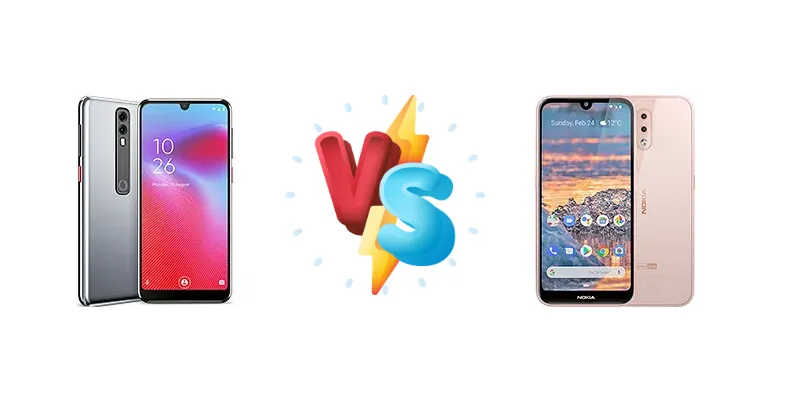
The Vodafone Smart V10 and Nokia 4.2 represent compelling options in the ultra-budget smartphone segment. Both devices aim to deliver essential smartphone functionality at a low price point, but they achieve this with different approaches to processing power. This comparison dissects the key differences between the Qualcomm Snapdragon 429 powering the V10 and the Snapdragon 439 in the Nokia 4.2, revealing which phone offers the better user experience.
🏆 Quick Verdict
For the average user prioritizing multitasking and smoother app performance, the Nokia 4.2 emerges as the better choice. Its octa-core Snapdragon 439 provides a noticeable performance uplift over the V10’s quad-core 429, making it more capable of handling everyday tasks and light gaming. However, the V10 remains a viable option for basic use cases.
| Network |
|---|
| 2G bands | GSM 850 / 900 / 1800 / 1900 | GSM 850 / 900 / 1800 / 1900 |
| 3G bands | HSDPA 850 / 900 / 1900 / 2100 | HSDPA 850 / 900 / 2100 - Global |
| 4G bands | 1, 3, 5, 7, 8, 28 | 1, 3, 5, 7, 8, 20, 28, 38, 40, 41 - EMEA, APAC, MENA |
| Speed | HSPA 42.2/5.76 Mbps, LTE Cat4 150/50 Mbps | HSPA 42.2/5.76 Mbps, LTE Cat4 150/50 Mbps |
| Technology | GSM / HSPA / LTE | GSM / HSPA / LTE |
| | - | 1, 3, 5, 8, 40, 41 - India |
| Launch |
|---|
| Announced | 2019, May. Released 2019, June | 2019, February 24. Released 2019, May 07 |
| Status | Discontinued | Discontinued |
| Body |
|---|
| Build | - | Glass front, glass back, plastic frame |
| Dimensions | 151.3 x 69.9 x 8.2 mm (5.96 x 2.75 x 0.32 in) | 149 x 71.3 x 8.4 mm (5.87 x 2.81 x 0.33 in) |
| SIM | Nano-SIM | Nano-SIM + Nano-SIM |
| Weight | 145 g (5.11 oz) | 161 g (5.68 oz) |
| Display |
|---|
| Protection | Asahi Dragontrail Glass | - |
| Resolution | 720 x 1560 pixels, 19.5:9 ratio (~291 ppi density) | 720 x 1520 pixels, 19:9 ratio (~295 ppi density) |
| Size | 5.9 inches, 85.5 cm2 (~80.8% screen-to-body ratio) | 5.71 inches, 81.4 cm2 (~76.6% screen-to-body ratio) |
| Type | IPS LCD | IPS LCD |
| Platform |
|---|
| CPU | Quad-core 2.0 GHz Cortex-A53 | Octa-core (4x1.95 GHz Cortex-A53 & 4x1.45 GHz Cortex A53) |
| Chipset | Qualcomm SDM429 Snapdragon 429 (12 nm) | Qualcomm SDM439 Snapdragon 439 (12 nm) |
| GPU | Adreno 504 | Adreno 505 |
| OS | Android 9.0 (Pie) | Android 9.0 (Pie), upgradable to Android 11, Android One |
| Memory |
|---|
| Card slot | microSDXC (dedicated slot) | microSDXC (dedicated slot) |
| Internal | 32GB 3GB RAM | 16GB 2GB RAM, 32GB 3GB RAM |
| | eMMC 5.1 | eMMC 5.1 |
| Main Camera |
|---|
| Dual | 13 MP, AF
5 MP | 13 MP, f/2.2, 1/3.1", 1.12µm, PDAF
Auxiliary lens |
| Features | LED flash, HDR, panorama | LED flash |
| Video | 1080p@30fps | 1080p@30fps |
| Selfie camera |
|---|
| Single | 8 MP | 8 MP, f/2.0, 1/4.0", 1.12µm |
| Video | - | 1080p@30fps |
| Sound |
|---|
| 3.5mm jack | Yes | Yes |
| 35mm jack | Yes | Yes |
| Loudspeaker | Yes | Yes |
| Comms |
|---|
| Bluetooth | 4.2, A2DP, LE | 4.2, A2DP, LE, aptX |
| NFC | No | Yes (market dependent) |
| Positioning | GPS | GPS, GLONASS, BDS |
| Radio | FM radio | FM radio |
| USB | microUSB 2.0 | microUSB 2.0, OTG |
| WLAN | Wi-Fi 802.11 b/g/n | Wi-Fi 802.11 b/g/n |
| Features |
|---|
| Sensors | Accelerometer, proximity | Fingerprint (rear-mounted), accelerometer, proximity |
| Battery |
|---|
| Type | Li-Ion 3400 mAh, non-removable | Li-Ion 3000 mAh, non-removable |
| Misc |
|---|
| Colors | Chrome Pewter | Black, Pink Sand |
| Models | - | TA-1184, TA-1133, TA-1149, TA-1150, TA-1157, TA-1152 |
| Price | About 180 EUR | About 130 EUR |
| SAR | - | 0.43 W/kg (head) 1.08 W/kg (body) |
| SAR EU | - | 0.45 W/kg (head) 1.53 W/kg (body) |
Vodafone Smart V10
- Potentially lower price point
- Simple and straightforward user experience
- Reliable for basic communication tasks
- Slower performance due to quad-core processor
- Limited multitasking capabilities
- Less capable camera ISP
Nokia 4.2
- Faster and more responsive performance
- Better multitasking capabilities
- More advanced camera ISP
- May be slightly more expensive
- Potentially similar battery life to the V10
- Software updates may be less frequent
Display Comparison
Neither Vodafone nor Nokia provide detailed display specifications beyond resolution. However, given the price point, both likely utilize IPS LCD panels. The key difference lies under the hood. The Nokia 4.2’s Snapdragon 439 has a slightly more capable ISP, potentially leading to marginally better image processing for photos taken on the phone’s camera. Bezels are expected to be similar on both devices, reflecting the budget nature of both phones.
Camera Comparison
Without detailed camera specs, a direct comparison is difficult. However, the Snapdragon 439’s image signal processor (ISP) is more advanced than the 429’s. This translates to potentially better image quality, particularly in challenging lighting conditions. Both phones likely feature a primary camera and a depth sensor, but the Nokia 4.2’s ISP will likely handle noise reduction and dynamic range more effectively. The presence of a 2MP macro camera on either device is largely a marketing gimmick and shouldn’t be a deciding factor.
Performance
The core distinction between these phones is their chipsets. The Nokia 4.2’s Snapdragon 439 features an octa-core configuration – four cores clocked at 1.95 GHz and four at 1.45 GHz – compared to the Vodafone Smart V10’s quad-core 2.0 GHz Snapdragon 429. While the V10’s cores are individually faster, the 439’s eight cores provide superior multitasking capabilities. This means the Nokia 4.2 will handle switching between apps and running multiple processes concurrently with less lag. The Snapdragon 439 also benefits from a slightly more advanced GPU, offering a modest improvement in graphics performance. Both phones likely utilize LPDDR3 RAM, limiting overall system responsiveness.
Battery Life
Battery capacity is not specified in the provided data. However, given the similar chipsets (both 12nm) and target market, battery life is likely comparable. The Snapdragon 439’s slightly more efficient architecture *could* translate to a marginal improvement in battery endurance for the Nokia 4.2. Charging wattage is also unknown, but both phones likely support standard 5W or 10W charging, resulting in relatively slow charge times.
Buying Guide
Buy the Vodafone Smart V10 if you need a truly basic smartphone for calls, texts, and light social media use, and prioritize affordability above all else. It’s ideal for first-time smartphone users or as a reliable backup device. Buy the Nokia 4.2 if you prefer a more responsive experience, enjoy occasional gaming, or frequently switch between apps. The extra processing cores and slightly more refined software make it a more versatile daily driver.
Frequently Asked Questions
❓ Will the Nokia 4.2 struggle with popular apps like Facebook or WhatsApp?
While the Snapdragon 439 isn't a powerhouse, it's sufficiently capable of running apps like Facebook and WhatsApp smoothly. The octa-core configuration provides enough headroom for these commonly used applications, offering a more responsive experience than the Vodafone Smart V10’s quad-core processor.
❓ Is the difference in performance between the Snapdragon 429 and 439 noticeable in everyday use?
Yes, the difference is noticeable, particularly when multitasking or switching between apps. The Nokia 4.2’s eight cores allow it to handle multiple tasks concurrently without significant lag, whereas the Vodafone Smart V10 may exhibit slowdowns when running several apps simultaneously. This difference is most apparent when browsing the web with multiple tabs open or playing light games.
❓ Are software updates likely to be consistent on either device?
Historically, Nokia has offered more consistent software updates than Vodafone on their budget devices. While neither phone is guaranteed to receive frequent updates, the Nokia 4.2 is more likely to receive security patches and potentially even Android version upgrades, extending its usable lifespan.