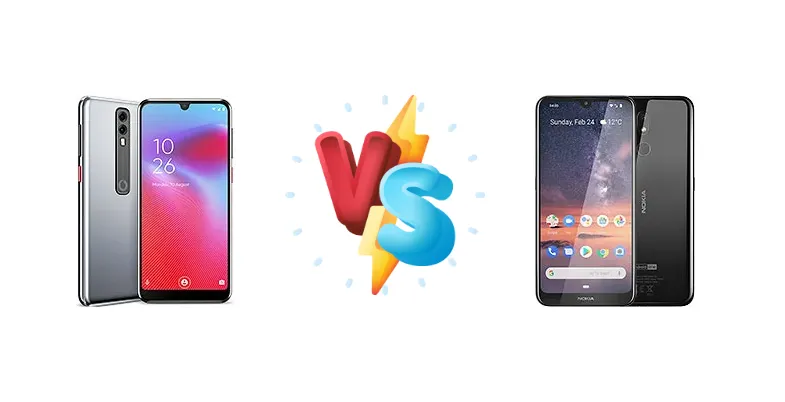
Both the Vodafone Smart V10 and Nokia 3.2 occupy the ultra-budget smartphone space, relying on the Qualcomm Snapdragon 429 chipset to deliver a functional Android experience. This comparison dissects the subtle differences between these two devices, focusing on how a slightly higher CPU clock speed and charging capabilities impact real-world usability.
🏆 Quick Verdict
For the average user prioritizing a slightly more responsive experience, the Vodafone Smart V10 edges out the Nokia 3.2. While both share the same Snapdragon 429, the V10’s 2.0 GHz CPU clock speed offers a marginal performance boost. However, the Nokia 3.2’s 10W charging is a welcome addition absent in the V10.
| Network |
|---|
| 2G bands | GSM 850 / 900 / 1800 / 1900 | GSM 850 / 900 / 1800 / 1900 |
| 3G bands | HSDPA 850 / 900 / 1900 / 2100 | HSDPA 850 / 900 / 2100 |
| 4G bands | 1, 3, 5, 7, 8, 28 | 1, 3, 5, 7, 8, 20, 28, 38, 40 - EMEA, APAC, MENA |
| Speed | HSPA 42.2/5.76 Mbps, LTE Cat4 150/50 Mbps | HSPA 42.2/5.76 Mbps, LTE Cat4 150/50 Mbps |
| Technology | GSM / HSPA / LTE | GSM / HSPA / LTE |
| | - | 1, 3, 5, 8, 40, 41 - India |
| Launch |
|---|
| Announced | 2019, May. Released 2019, June | 2019, February 24. Released 2019, May 22 |
| Status | Discontinued | Discontinued |
| Body |
|---|
| Build | - | Glass front, plastic back, plastic frame |
| Dimensions | 151.3 x 69.9 x 8.2 mm (5.96 x 2.75 x 0.32 in) | 159.4 x 76.2 x 8.6 mm (6.28 x 3.00 x 0.34 in) |
| SIM | Nano-SIM | Nano-SIM + Nano-SIM |
| Weight | 145 g (5.11 oz) | 181 g (6.38 oz) |
| Display |
|---|
| Protection | Asahi Dragontrail Glass | - |
| Resolution | 720 x 1560 pixels, 19.5:9 ratio (~291 ppi density) | 720 x 1520 pixels, 19:9 ratio (~269 ppi density) |
| Size | 5.9 inches, 85.5 cm2 (~80.8% screen-to-body ratio) | 6.26 inches, 97.8 cm2 (~80.5% screen-to-body ratio) |
| Type | IPS LCD | IPS LCD |
| Platform |
|---|
| CPU | Quad-core 2.0 GHz Cortex-A53 | Quad-core 1.8 GHz Cortex-A53 |
| Chipset | Qualcomm SDM429 Snapdragon 429 (12 nm) | Qualcomm SDM429 Snapdragon 429 (12 nm) |
| GPU | Adreno 504 | Adreno 504 |
| OS | Android 9.0 (Pie) | Android 9.0 (Pie), upgradable to Android 11, Android One |
| Memory |
|---|
| Card slot | microSDXC (dedicated slot) | microSDXC (dedicated slot) |
| Internal | 32GB 3GB RAM | 16GB 2GB RAM, 32GB 3GB RAM, 64GB 3GB RAM |
| | eMMC 5.1 | eMMC 5.1 |
| Main Camera |
|---|
| Dual | 13 MP, AF
5 MP | - |
| Features | LED flash, HDR, panorama | LED flash |
| Single | - | 13 MP, f/2.2, 1/3.1", 1.12µm, AF |
| Video | 1080p@30fps | 1080p@30fps |
| Selfie camera |
|---|
| Single | 8 MP | 5 MP, f/2.2, 27mm (wide), 1/5.0", 1.12µm |
| Sound |
|---|
| 3.5mm jack | Yes | Yes |
| 35mm jack | Yes | Yes |
| Loudspeaker | Yes | Yes |
| Comms |
|---|
| Bluetooth | 4.2, A2DP, LE | 4.2, A2DP, LE, aptX |
| NFC | No | No |
| Positioning | GPS | GPS, GLONASS, BDS |
| Radio | FM radio | FM radio |
| USB | microUSB 2.0 | microUSB 2.0, OTG |
| WLAN | Wi-Fi 802.11 b/g/n | Wi-Fi 802.11 b/g/n |
| Features |
|---|
| Sensors | Accelerometer, proximity | Fingerprint (rear-mounted, 32/3GB only), accelerometer, proximity |
| Battery |
|---|
| Charging | - | 10W wired |
| Type | Li-Ion 3400 mAh, non-removable | Li-Ion 4000 mAh, non-removable |
| Misc |
|---|
| Colors | Chrome Pewter | Black, Steel |
| Models | - | TA-1156, TA-1159, TA-1164 |
| Price | About 180 EUR | About 140 EUR |
| SAR EU | - | 0.24 W/kg (head) 1.63 W/kg (body) |
Vodafone Smart V10
- Slightly faster CPU clock speed (2.0 GHz)
- Potentially lower price (depending on retailer)
- Clean Android experience (likely)
- No fast charging support
- Battery capacity unknown
- Limited camera capabilities (assumed)
Nokia 3.2
- 10W wired charging for faster top-ups
- Clean Android experience (likely)
- Potentially better availability
- Slower CPU clock speed (1.8 GHz)
- Limited camera capabilities (assumed)
- Battery capacity unknown
Display Comparison
Neither Vodafone nor Nokia provide detailed display specifications beyond the basic panel type. Given the price point, both likely utilize IPS LCD panels. Without knowing the resolution, brightness (in nits), or color gamut coverage, it’s difficult to definitively declare a winner. However, the absence of features like high refresh rates or HDR support is expected in this segment. The user experience will likely be similar on both devices regarding visual fidelity.
Camera Comparison
Detailed camera specifications are unavailable for either device. However, given their price point, it’s safe to assume both feature basic camera setups. The focus should be on adequate performance in good lighting conditions, rather than expecting high-quality low-light photography. Any additional cameras (often 2MP macro or depth sensors) are likely to offer limited utility. Without knowing sensor sizes or lens apertures, a direct comparison is impossible, but the image processing algorithms will likely be the defining factor, and this information is unavailable.
Performance
Both the Vodafone Smart V10 and Nokia 3.2 are powered by the Qualcomm Snapdragon 429 (12 nm). The key difference lies in the CPU clock speed: 2.0 GHz for the V10 versus 1.8 GHz for the Nokia 3.2. While both utilize a quad-core Cortex-A53 configuration, the 200 MHz difference translates to a measurable, though not dramatic, performance advantage for the V10 in CPU-bound tasks. This will be most noticeable when opening apps or multitasking. Both devices likely feature a similar amount of RAM (typically 2-3GB in this segment), further limiting overall performance. The shared chipset means GPU performance will also be nearly identical, making them equally suitable for light gaming.
Battery Life
Battery capacity is not specified for either device. However, the Nokia 3.2 includes 10W wired charging, a feature absent in the Vodafone Smart V10. This means the Nokia 3.2 can replenish its battery faster, offering a more convenient user experience. While a larger battery capacity on the V10 might offset this, the lack of any fast charging support makes the Nokia 3.2 the more practical choice for users who frequently need to top up their battery throughout the day.
Buying Guide
Buy the Vodafone Smart V10 if you need a phone for basic tasks like calls, messaging, and light social media, and are willing to sacrifice faster charging. Its marginally faster CPU offers a slightly smoother experience for these core functions. Buy the Nokia 3.2 if you prioritize convenience and the ability to quickly top up your battery, even if it means a slightly less responsive interface. The 10W charging is a significant benefit for users who dislike long charging times.
Frequently Asked Questions
❓ Will the Snapdragon 429 in the Nokia 3.2 struggle with modern apps?
The Snapdragon 429 is an entry-level chipset. While it can handle basic apps like messaging, calls, and social media, it will likely struggle with demanding applications or heavy multitasking. Expect some lag and slowdowns when running multiple apps simultaneously.
❓ Is the 10W charging on the Nokia 3.2 a significant advantage?
Yes, for a phone in this price range, 10W charging is a notable benefit. It allows you to quickly top up the battery when needed, reducing downtime. The Vodafone Smart V10 lacks any fast charging support, meaning significantly longer charging times.
❓ Can either of these phones run PUBG Mobile?
PUBG Mobile is likely playable on both devices, but only at the lowest graphics settings and frame rates. Expect a choppy and less-than-ideal gaming experience due to the limited processing power and graphics capabilities of the Snapdragon 429.
❓ Do either of these phones support VoLTE or Wi-Fi calling?
Support for VoLTE and Wi-Fi calling will depend on the carrier and region. It's crucial to check with your mobile provider to ensure compatibility before purchasing either device.